
THE CONCEPT OF ME

Aren’t so many of us in search of meaning in our lives? Isn’t that quest ultimately driven by the age-old question, Who am I?

When we’re born, most of us don’t yet know who we are. As we move through life, we begin to fill that blank space with ideas shaped by our experiences and the people around us. We form an image of who we should be—one that reflects inherited beliefs about what makes us worthy, safe, and special. Over time, we find ourselves striving toward that image or resisting anything that threatens it.

Our sense of good and bad is shaped entirely by experience. Some of us are even taught to mold ourselves into someone else’s version of “good,” or to believe that what another person calls “bad” is actually right.

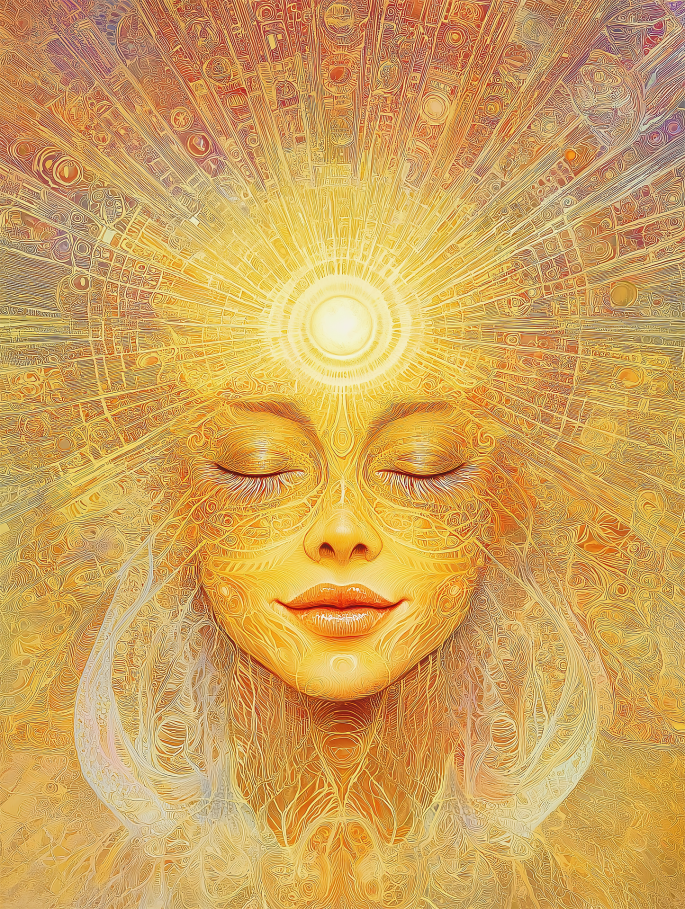
Being born can feel like beginning a painting on a blank canvas. At first, each brushstroke is our own, but as life unfolds, other hands begin touching the canvas—through influence, circumstance, and expectation. Eventually the shapes and colors morph into something foreign, something other than me.

So we keep painting, layering new strokes in search of meaning, hoping to finally create something magnificent. Yet the more we add, the more we forget what was there before the first stroke—the untouched space that quietly recognizes itself completely.

Perhaps our longing comes from that remembrance. In this way, the world becomes the practice ground—to learn to unlearn the belief that we must become something in order to find peace. We gently undo every version of ourselves we thought we needed, each one an avatar created for a different chapter of the dream. But who is the one dreaming the life lived through them?

It can feel mind-bending, especially when our senses insist that only matter is real. Yet suffering always arises at the borders of the self-concepts that make up the collective—the places where we divide and separate. When the little “i” of separation becomes the center of perception, we can’t fathom the all-inclusive reality of Love—a Love so abundant it breaks the laws of this world, where one’s gain must come at another’s loss. In the realm of the shared Self, what is given is also received, because the giving and receiving happen within the same One.

When I scrutinize what version of myself would finally make me happy, I see that I can never be truly satisfied, no matter what I overcome, do, or achieve. Fulfillment based on what my body does—or fails to do—is always temporary. I find myself asking: What are these values for? What version of myself am I protecting, and why am I so afraid of losing it? Perhaps it’s because I made it and it feels so precious.

The healthy self, the creative self, the strong self, the generous self—all exist beside their opposites, each quietly in conflict with the other. Life becomes a dance between these selves, each grasping at fleeting ideas of happiness and safety.

My state fluctuates with my mind. My vitality can be snatched away in an instant when old fears catch up with me in a single thought. Even when nothing around me has changed, the thought I don’t want this to change can take my healthy self hostage, seized by the one facing the formidable unknown.

These moments remind me, viscerally, that no version of my constructed self can protect me from impermanence. Peace can only be found through trust in divine law—the truth that we are already perfect, whole, and eternally safe as we were created, of the same essence, beyond any concept of ourselves we could imagine.

I can only begin to envision that everlasting beauty, and so I practice believing—trusting that what is real has never changed.

When I contemplate my true identity as a perfect creation untouched by what I think or do, I feel immense relief. Whatever I believe I am—or should be—has nothing to do with what I truly am. Beneath all layers of self-concept lies the original, unalterable holy Self, exactly as Love created me. This same unchanging Self lives in everyone, quietly waiting to be remembered. And because our minds are ultimately joined, remembering it in myself and choosing to recognize it in others helps reveal it in all. This is no easy feat, especially in the face of pain or injustice, nor does it turn me into a passive bystander to be tossed about. It does, however, give me the sense that I’m standing for something meaningful—something that points toward a freedom resting on stable ground.

Duality—the yin and yang of life—reflects the tension of opposites that governs this finite world. But what if duality was a choice we made with the first stroke on our canvas? What if we set in motion a painting meant to contain everything we thought we wanted, only to discover that no canvas could ever hold what we truly are?

And yet, beneath every shifting stroke, something changeless remains. The shared Self is untouched by striving, fear, or judgment. The world continues to teach and challenge us, but we can look beyond its rules for solutions—to step back, breathe, and question what is determining our state.

When the insanity and heartbreak of this world bring me to my knees, my practice is to return home—to divine reality—where our shared essence holds us, and peace is all there is.

Holding this paradox—the life we experience and the perfection of our true identity—is where I seek freedom. As we release the layers of self-concept that shift with every experience, we find steadier ground within. Each moment of awareness becomes an opportunity to return to that quiet, unchanging Self—the part of us that has never been lost. Even for an instant. And that instant can lengthen into the next, and the next.

Life is not about finishing the painting or capturing every detail perfectly. It is about remembering that the masterpiece already exists within us—the quiet assurance that nothing we do or fail to do can alter what is already complete.

This blog was inspired by my reflections on my weekly ACIM Essentials class, “A Case of Mistaken Identity,” taught by Robert and Emily Perry at the Circle of Atonement. They have a vast selection of podcasts exploring A Course In Miracles here https://circleofa.org/podcast/
THE GIFT OF SAYING ‘YES’

Being in a position where I regularly faced mortality gave me the gift of valuing what has always been free, yet so easily overlooked. My devotion to love was mostly reserved for my immediate family, nature, and a few very special friends I could probably count on one hand. I’ve never considered myself a particularly social person. Truthfully, I’d much rather hunker down at home—where all my needs are met—than seek out company.

But that part of me has shifted. I’ve come to deeply value what can unfold when I choose to connect and leave space for something new to reveal itself. So when I received an invitation to my cousin’s wedding—a cousin I hadn’t seen in years—I said yes. Even though the timing wasn’t ideal and the airfare would be costly, I recognized it as an opportunity to reconnect with extended family and chose to go.

The matriarchs of our clan—as we fondly call ourselves, being descendants of Scots—are now in their mid-80s and 90s. It’s a rare and precious occasion for all of us to be together, and who knows if there will be another opportunity to connect and celebrate in this way again.

I had once travelled through India with the cousin who now, at 61, was preparing to be married. After being a bachelor for most of his life, it felt like a miracle that he had found his greatest love. I knew I needed to be there—not just for him, but for myself. This precious life is meant to be shared, and my experience has taught me that it’s always worth making the initial effort to connect with others. The gift we give by showing up is also the gift we receive.

It’s been nearly six years since Lump came to mentor me. In that time, I thought I understood so much—yet ultimately, I still understood very little. I’d like to think I’m now closer to gaining a deeper understanding of the biggest question. That question has shifted—from asking why I got cancer to a deeper devotion to how I can stay on a path of love in a world that seems to be growing more loveless by the minute.

How can I nurture connection in a world so divided?
How do I discern whether I’m being guided by an intelligence that knows what’s best for me, rather than the voice in my head that simply wants to be right?

This is how I’ve been gauging my healing: by observing the thoughts that occupy my mind, and by my willingness to examine what’s dominating my mental space—and change it if it’s not in alignment with how I ultimately want to live.

I was at the airport on my way to the wedding when I ran into a friend I’d been thinking about. I had even considered reaching out after hearing she was going through a health crisis. But, like it happens for so many of us, I put it on the back burner—letting other things take priority over the persistent nudge I kept feeling.

The truth is, I was afraid. I was scared of how unwell she might be, and I didn’t want to face it—because it would stir up my own insecurities about my health. Then guilt would follow the avoidance, and denial would mask the act of looking away. This is the typical pattern of our default survival mechanism—and even as I become more aware of it, it still takes conscious effort to break the cycle.

The moment I saw her, I recognized it as my chance for a do-over. But the airport was busy—she was heading outside just as I was going in. I genuinely wanted to connect and told her she’d been on my mind. I could feel the moment slipping away, so I said, “Let’s talk in the waiting room once we’re through security.” There was only one flight into the city, so I knew we’d be on the same plane.

She agreed, and I went in first to clear security. The waiting room was packed, but I managed to find a seat with an open one beside it. I saved it for her, holding onto the hope that we’d get a chance to catch up.

The woman beside me started chatting with me. I’ve come to learn, through A Course in Miracles, that any encounter holds the potential to be a holy encounter—a moment where the barriers between two people dissolve. It is through these connections that we can begin to heal ourselves, each other, and ultimately the world. So I chose to be present and engage with her, even as my eyes continued to scan the room, hoping to spot my friend.

Our conversation came to a natural pause when the woman beside me turned her attention to her phone. I took it as a sign to look for my friend again. I thought about leaving my things on my seat to walk around the waiting room in hopes of finding her—but I noticed an almost anxious energy rising in me as I stood. I sat back down.

That’s when I heard a clear voice in my mind say, “Don’t worry, you’ll sit next to her on the plane.”
What? I responded internally.
Then came the doubt: “Here you go again, thinking you’re hearing the Holy Spirit. You’re just making it up.”
And then—quiet, steady—“You’ll find out. Now let it go.”

So I did. I let it go, sat back in my seat, and relaxed until it was time to board the flight.

I used to always strive to be early, driven by the stress of wanting to get ahead of everyone to save time. But knowing better now, I stayed in my seat until most people had boarded. Just as I leisurely made my way to the line, I spotted my friend doing the same from across the room.

There you are! I said. Too bad we only have a few minutes to catch up while we’re in line.

I asked about her health, and she gave me the shortest version as she pulled out her passport with the boarding pass tucked inside. My eyes caught sight of the seat number peeking out, and suddenly my heart burst open—tears welled up in my eyes.

As soon as the boarding agent cleared us through, I poured my heart out to my friend about how much it meant to me that I’d received the message we’d be sitting together. I didn’t hold back—she was the kind of person who would understand. In fact, she too had been gaining a similar understanding. As she put it, “We are not the ones in charge.”

It wasn’t just that the message turned out to be true. It was the confirmation I needed—that the way I’ve been learning to step aside, to get out of my own way and seek guidance in my healing journey—is the right way. The only way for me. Because the truth is, I’m never making these decisions alone.

We were both given the gift of a full hour sitting side by side, sharing our stories and the lessons we’d each gathered along our healing journeys—each echoing the same truth, spoken in our own way. There was a deep joy in realizing that we are waking up together—in ways we may not fully understand, but with a quiet faith that something we are seeking is unfolding. And I do believe it’s happening on a collective level.

The crazier the world seems to become, the more I sense a quieter, steadier voice within us all—beckoning us to choose again. To choose alignment with peace. With love. To remember that there is always another way to see—one that brings us closer to wholeness, and closer to each other, no matter who we seem to be on the outside.

The great clan gathering at my cousin’s wedding was the most love-filled icing on the cake. I had many heart-to-heart conversations that affirmed something we all seemed to know deep down: that love is the only answer to help us through the mess of the world. Attacking and dividing only create more of the same. The wise matriarchs of our clan radiated joy, wisdom, and steadfast love—and inspired me to age with that same kind of grace.

My heart swelled seeing my beloved cousin so deeply in love, so alive with excitement to begin this chapter with his bride. My two brothers were there, and I couldn’t help but feel proud to be their sister—two kind, thoughtful, and hard-working men who carry strong family values. I spent precious time with my three cousins, each of whom I’ve shared meaningful chapters of life with, and my favourite witchy aunties—shining gems and radiant examples of joyful, spiritually-rooted living. As an added joy, my beloved friend—and friend of the family—arrived in perfect timing, lighting up the gathering with her bright, beautiful presence.

There was so much love in that intimate gathering, and I silently thanked the Holy Spirit for guiding me there—to receive gifts meant not only for me, but for all of us.