
To celebrate the beginning of my 49th cycle and the new year, I gifted myself the opportunity to turn inward and honour my body with a cellular reset through a three-day water fast. I was intrigued by how fasting has been practiced across nearly every spiritual lineage as a means of quieting the mind and attuning beyond the physical. Only in recent times has scientific research begun to explore how fasting may also ignite the body’s innate capacity for self-healing.
The timing felt especially meaningful. The fast followed a wonderfully indulgent holiday in Mexico over the Christmas season, where I gave myself full permission to release my health routines. I spent my days taste-touring taco stands with my family, filling my belly late into the night, enjoying decadent desserts, savouring fresh, vibrant foods not in season or readily available in Canada, and even getting drunk on tequila—laughing and belting out classic Prince songs on the beach with old friends—all completely free of guilt. That conscious enjoyment, in itself, added to the richness of our holiday.
We returned home just in time for our annual New Year cleansing ritual in the frigid waters of Kootenay Lake. A large group of enthusiastic polar bear dippers gathered, many familiar faces from years past.
At the inception of this rather wild ritual over two decades ago, our bare feet stood on stacked snow, the cold biting fiercely at our gooseflesh. It took every ounce of courage to move once the go-time horn broke our frozen spell and ushered us forward. The first step into the grey, seemingly lifeless lake delivered a shock so sharp my breath and brain seized until I completed the task of dunking my entire body and head. Then, every ounce of energy that wasn’t frozen was sent to my extremities, motivating my rapid retreat back to shore.
I haven’t felt that kind of cold in years. Standing there on the first day of 2026, I couldn’t remember the last time there had been snow on the beach for this event. It was bloody cold, but a far tamer version of what I had experienced back before cancer marked me and before the effects of climate change became undeniable.
I reflected on how much can change in the short span of time, both in the world around me and within my body. Last year, on this very beach, facing the same lake at the same time, I stood with a singular prayer to live. Then, I was at the peak of survival—thin as a rack, my hairless head bare against the cold, my breast bandaged and sealed beneath layers of waterproof dressings to protect an oozing wound. My iron will to uphold our New Year ritual was stronger than how I felt. I refused to let the disease take away what made me me, even as I felt vulnerable, not only to the elements, but to how I might be perceived by others. And yet, my family held me up then, as they do now, ready to run together into a new year.
This year, I faced the lake vibrant and strong, crowned with a thick, unruly mass of wild curls, my bones supported by healthy muscles built through dedicated strength training. So much can change in just a year. I celebrated all of it, screaming in glee as I ran into the lake with my family. I emerged feeling purified, deeply connected to the life force that sustains me, and inspired to gallop forth into the year of the Fiery Horse.
I’ve been in a relationship with cancer for over six years now. Like any challenging relationship, it has been marked by trauma, conflict, and resistance. But time is a wonderful teacher, giving me the opportunity to choose another way and to recalibrate what it means to be in relationship. I’ve made peace with what I once wanted so badly to end, accepting that chasing the ending of things would have cost me the miracle of all that I have now. Over time, amplifying the gifts of the present is revealing a way forward that does not feel like sacrifice.
For the past few years, my focus has been primarily on my spiritual life, allowing it to guide me through the adversities I faced. Earlier in my diagnosis, I devoted myself to healing my body through strict and intense physical protocols that eventually proved unsustainable. Even though I aspired to be spiritually attuned, the core reason was to heal the malfunction of my body—to gain the knowledge to fix what was broken. Despite all that effort, I only became more confused. I overcompensated, doing so much for my body, yet Lump stayed and grew.
When things became especially difficult a couple of winters ago, I turned my attention and committed fully to nurturing my relationship with God. I had nowhere else to turn, so I invested in the highest order. I went all in, holding fast to the belief that true healing begins in the mind where God resides, and that as a result, may even ripple out into the body. It is a paradox to live in a body that can feel unreliable and vulnerable, yet its limitations inspire me to know myself beyond it.
As my birthday approached, I felt deep gratitude for my regained vitality and the abundance of love in my life. I’m convinced that love is the only medicine that works miracles, reciprocated in ways that seem to defy the laws of the world. I remind myself not to cling too tightly to anything but to honour balance: to tend to the body as the vessel that allows me to be here without letting it define my identity, and to care for it lovingly so it may remain an open conduit for what serves us all.
I received a wink from the universe in the fall when a woman at my gym insisted I read a book about fasting. I barely knew her, yet her conviction, paired with my own readiness to be guided by the Holy Spirit, urged me to listen. So I did. I bought Fast Like a Girl by Dr. Mindy Pelz and devoured the book.
Fasting itself was not new to me. I’d completed a month-long grape fast in response to a fresh diagnosis, an action I could take to give me a sense of control in a situation that felt completely out of my control. I understood fasting as a primal, natural phase of survival from the time of hunter-gatherers- a powerful state in which the body functions at its peak when food runs out and it is time to hunt. At the cellular level, when the body is not busy digesting, its innate ability to cleanse damaged and diseased cells becomes optimal.
My last MRI still showed remnants of the disease in my right breast. Eating to keep my hormones balanced, avoiding the sugars that cancer cells thrive on, and fasting to activate my body’s innate “superpower” didn’t feel like a sacrifice—it felt like an empowered way to keep my peace.
In the months I spent resetting my system using Dr. Mindy’s metabolic switching approach, I noticed an increase in energy and a return of my menstrual cycle to a steady 28-day rhythm, reminiscent of my younger years. Her research deeply resonated with me. The practice involves shifting the body’s primary energy source from glucose to ketones derived from healthy fats, while varying periods of eating and fasting to support the unique symphony of female hormones throughout our lunar cycle, even in seasons of life when we no longer bleed.
The keto diet that many claim is the best for fighting cancer never felt right for me, as it limits many of the nutrients and vitamins found in fruits and vegetables that feel integral to health. What was missing, I discovered, was not only what I ate, but when. Dr. Mindy’s ketobiotic approach prioritizes healthy fats, moderate protein, and low sugar intake, while drawing from macrobiotic traditions that honour seasonal foods, thoughtful preparation, and the body’s natural rhythms.
For women, intermittent fasting lengths shift depending on which hormones are predominant throughout our cycle. Longer fasts and ketobiotic foods are encouraged when sex hormones are at their lower points, during the first ten days of the menstrual cycle and again after ovulation. As hormones rise in between these phases, the focus turns to hormone-feasting foods that nourish the body with complex carbohydrates and fermented foods, while fasting windows are shortened.
Being part Japanese, I’ve had a complicated relationship with sugar, raised in a culture that lovingly celebrates refined carbohydrates like rice and noodles, which quickly convert to sugar in the body. In Japan, sweets also carry deep social meaning. Omiyage—the custom of gifting beautifully packaged treats—is a gesture of respect, gratitude, and care. These offerings are woven into daily life, making sugar not just a food, but a language of connection and appreciation.
It didn’t take long to not only metabolically switch, but to also shift my relationship with food with the understanding of how it would positively affect me. My brain fog began to lift, my energy blossomed, and knowing that I was caring for my body created more space to focus on what fuels my spirit.
Knowing what my body would be doing during days without food, as taught in Dr. Mindy’s work, helped me stay the course. I’d learned that fasting triggers the body’s repair mechanisms in stages. Around 16–18 hours without food, the body begins cellular cleanup and repair. By 24 hours, the gut benefits from a pause in digestion, creating favorable conditions to reduce harmful bacteria while supporting beneficial microbes and immune function. By roughly 36 hours, the body shifts more fully into fat-burning, drawing on stored sugar and fat that can accumulate around organs. Around 48 hours, dopamine pathways overstimulated by our instant-gratification culture move toward homeostasis—perhaps the restoration of balance holds clues to the rising prevalence of anxiety and depression. By 72 hours, stem cells may become more active, supporting regeneration and repair by responding to areas most in need of healing. This was where I aimed to arrive and offer my body the conditions in which it could express its innate intelligence and capacity to self-heal.
I didn’t use a glucose or ketone monitor, so I relied on paying attention to the signals my body gave me during the fast. In this way I felt like I was in a healthy relationship with it. Thirty-six hours in, on my birthday, I received a clear message to eat a small, intentional snack—one that wouldn’t break my fast. This willingness to listen and soften my iron will felt like another sign of healing. I became extremely lightheaded and shaky, and no amount of electrolytes seemed to help. Wanting to be fully present for the beautiful day planned at the hot springs with my family, I ate a tablespoon of almond butter.
The immediate sense of grounding I felt from that single spoonful revealed something profound: that even such a small amount, the right food at the right time, could entirely change the state of the body.
By the third day, close to the end of my fast, all I could think about was what I’d eat. Dr. Mindy stressed the importance of breaking the fast in stages- to take it slowly, intentionally and gently, to transition back into eating mode. Even though I could have scarfed down a three-course meal, I held back, patiently taking time to honour my body that felt charged from the experience.
I concluded my birthday with a deeply nurturing massage, during which I was visited by a friend who had passed on. Perhaps my fasted state allowed the veil between the physical world and infinite reality to join for that holy instant, or perhaps the trauma of loss, confusion, and regret stored in my body was finally ready to be released. I hadn’t realized it was still there; like remnants of disease that linger, emotional wounds can persist even when they are unconscious.
She had purchased an original painting of mine that I was ready to release, as it carried the weight of painful memories. I had titled the piece Transcendence. It depicted a woman leaving her broken body, liberated into her light body, and returning to her essential nature, guided by her ancestors. I was in the midst of completing this painting when I learned that a close friend, who had been on a similar healing journey with cancer, had been found dead alone in her apartment. The timing tethered the image to shock and grief, mingled with an eerie sense that I’d created some kind of visual premonition. What was meant to be a depiction of embracing our true identity became a constant reminder of the regret I carried for not checking in with her sooner. Grief likes to blame and point the finger, trying to convince you that you could have made a difference.
When the friend who later purchased the painting ended her life, the piece took on a darker presence in my psyche as the link to death and the fear of whatever lies beyond it. During the massage, she appeared in my field, imbued with a soft, luminous light. I instantly got the download that the reason she chose the painting was because it reflected her truth. It was an expression of herself unable to fully inhabit her earthly body and the longing to return to who she really is, which she is now.
In that moment, something within me released. A knotted vortex of suppressed emotion unwound, leaving me with understanding and compassion. What mattered was not whether the experience was real or imagined, born of a fasted state or a deeply nourishing massage, but that in receiving the gift of forgiveness, an old wound was healed on my birthday.
LESSON: FORGIVENESS LIBERATES US ALL
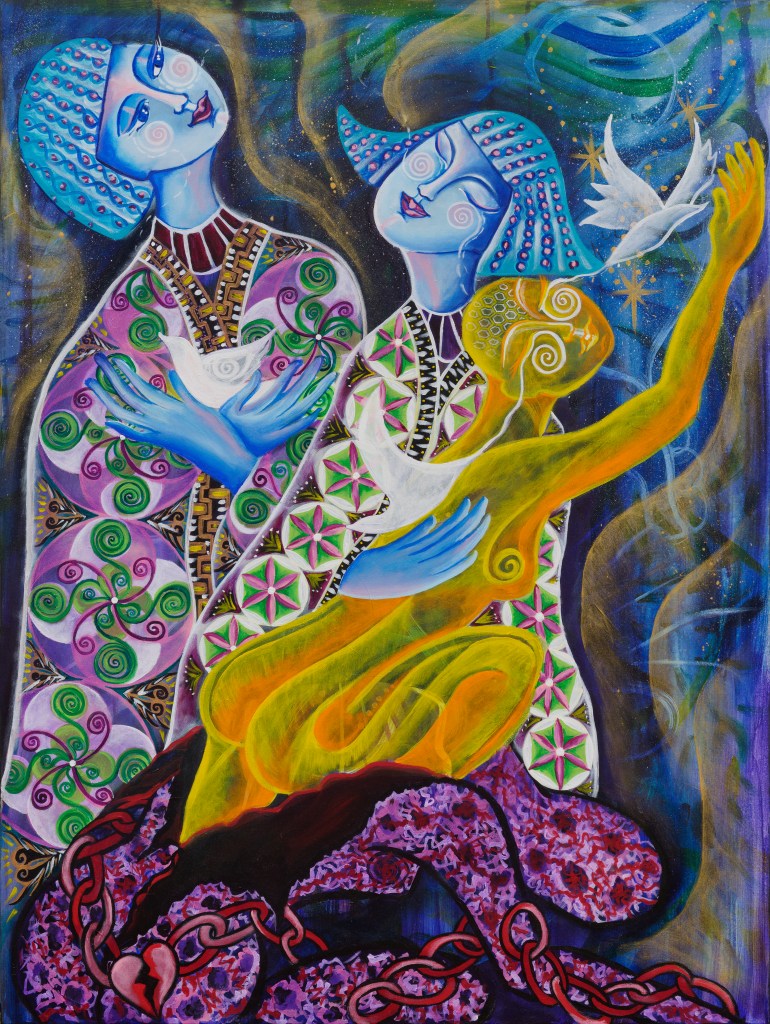
“Transcendence” – Acrylic on Canvas by maasa.ca

 LESSONS FROM MY LUMP