
TOUCHING GOD WITH MY HANDS

The result of my most recent PET scan did not give me the clarity I sought. It’s so easy for the mind to think it has things all figured out, running scenarios, making assumptions, seeking assurances that only ever show up wearing a different face. I wanted the result to say “significant reduction of disease” or “evidence of effectiveness of treatment” — something that would feel like confirmation, that I’m on the right track.

The right track to where, exactly?

“You should be happy that you are stable, this is good news,” says my doctor as he ran his pen to speed-read over my result. “You have no new spots, and the spot on your sternum seems a little better. Although the diminishment of disease is minuscule, we have to assume that the treatment is helping.”

Seems. Assume. I don’t like those words. Not solid enough where my life hinges.

“But what about the areas where it has enhanced slightly?” I asked.

“It’s not a lot,” he said. “PET scans can be ultra sensitive, even to a fault, affected by your lifestyle, what you’ve eaten, and metabolic shift on a daily basis.”

Then what can we make of any of this, if all it gives me is a weird grey zone? My mind circles around a child stomping her feet. So what does this mean? Is it working? Do I need the full dose? But… I’m leaving for Spain next month…

Thoughts that feel like a noose tightening around my neck.

On the outside, I’m looking healthy and strong. Even my doctor notices it. As I rest my arms behind my head, taking the weight of it — so full of heavy thoughts — my biceps flex and bulge, bare out of my sleeveless vest.

“Wow, look at you looking buff!” he says, trying to lighten the mood.

“Ya, I’ve been working out,” I reply. But the outside is the easy part. It’s the inside that persists.

My main oncologist was supposed to go over the results before proceeding with my 4th round of treatment. She was on holiday, and I felt slightly annoyed to be put on the back burner without her to consult. We’d hoped the scan after 3 rounds would give us something to work with. Instead I’m left squinting at ambiguous data, trying to find a foothold.

“Let’s just keep going with the current dose for 2 more rounds until I go on my trip. No point rocking the boat before I go,” I said. By now I know I have the power to shape my treatment plan. Every case is uncharted territory. No two bodies, no two paths, the same. To my doctor, stable is good enough. My glow and zest for life tells him what the scan cannot, and he knows I need this trip to keep the lamp of my spirit brightly lit.

And yet, the pain in my spine is becoming more noticeable. Is it more noticeable because I’m paying attention to it, or because it’s where the cancer is most active?

What happens next is my choice. I can sabotage it with thoughts that spiral and lead nowhere. Or I can exchange them for something that keeps me free.

Where is my peace? Not in the mind where there are land mines everywhere.

I must have been in my mid-twenties when the title A Course in Miracles first grabbed my attention. What enticed me then was my perception of what a miracle would be, some grand act of supernatural power that would give me what I wanted. The miracles I wanted at that time were nothing but ego boosters: recognition, world goals, jet-setting around the world as a wellness leader of some sort.

It wasn’t until the framework of my own making had to be examined, when my physical framework began to break down, that I finally began to understand what a miracle truly is. The book landed in my life at exactly the right time. It is saving my life by teaching me how to live no matter what is going on.

A Course in Miracles is not a religion. It is a retraining of the mind, teaching us who we really are as love created us. The Course comes with 365 lessons, one for each day of the year. On the hard days, I hang onto it like a lifeline. It has given me an antidote to every fear I could ever conjure, and the steps to help me solidify it. Some days I have to come back home every thirty minutes. That is the power of fear. But fear is no match for Truth.

The Course truly landed for me in 2022. On my birthday, January 7th, I wrote this in my journal, a line from the Course that felt like a direct message from God:

“You are perfectly safe as long as you are completely unconcerned about your readiness, but maintain a consistent trust in mine.”

My mind accepted it as Truth. I no longer felt I could trust my own way. I am made up of temptations and contradictions that will snatch my peace away. The judgements I hold and the identity I’ve constructed always want more, and are never satisfied, no matter how much I feel I’ve accomplished. I need help to walk my walk, so I’ve entrusted the way to the One who knows.

This forgetfulness is a cloud that would have me wandering aimlessly in its shadows until I remember that I am still shining bright, as I have, and as I always will be, forever unchanged. I do believe that our earthly experience is designed only for our awakening. We each gravitate towards a life and a path that will bring us home to our godly state when we are fully awake. To realise that the safety of our true home was always within reach.

There is no right path. Only that whatever way we take, we recognise that truth is truth and it is the same for everyone. There is never a sacrifice in reaching truth. The only things we sacrifice are the things we cling to that were never real to begin with. What we release is what was standing in the way of really living, the kind of life that doesn’t end.

I feel this in the tears that stream down my face, love’s guarantee that nothing can take away what I already am.

It is not God that sets our curriculum. It is our soul that chose to forget, so it can experience God through remembering. Why on earth did I choose to have this earthly experience? Perhaps in the ultimate power of creative expression given to me, I wanted to play God in the world of my own making. Who needs God when I can be my own God?

And the light of me that is always connected to my creator is nudging me, sometimes shaking me wildly, to wake up from this dream I am dreaming. And when I land home, even if only for an instant, my heart bursts into an expansiveness that is not of this world. I’ve landed in this space through connection, not just with others, but with nature that reflects the purity of my mind so beautifully.

These are the miracles I now speak of.

God reminds me that my only job is to love another as I am loved. When I feel my Creator’s love, I want to collapse into the immensity of that gentleness, that eternal patience, those arms always open for me to fumble into, with just the slightest willingness to reach for truth. This is the true meaning of forgiveness: to forgive the world, to forgive all outer appearances and actions, and to remember we are all just waiting to fall into the most perfect embrace of who we really are.

And because that love is so kind and generous and gentle, its way brings me peace. Difficult decisions become easy, because the fears that are amplified dissolve, knowing that ultimately none of the problems I think are an issue is really a problem. No matter what, my safety is guaranteed, and nothing in this world can offer me that. It is only the split mind that suffers. The return to wholeness is only one thought away.

In the modern world, there’s so much focus on self-care and building boundaries to keep us safe. What I love about the Course is that healing often comes through relationship.

I am in a beautiful position through my massage work. I am constantly reaching strangers through my touch, where my hands become an expression and an extension of my heart. If I am struggling, it is evident within the first moment of contact. Perhaps I’ve had a hard day. Perhaps there is a judgement. Perhaps my client said something that made me shut down. And in the time we have together, I return to my lesson for the day and remember that my only job is to love them as love meets every single one of us.

When I am there, I know it is accepted, because it is returned back to me. In those moments on the table, I reach for a meeting place in our minds. A place where I can say, without words: there you are. I see you. And in that timeless space of connection, we are both being nurtured by something far deeper than touch. We have landed in peace.

So I invite you: the next time you’re stuck in the storyline of discontent, go out into the world and extend your love to someone else. I’ve found it surprisingly easier than sitting with my raging mind. The act of getting up and giving to someone else, when I can barely give to myself, is how I paradoxically give to myself.

If we pray to be of service to others from a place of genuine care, integrity and authenticity, truly miraculous things can occur. Not just for them, not just for us, but for everybody. Because we are one.

Even if you are not physically with someone, place somebody in your mind who is struggling. And instead of trying to fix their problem at the earthly level, hold them with all of your mind to the perfection of who they really are, as love created them. Hold them in the light of their love, healed, untainted, pure, and whole.

Hold them there until you can really feel it.

This is how I touch God with my hands.

AS WITHIN, SO WITHOUT

My doctors are careful to avoid words like miracle or cure during our monthly appointments. Living with stage 4 cancer that is currently inactive, they tread lightly, cautious not to spark false hope. They reinforce the same quiet disclaimer: for now, you’re doing well.

There are three doctors in rotation at my local clinic, each of whom I leaned on through the peak of my healing crisis. Whoever was on shift became my lifeline that day, meeting me wherever my crisis happened to land.

I will never downplay how profoundly grateful I am to live only five minutes from the hospital. Over time, I came to know most of the oncology nurses, and they came to know me—by name, by story, by the rhythm of my visits. They were always just a phone call away, always prioritizing me when my body went through its strange, frightening eruptions and changes.

This is one of the many blessings of living in a small town: care feels personal, human, and near.

The female doctor is warm and kind, yet she never sugarcoats the truth. She has a practiced way of sliding the tissue box toward me when my eyes well up, speaking plainly about what I’m facing, her soft eyes full of sympathy, even while she knows there is only so much she can do.

The younger male doctor has a bit of doom‑and‑gloom vibe, yet when it mattered most—like the day I reacted badly to the drugs in my IV—he became tender and human. I told him I was scared, and he anchored me with his steady presence, holding my hand and staying by my side until the heavy sedative finally pulled me under.

The doctor I’ve gravitated toward—maybe because he’s also a contractor like my husband and enjoys his band—is light, funny, and warm. He gives me hugs, reinforces what’s working, and encourages me to lean into optimism. He understands how I operate and does his best to support me, even when he doesn’t always agree. He’s a good match for me because, with him, I feel completely at ease to be myself. I’ve even shared some of my more ‘out there’ protocols with him, and although he sometimes raises an eyebrow, he never dismisses or downplays the way I approach my healing.

Each of them, in their own way, does their best to guide me with the wisdom their experience has given them, while staying within the boundaries of their profession—where “best‑case scenarios” are measured by statistics from funded research. But there aren’t many statistics for people like me: riding shotgun with Holy Spirit and focusing on healing the mind because I believe healing must first take place in the mind before the body can follow.

At my last appointment, I wasn’t expecting the young doctor—it was a Thursday, the day my easygoing doc usually works, but he was away. My heart raced a little faster, alerting me that my nerves were picking up the signal: I was uncomfortable. Sitting across from him always feels like breaking the ice. He carries a quiet sadness, as if he spends his days delivering news he’d rather not give, and suddenly I felt anxious—wondering if it had something to do with my blood test results.

As I waited for him to open my chart, I debated whether to ask the question that had been hovering over me—the one about wanting a goalpost for the end of my treatment.

Even with lingering restrictions from scar tissue left by the tumor’s ulceration on my right side and a frozen shoulder on my left, I’m on a mighty comeback—those unruly cells have receded and remembered their true function in a surprisingly short time. But miracle is not a word I can freely use in that room, so I hold it close as my own secret.

My tumor markers have been clear for months. My last two CT scans cautiously describe me as “responding exceptionally to treatment.” Not cancer-free—never that—but exceptional nonetheless. There were tiny nodules detected in my right breast, which could simply be scar tissue puckered into a four-inch seam where the wound finally closed—or it could be residual disease, the inevitable disclaimer.

It’s hard to know without a PET scan, which is more sensitive to metabolic activity and can better distinguish active cancer from scar tissue. But PET scans aren’t handed out lightly—they’re expensive and usually reserved for getting answers that could lead to a new direction in treatment.

Why do I need to know more if I’m responding so well? Because treatment indefinitely feels too permanent for my free spirit. I’d have to advocate for myself and convince my oncologist to get me that Cadillac scan.

“How long do I continue with treatment?” I asked, testing the air, careful not to wander into the dark territory where his answer might trap me.

“You’ll continue until it stops working, until the cancer mutates and we have to try something else.” He looks at me as if I’m a ticking time bomb.

I slammed my shell shut around the pearl of the life I’ve reclaimed—the bright, miraculous reality of surviving what I did and feeling like it’s finally behind me. I ended my line of questioning, course-correcting the trajectory back toward my happy life without disclaimers, where the only ticking is the joyful beat of my heart.

When I leave the clinic, I return to the place where my real processing happens—my canvas. Painting is both a spiritual practice and a mirror, reflecting the oscillation between what I want to release and what I want to embrace. It’s the dance between fear and love, the discomfort of not knowing, and the willingness to reach beyond that uncertainty to explore what is possible.

Facing a blank canvas feels much like facing the uncertainties of my life—grappling with the desire to grasp certainties where none exist, only to find clarity in the ebbs and flows as they come, which then shapes the terrain my mind will inhabit.

I’m not a formally trained painter. I don’t plan ahead; my ideas take shape gradually, layer by layer, percolating beneath the surface—some elements stay, others dissolve into the underpainting. Often, what I see in my mind or feel in my heart doesn’t translate through my hands, which is deeply frustrating. Sometimes, my inner critic is so harsh it makes me want to give up entirely.

This is the darkness that hovers beneath the bright light of my creative inspiration—the same kind of trap the mind sets when it dwells on the thought that this body may never be fully free of disease. It’s easy to get stuck, feeling down and out, if I let it have its way.

A respite from the circling back of my disclaimer came in the form of a woman who had purchased a painting from me. She had worked as a curator at the Tate in London and other prominent art institutions. She is launching a passion project—an advisory and curatorial platform born from her extensive experience in the art world—dedicated to creating space where underrepresented artists’ work is fully appreciated and thoughtfully presented.

She told me she’d been following my work and felt a deep spiritual connection to it—the light within it. She wants to represent me and help bring my art into the world, with plans for exhibitions in LA, New York, and London. I was thankful that I believe in miracles because this definitely felt like one landing right into my inbox.

During our Zoom call, I connected with her instantly. Through her eyes and passion, I saw my work anew. She spoke with sincerity and joy, and I felt the unmistakable stirrings of purpose—that I could extend my love through my creations beyond my little town, with her as an ally. A contract was promised, with her taking only a small commission, and I accepted, allowing myself to rest unguarded in the grace of it all.

But the contract didn’t come. Not the next day. Not the day after. Days stretched into silence. My mind turned violent on itself: She changed her mind. She saw how much of an amateur I am. How foolish to believe I could belong in that world.

Every time I sat at my canvas, my insecurity bled into the colors. My painting became chaos—a mirror of my spiraling thoughts. After four days, I finally sent a gentle reminder via text. Still nothing. I felt small and stupid.

Eventually, my sanity recognized that my ego gripped expectations and outcomes with white knuckles, spinning lies and judgments that made me miserable. I returned to my hourly spiritual practice with renewed vigor. I prayed to release the thoughts I did not want and anchored myself to a new perspective. I sent her love and gratitude for recognizing my light and released her from my expectations. I chose to return to the ample abundance already present in my life. I chose to love everything about my life in that release—and something shifted.

I approached my canvas with a willingness to let go, covering it with a bold layer of glaze. There would be no turning back after this move—I’d have to surrender the small part in the center that I loved and didn’t want to change. The rest was a busy swirl of colors.

Nervous but determined, I washed my canvas with a cool blue and a warm ochre. The chaos stilled instantly, creating a quiet space to begin again—from a different vantage point, this time guided by the eye of my heart. Creativity returned: tender, curious, and flowing.

The release I felt was palpable, and on that very day, the woman wrote back. She apologized—her mother had suffered a medical emergency that had consumed her attention. We can never truly know what others are going through, but what we can know is that everything we experience is a choice, and our choices shape how we perceive life. It was a powerful lesson in how easily the mind can distort reality, and how love and release can restore clarity.

I don’t know what will come of our relationship, and I will not cling to any expectation. What is clear is that painting is crucial medicine for me—a place where I can process and choose to trust that I’ll find a way through the muck in my mind to the purity of joy, peace, and beauty that reveals the essence of my spirit. I’ll keep painting, and I’ll keep finding my way, regardless of where it might lead.

So, I choose not to accept any disclaimers in my life. I choose to trust that I will know when it is time to change course, to glaze over what needs to shift, and that by seeking a better way through love and peace, I will always be shown the way.

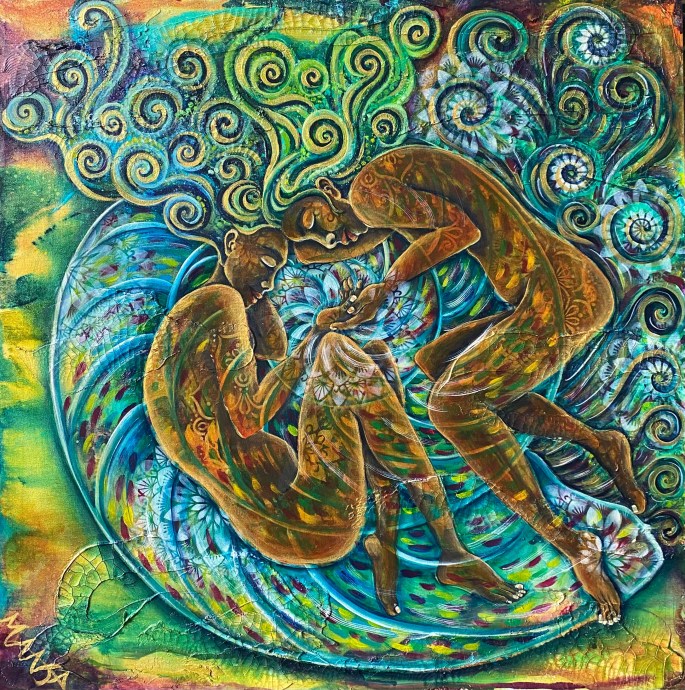
Above painting by Maasa: “As Within, So Without” – Inspired by teachings of A Course in Miracles. “Love created me like itself.” When we offer love to fill the space between us, it ripples outward— received by all, for love recognizes only itself.