LIBERATING THE GIRL IN THE ORANGE TUTU.

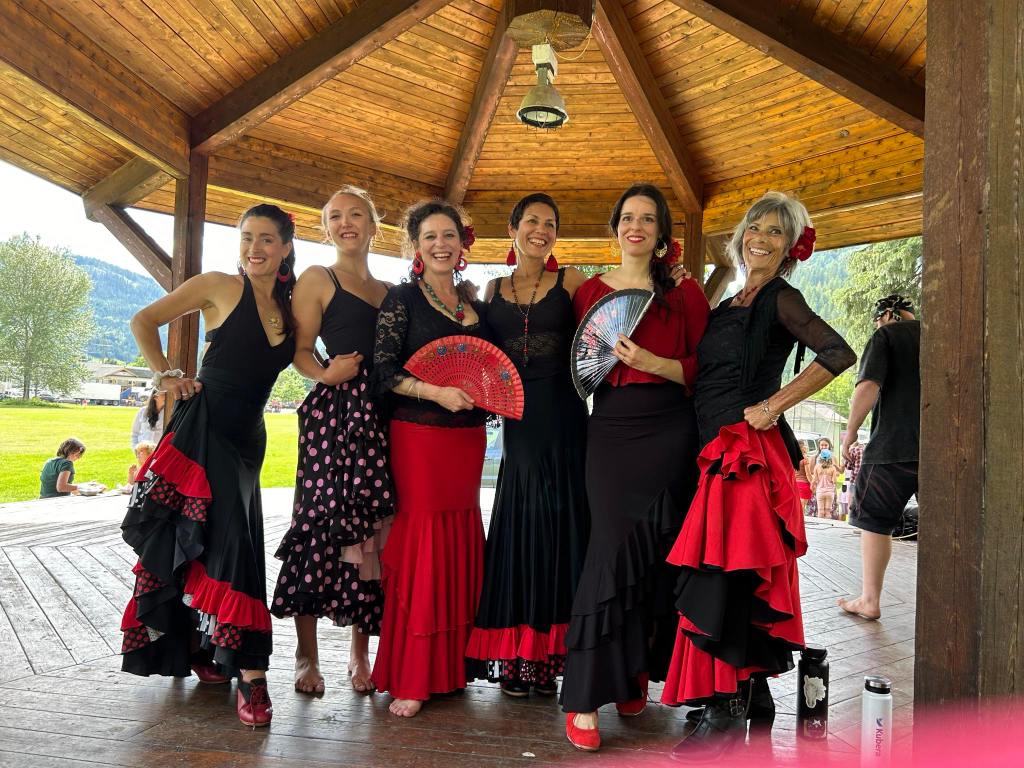
I’ve taken my place on stage, and all I can see are the silhouettes of what look like hundreds of people beneath the blaring lights shining directly on me. Our flamenco group, Las Llamadas Del Flamenco, has been practicing diligently for this very moment: to dance at the Starbelly Festival in a prime evening slot. Then, it happens again. My mind goes blank, and I feel myself distancing from my own body as panic sets in. I’m experiencing myself outside of myself, and I know that I will cause a train wreck if I don’t get out of my head. This disconnect is not new; I’ve felt it when the pressure of perfectionism rears its ugly head.

The first time this happened is one of my earliest memories. I was five, maybe six, enrolled in the prestigious Miyashita Ballet School in Kyoto, Japan. The school was known for its rigorous and comprehensive ballet training, even for young dancers. I remember the day of our big performance. Mama, along with all the other moms, was getting me ready backstage, slathering make up on my face and slicking my hair back into a tight bun on the top of my head. It was so tight that it pulled my eyes up, but no amount of pulling could hide the obvious Caucasian traits of my gangly limbs and my reddish, light brown hair. Amongst the thick, silky black hair and the build of other Japanese dancers, I was already blatantly out of place.

We all took our positions on stage, dressed in our orange tutus. I looked for my parents, but the lights blinded me. As the music started, I felt my heart in my throat, and suddenly, my mind went blank. I had no idea what I was doing up there, and my only reaction to the sudden displacement within myself was to move to the music. But my dance was entirely my own and bore no resemblance to what I had learned. I vaguely remember making the commitment to keep moving, flying solo on a gust of wind that only I could feel against the unified flock of orange tutus. I was completely in my own world throughout the entire performance, a fact that everyone witnessed. When others made it evident that I had made a colossal mistake, it forced me to carry the weight of a newfound burden of shame.

Fast forward forty-five or so years later, I’m back on stage, and I find myself on the outer perimeters of myself, desperately clinging to presence. The music starts to sound out of sync with my tapping feet, and I realize I’ve missed a cue. Drifting apart from the other dancers, who move seamlessly in sync, my mind teeters on the precipice of a total blank as I struggle to regain composure. Within the crisis, my body takes over and aligns with my group in the next bar. I have no idea how long I have been out. I willed myself to focus on my sisters on stage and to calibrate with them rather than with my competing mind that was trying to hijack the performance. It was a tug of war that I somehow managed to dance through, but not without leaving its ugly mark.

The idea of preparing for and attending a three-day festival, vending my art and performing late into the night, might have been a stretch. I had missed a flamenco performance a few months earlier because my body simply said ‘no’. After five months in treatment, a couple of visits to the ER, and dealing with a gnarly ulcerated tumour, I needed a win, so I did it. I showed up anyway with a wing and a prayer.

My shame over not performing as well as I knew I could, with a mistake I couldn’t forgive, cast a dark shadow from the moment I left the stage, despite the exuberant applause of the crowd. I was deaf to any compliment that followed. Consumed by the desire to hide, I couldn’t help but feel that I let my group down. Frustration set in as I realized I’d fallen victim to my ‘old program,’ perhaps starting back when I was the rogue dancer in my orange tutu. Exhausted and upset, I couldn’t let it go. My ego had robbed me of the joy I could have celebrated simply by being there and able to dance at all.

I awoke from a restless night of sleep, still sticky with the residue of regret over what could have been. In the light of day, I realized that an old program had surfaced because it was ready to be healed. That little girl in the orange tutu longed to be liberated, but I didn’t know how, as my ego still dominated my mind space. I’ve learned to ask for help through prayer when I’m stuck. I prayed to be liberated from attacking myself. I prayed to forgive the false perception of myself and to have a beautiful day filled with meaningful connections. I sincerely prayed to let it go.

As I walked toward my tent filled with my visionary creations, a woman stopped me along the way. Her eyes welled up as she told me that the solo I performed the night before moved her to tears. Feeling her sincerity and her need to express appreciation for my performance, my heart instantly opened to receive her perspective, releasing what was holding me. The miracle was that I actually believed her.

The day continued with numerous people expressing their love for our performance, highlighting how our group moved together while showcasing our individual gifts of creative expression. I was gobsmacked. Their perception was entirely different from how I perceived it; I was so focused on what I did wrong rather than celebrating dancing with my flamencas—a typical sabotage of the ego, which only attacks to seek importance.

The Holy Spirit showed me that healing isn’t done alone; it happens with the help of others who can shed light on who we really are beneath the distortions lurking in our subconscious. What blew my mind was seeing the footage of our dance performance. As I cringed, anticipating the part where my mistake occurred, I was shocked to find that it came and went in a flash. During that time, I was entirely in sync with the music, doing something different from the others but it looked intentional and seamlessly integrated into the whole dance. Perfectly imperfect, the girl in the orange tutu was finally liberated.

LIFE IN PRESENT TENSE

I regretted asking the moment the doctor responded. Until today, I had never inquired about my official diagnosis. Did it not matter to me because I’m focused on the work to get better, or did I simply not want to know? ‘It’s stage four,’ she said. She didn’t have to finish with an extended explanation and we both knew it. My stomach dropped as her words instantly filled the hollow in my gut. Though I knew this to be true, it had been tucked away in a no-access zone, hidden out of sight and out of mind.

My coping mechanism oscillates between faith and denial, with only a thin veil separating the two. I’m learning that adversity is an invitation to awaken to my response to life. Struggles only arise when I compare myself to my past self or when I’m overwhelmed by what might happen to me in the future. Both tendencies make me miss what’s possible now.

I was fine until I asked. I even impressed myself with my ability to detect the early stage of another staph infection, which was the reason I was sitting in the doctor’s office in the first place. Instead of being upset about another recurrence only a couple of weeks after the last, I chose to be grateful that I caught it early this time instead of landing in the ER again. Instead of resisting another round of antibiotics, I accepted what needed to be done given the circumstance. I showed her my breast, and she noted how much better it looked, confirming how I felt. But everything changed when I was put into a category.

The power of two words spoken aloud by someone else instantly created a different reality. It contradicted the feedback from my body, which suggested that despite the expected side effects, the treatment is working. I recognized my visceral reaction, which prompted a sudden shift in my state. The chill that ran through me seemed to extend into the future, yet it felt like just one of many potential versions, too elusive to keep me in a state of panic. My wise friend reminded me that a diagnosis is not a prognosis. With this reassurance, I return to the baseline of what I know to be true in this moment, focusing on all that is well within me rather than fearing what could go wrong.

I continue to meet myself as life unfolds before me. Today, I was granted the grace to observe my reaction and respond in a manner that felt more authentic than succumbing to the abyss of ‘what ifs.’ I became aware that I attributed meaning to those words based on conditioning that was not mine and not based on where I’m at now. There is no future, only now and now and now.

With the residue of Doc’s words still echoing in my mind, I drove home, recognizing the weight inside me. I allowed myself the catharsis of tears to release it. Seeking solace in the forest, I clung onto a sturdy tree. Shinrin-Yoku, the Japanese practice of forest bathing, has continually brought me home to myself. Amidst the trees, I felt the cleansing stillness wash away what was not serving me. Anchored in the solid embrace of a cedar, I calibrated to its unwavering presence. My senses opened to the palpable calm around me as I slowly exhaled.

I asked myself: ‘What is true in this very moment?’ The answer came with ease: ‘I’m safe, I’m okay, I am not in imminent danger.’ Such certainty is only available in present tense.

I’m aware that my grievances stem from reaching towards life without cancer, from being free from interruptions of symptoms, and from having limitations. Yet, my quest for purpose is unfolding in the present. This is my purpose—to find a way to meet myself as I am and find ease in the midst. There is always a choice to accept or resist. The gift lies in having a choice, even when it may not feel readily available. It’s okay to shake and shudder until the moment leads to something else. It always does.

Each moment serves as a meeting place for the full gradation of possibilities of how I can engage with my life. It’s a beautiful life, filled with the diverse shades of the human experience. To be asleep to it, lost in denial, is to miss the essence of my purpose. This, perhaps, is the most profound lesson showing me the way to liberation in any given moment. .

THE PATIENT PATIENT

I’m battling the Saboteur, determined to resist its attempts to tarnish the glow following a delightful stroll in the sunlit forest. It lures me into exchanging it for a darker version of my circumstance. During the walk, I was impressed by my ability to maintain a brisk pace without compromising my stamina. Even on the uphill climb, I sensed newfound strength compared to my previous treks.

Returning home, exhaustion engulfed me, my focus latched onto the energy being syphoned out of me. The electric pain travelling through my body brings my attention to a new, suspicious discolouration under my breast. Now, the Saboteur transforms into the Victim, and a sense of helplessness drags me into shutdown mode. The mind, once uplifted in the forest, now succumbs to weightier thoughts-dragging me into numbing sleep.

Negative thoughts possess a density capable of overshadowing the light without a moment’s notice. They filter out the wisdom I’ve gathered into a blank void. The Victim induces temporary memory loss of all that I have to be grateful for. It’s evident that I’m not a patient patient, and I’m frustrated with life revolving around the central axis of my health. I’m frustrated with being frustrated when I know the only way through this is to allow it to be whatever it is. I’m looking for ways to escape but this will follow me wherever I go.

A sickly-looking woman is gazing back at me in the mirror. She has a shaved head with patches missing and dark spots decorating her skin. Who is this person looking back at me? What is her purpose?

The judgement values that have served as a measure of my self worth is suffocating me. I can no longer rise to the gold standard to satisfy the insatiable need to achieve more. These unreasonable expectations, even at the best of times, demand ‘you should be’ orders, kicking me while I’m down. Curled up with my hands pressed on my ears, guilt washes over me.

A chasm exists between the part of myself witnessing this self-abuse and the one perpetuating it. The witness sees the dominating pattern that has been running the show all my life. She shakes her head with her hand on her heart while the abuser is barking orders, pushing me to do and be more. The irony lies in the fact that the relentless drive to achieve more has been a fundamental building block shaping who I am today. Now, I’m being forced to find a new way to satiate the need to do more to feel of value.

It feels like the stripping away of what used to give me a sense of purpose is bringing me closer to my real purpose. I still don’t know what that is, but I sense that I’m immersed in it without fully recognizing its value. This is where the healing needs to happen. Instead of feeling weak and aimless, how about translating it as a sign of healing? How about taking this exhaustion and the need for rest as a sign of my body recalibrating? How about viewing my unstable emotional state as a reflection of the beauty of my vulnerability, rather than something to dismiss with a smile? How about the grace of love to be enough as I am now?

Perhaps a deeper alchemy is unfolding beneath the biological changes induced by these medications, maybe budding beneath the layers of depression and exhaustion. This slow, sticky, stagnated state could serve as the perfect incubation ground for whatever needs to be realized and embodied in preparation for my next phase. At some level, I’m still in denial about what is happening inside me, clinging to the idea that life should continue just as it did before. Amidst the complexity, there are numerous layers—some more readily peeled away, while others need to be left as they are, forming the foundational base of what is to come.