POLKA DOT ORANGE LIGHTS

“I’m happy about your results,” my oncologist says over the phone. She’s relaying the radiologist’s report from my recent PET scan. I’m surprised by the felt sense of release, even though I had convinced myself that this time I wouldn’t let it get to me. I wouldn’t let the anticipation of the result become an invisible weight I carried. But it was still there. The difference is, I’m stronger now, and I can carry it without letting it drag me down.

Still, my light-as-a-feather release moment was short-lived. My quick translation of what she said was, “I’m done, I’m cancer free! Whoopee! Finally!!” But then she proceeded with what I didn’t want to hear which meant: it ain’t over yet.

The Coles Notes version is that there are lumpy remnants of disease bound up in my scar tissue. There are still a few small nodules left over from the breakdown of the big tumour. I focused on the positive: it’s no longer in my other breast, sternum, liver, lymph nodes, or in the suspicious activity that showed up in my right lung several months ago.

“There is a new lesion in your spine at T4 that we are going to have to keep an eye on,” she continued. It’s a game of give and take, and what is left over is where I have to count my blessings. My mind quickly grasped for an explanation.

I had two terrible falls last year where my heels went over my head and I smashed hard onto my back. Both involved slipping and landing on solid slabs of wet rock. The first time, I broke my fall with my left arm, which fractured my humerus and left me with a frozen shoulder I’m still patiently thawing out.

The second time was a classic ass-over-teakettle slip down the stone steps to my garden. That time I remember lying there motionless, afraid to move, praying that I hadn’t broken my back.

“Could a fracture or major trauma in that area cause a higher glucose uptake in the scan?” I ask. I can hear the desperation in my voice and feel my heart squeezing around panic. “It could,” she replies, “but the formal report says that it is likely a metastasis.”

This is how it starts: fear finds a crack to get in. If I look away and let it in, it will take hold—and that is what metastasizes and spreads. That is what alters my experience from being free to becoming a prisoner. I know I have to nip it in the bud—not with denial, but by shifting my awareness to a greater Reality that will guarantee my safety.

This is the thing: the radiologist is commenting only on the supposition in cases like mine. The last PET scan was done over a year ago, when the orange glows of sugar uptake in my report were polka dotted in too many places. Assuming that cancer “spreads,” all the orange glows led to the presumption that it was all cancer — even though healing tissue also takes up sugar. This is my own disclaimer on these super sensitive machines that pick up everything. I was never completely sure that was the case, but I didn’t want to biopsy bones and organs, so I went along with it, hoping it wasn’t as bad as it seemed. It was most likely denial, but at the time, it was the only defense I had to keep going.

The radiologist comments on my scarring as a “surgical site,” which it is not. The scar tissue was not from a clean cut surgery. I wanted him to know what I endured—that I didn’t have the option for a quick and easy removal of my problem. It’s more like a mesh of healed tissue from a decomposition site. I find it mildly annoying that the guy writing this report has no idea what I’ve been through and writes without considering my falls as a possible explanation for the T4 light-up. I recognize my annoyance is guarding what I want to keep safe, so I let it go with my next out breath.

My oncologist is thorough and pulls up the last three PET scans, spanning two years, to compare them on her screen. “Maasa, you really should see the changes in the imaging. You can literally see those orange globes of light around your body dissipating with each scan. I think you would feel really encouraged if you could see what I see,” she says. I love this woman, especially because she wants me to just keep doing what I’m doing. And even though there is no real end to talk about in terms of treatment, I decide that this is good news—because really, it doesn’t change anything. I can keep living the way I am.

I had decided I wouldn’t live suspended on “what ifs.” There will be more tests, and the only constant is change in whatever direction life flows, so I’m training my mind to anchor to what is steady and forever. It’s ongoing daily work — practicing permanence in a world that only guarantees impermanence.

I was nervous when I signed up for a workout class that I used to do in my twenties. I’d been feeling the nudge to get strong, to push healthy oxygenated blood through my system for a house clean. To feel those endorphins combat the restrictions in my body, to be told what to do by a guy that inspires me.

Coach tells me not to ask questions and just do what he says. That is exactly what I need: just show up, do the work, and get on with it. I survived the first week of a strenuous, sweaty workout, which confirmed for me that so much of how I feel depends on the limits I place on myself. Sure, I have to modify here and there, but my body followed the state of my mind that chose not to let anything get in the way.

My monthly treatment in the chemo lounge was right after class on Friday. My veins were so pumped that, for the first time, the nurse couldn’t get an IV into me. It gave me a funny sense of satisfaction—even though it hurt to have her poke and prod until I finally relaxed and let her in.

It’s helping my mindset to know that the cocktail of two drugs for my targeted therapies does not damage my healthy cells. Instead of attacking fast-dividing cells like chemo, they target and block the receptors that fuel the cancer cells. The hope is that, without fuel to grow, those unruly cells will weaken. With me strengthening my own immune defense through everything I’m doing—mostly mindset, herbs, supplements, and exercise—they may eventually remember their true function and return to behaving like healthy cells.

My life can easily be defined by tests and the shifting statuses of this disease. What I’ve learned from the latest PET scan is that I’m still reaching for the finish line — and I don’t want to be in a race. My path is the one I’m on, and anticipating it to be any different will only cause me grief.

Tests come in three-month increments. Thankfully, the next one is an MRI, which I requested because I need a break from the radiation of these nuclear medicine machines. Rather than reaching for a different kind of life or pinning my hopes on a better scan result each time, I’m practicing being here now — finding perfection even in the nooks and crannies. To be an expression of the good stuff I want to share — and for the rest, I place the future in the hands of God.

FROM WHAT IF’S TO WONDER

It is inspiring to learn that peace is something I can access within myself, but it requires a conscious choice. It may be fleeting—like the sea, calm one moment, turbulent the next, yet in the depths, it remains still—constant and ever-present beneath the moving waves. We thrash against what we cannot control, cling to what we don’t want to lose, and forget that deep below lies the safety we seek. When we focus only on what’s happening on the surface, it’s easy to get lost at sea.

It takes daily practice to train myself to believe that I am not a body, but it is the only idea that truly offers the kind of guarantee I seek. Every fear I’ve ever had comes from external circumstances affecting me, my loved ones, and the world at the physical level. So, I aim to manage how I think about the physical world in order to make peace with what I cannot control or understand.

Six years ago, right before the Labour Day long weekend, I left our beautiful campsite at Garland Bay on the shores of Kootenay Lake for a solo trip I’d been dreading for months. The lump in my breast had been growing, and I could no longer hide behind my stubborn denial. The biopsy was scheduled during our camping trip, just days before my daughter was to start Grade 4.

I didn’t want to be coddled or accompanied; I just wanted to slip into town, get it done, and return in time to savor our last summer hurrah together. She was only nine then. Today, she’s starting Grade 10—and here I am once again, waiting for scan results after the Labour Day long weekend. Interesting how cycles repeat, but this time I keep my peace close by.

I still feel the twinge of “scanxiety” lurking, trying to take hold with worries of the result. Each time fear rises, I anchor myself to my spiritual practice, drawing on the teachings that remind me of what is truly unshakable.

Mama and I decided to make the trip together to Kelowna, where I was scheduled for a PET scan at the B.C. Cancer Center. Seeing her navigate life with an uncomfortable ileostomy bag for months, after her emergency surgery for acute diverticulitis, reminds me of the resilience we both carry—and of the quiet strength it takes to live with open hearts amidst unknowns.

Mama rarely complains, even as the overburdened medical system made her wait long past when her reversal surgery was due. With thirty people ahead of her and a surgeon who works only twice a week, she has been patiently waiting her turn. We’ve both endured our share of bodily challenges but managed to stay afloat. That’s just how our family is—we don’t linger in self-pity; we strive to shift perspective until it becomes useful and meaningful. Together, we turned the trip to Kelowna into a celebration: good food, shopping, and the closeness we share.

Entering the Cancer Center, I leaned on my daily A Course in Miracles lesson. I’d started the 365 lessons at the beginning of the year, and that day’s—Lesson 240, “Fear is not justified in any form”—felt fitting for a waiting room full of uncertainty. I reminded myself that who I am, as God created me, can never be truly threatened, and that fear only arises when we believe something outside of us has power over our peace. Looking around, I felt a gentle compassion for everyone there, each facing their own mortal struggles just like me. The body is the ego’s most convincing disguise, yet beneath it, I held onto the awareness that our true nature is always safe—and silently shared what I believed with those around me.

Over the last two years, my main oncologist at the cancer center has been a steadfast ally. There is a mutual respect between us—one I might even venture to call a friendship. When I received the appointment for my PET scan at the Cancer Center, I asked if, by chance, she could see me for just a few minutes, assuming she was at work. The lovely ladies on her team conveyed the message, and my heart leapt when I saw her coming down the hall—I didn’t hold back my embrace, even though it was our first time stepping beyond the usual patient-doctor boundary.

I showed her the large scar where a third of my breast had putrefied and is now fully healed. She traced her fingers gently across it and congratulated me, and I couldn’t help but laugh at the absurdity of us standing in the hallway, admiring my scarred breast as patients and staff walked by. Her effort to come see me, even for those brief but meaningful minutes, reflected her genuine care—and I felt it. That kind of love is its own medicine. I hugged her again as I said goodbye and made my way to the nuclear medicine division.

With this scan, I will gain clarity on the source of the lumpy remnants in my breast and whether any cancer activity remains in my body. Even though the body is not who I truly am, I need it as a neutral vehicle through which to extend my love into the world while I am here. The PET scan nurse guides me into a room and injects me with radioactive sugar, which will light up areas in my body if there are any hungry cancer cells. She reminds me to avoid pregnant women, babies, and children for six hours, as I will still be radioactive. I go over my prayers and fill my mind with thoughts of peace for forty minutes, allowing them to take effect. Then I step into the tunnel, and lay down in the hands of God.

I remembered all the times I tried to manifest the life I thought I wanted—things, circumstances, comforts. How often did I get what I asked for, only to feel empty again? Manifesting has taught me that I don’t truly know what I want. What I long for most is a peace that cannot be disturbed, safety that is guaranteed, and a sense of wholeness that comes from within and spills outward. It can only come from returning to my Creator and creation itself, already present beneath the layers of the human story. This is what Lump led me to learn—the greatest gift to come from the messiest part of my life.

During this time, we were caring for the last of our four pet rats, whose body was riddled with tumors. She was in rough shape, yet her insatiable drive to eat and be touched made it unbearably difficult to decide to play God and end her life. Each day, I watched her struggle and felt a conflicted mix of trusting nature to take its course while confronting the unsettling echo of my own journey with cancer. It reminded me of the uncertainty I was still facing, and that no matter how much I practice, the fear of death and the attachment to the experience of being in this body remain primal. I played tug-of-war between loss and what cannot be lost as we prepared for our Labour Day camping trip to Silverton, B.C., the day after my return from Kelowna.

Standing on the paddleboard, gliding across the crystal, glassy water of Slocan Lake, the mountains rose in their majesty all around me—a reminder of my place in the vast mystery. I landed in the kind of peace I had been seeking, where the debris of “what ifs”—the scan results and all that I cannot know—settled to the bottom of the still lake. I realized how long I had been chasing the “whys” of this disease, trying to make sense of it. At last, it didn’t matter to me anymore.

After exploring many spiritual traditions throughout my adult life, I have chosen one path to study and practice. Following the teachings of A Course in Miracles helped me navigate what could have been the darkest time of my life, offering an alternative perspective that shone a light onto what feels timeless and real. It resonates with me deeply, even though it will likely require practice for the rest of my life. My experience has shown that as long as love, forgiveness and peace remain my priority, the way continues to unfold. In this light, I can relinquish the “why” and rest in the changeless.

As the light of our perfect day yielded to night, Al and I walked down to the beach, drawn by the splendor of the star-filled sky. Above us, space unfurled in deepening shades of blue, dissolving into velvet black. Millions of stars glittered overhead, and the Milky Way stretched like a luminous river, a bridge leading me into the mystery.

The Big Dipper was straight ahead in my sightline when my eyes caught a light racing across the sky at incredible speed. Just as I exclaimed, “What’s that?” Al locked on too. Out of millions of stars, he found the very one I had seen ripping across the night. “What is that?” he echoed.

Moments later, another appeared—this one wavering, flashing, and veering at an odd angle like a drunk driver. “Another one!” I cried. For an hour, we watched as lights darted, flared, and streaked in ways no plane or satellite ever could. Dozens of them moved with impossible speed and strange, erratic patterns, like vessels skipping across dimensions.

They would appear out of nowhere, often right where we were already looking. The most thrilling moment came when two streaks hurtled toward each other from opposite directions, seemingly destined to collide—only to miss by a hair’s breadth to our naked eyes. And the most mesmerizing part wasn’t just the spectacle itself, but that Al spotted each one only a heartbeat after I did, as if we shared the same mind. “Are you creating them?” he asked.

“Am I… or is it us out there creating us here in this moment?” I answered.

We sat in the darkness, gobsmacked and spellbound. We wanted answers. Our minds wanted to know—what were they, why were they there, and what they were doing? It is in our nature to ask, to seek safety within the confines of understanding. But by releasing the “why,” we received the gift of wonder in the mystery. In the vastness that cannot be explained, we can let our imagination roam, embracing what cannot be contained and can only be experienced—even with lingering question marks.

Opal, our ailing rat, was still hanging on when we returned—still eating feverishly, dragging her broken body to the food bowl as if her survival depended on it. I noticed a small ulceration under her armpit, exactly where mine had been. And then, out of nowhere, just like the lights in the sky, clarity appeared in my mind. I knew it was time. I made a phone call, and the decision was confirmed with an opening that very afternoon.

I was surprised at how emotional I became. She had become a symbol of facing the impermanence and suffering of this world—to feel it all, yet anchor to what I believe to be true: that there are no endings, even when it feels so out of reach. I stroked her feeble body and repeated the ideas that have given me solace from the Course: You are not a body. You are free, for you are still as God created you. Love created you like itself—unto love you will return. As I choked out these words through tears that would not stop, I found myself caught in the beautiful paradox of yes, I know—but it still hurts.

It took another lethal shot for her eyes to glass over, carrying the palpable sense that she had left. From her ending here to another beginning, wrapped in the blanket of mystery, I felt the same serenity I had felt paddling on the lake—the stillness of peace where everything settled into its rightful place. She rests alongside the ashes of my grandmother, two of my star babies who did not make it to term, and other fur babies who passed before her. I used to push death away, unable to be too close to endings, but now I understand that it is love that allows us to be fully present as life flows out and on.

UNFORESEEN VISITOR

Lately, I’ve had several graphic dreams of giving birth. I wake up wondering what they’re trying to tell me. Maybe it’s about birthing something new—a sign of the life that’s been extended to me—or perhaps it’s my body speaking, mourning the loss of the monthly cycles that abruptly stopped over a year ago when I began hormone therapy. A rhythm that often synced with the full moon and had accompanied me since I was twelve.

I didn’t have the capacity at the time to make sacred the closing of my fertility. I skipped the slow transition and dropped straight into the volatile swings of menopause within a month of starting treatment. Not that I was planning on having another child at this stage of life, but it still felt too soon, too sudden, and too permanent. With my life on the line, it was a sacrifice I didn’t give much credit to—just something I let go of without a proper goodbye.

Life in survival mode barely registered the radical shift from mother to crone. I felt myself aging from the inside—losing weight rapidly, aching joints, thinning hair, a fading sex drive, and dry skin. I couldn’t tell whether it was my body under siege by cancer or the absence of the hormones that had kept me feeling bouncy and womanly. All of it took a back seat to the tremendous effort it took just to keep my mind from cracking under the relentless pain of my lump unraveling over those months.

With my monthly cycle dormant, the familiar waxing and waning of my internal rhythm has shifted into a new tide—one of unpredictable waves, where heat rises without warning and chills follow like a shadow.

My husband and I decided months ago that whatever sleep we could get in separate beds was far more valuable than insisting on sleeping together. At first, it was hard—after twenty-four years of sharing our bed and sleeping within arm’s reach. But now he can snore away without worrying about keeping me awake, and I can thrash around, kicking the blankets on and off, fiddling with the wireless fan all night long. It works for both of us—and yes, date nights still happen, even if I have to talk myself into it. I wasn’t about to let that spark die, even as my body smouldered quietly in the background—my sense of identity rebelling against the slow withdrawal of my sexual desire.

I stopped hormone therapy when my cancer shifted from HER2-negative and hormonally driven to HER2-positive and protein-driven—a mutation I believe was triggered by starving the cancer of its hormonal fuel. At forty-eight, it was unlikely I’d regain fertility, even seven months after stopping the hormone blockers. For someone who once relished deep, uninterrupted sleep and napped regularly, the hormonal upheaval and circadian disruption stole what had been my superpower: sleeping through just about anything. I even became an early riser—for the first time in my life.

Recently, I’ve turned a corner—sleeping better, feeling less discomfort, and no longer riding the thermal rollercoaster. I convinced myself that the initial storm of menopause had run its course, that I’d paid my dues and finally got the hang of being a crone. I even packed on some weight that, just a few months ago, felt impossible no matter how much I ate. I took it as evidence of my body returning to homeostasis—a healthier new normal.

Another vivid dream of blood between my legs—and today I finally understood: these dreams were heralds of a reckoning with what was lost. At first, I was baffled. Then I burst out laughing, holding the evidence on toilet paper, and announced to my family, ‘No way—I got my period!’ Suddenly it all made sense: the weight gain, the return of vitality, the longer nights of deep sleep, my tender breasts. My womb has resurrected to it’s normal function—and it’s shedding what’s left of my eggs! I’m giddy, even as the familiar cramping and bloating return—sensations I haven’t felt in so long. My body is staging its own comeback, offering me a gentler, more natural transition into cronehood—a redo of what was taken too soon.

I’m amazed by the intelligence of the body—how it can pick up where it left off, even after everything in between. I carry a map of scars, proof of my undoing and remaking. To reclaim what was lost feels like a quiet miracle. This return reaches far beyond a biological comeback—It’s a homecoming to myself, and a reminder that what was once lost can be found again.


MIRACLE SHIFT

“Your CT scan shows that you’ve responded exceptionally well to treatment,” my oncologist said excitedly over the phone. “There doesn’t appear to be any tumours in either breast although, It’s hard to assess the right one due to extensive scar tissue from the ulceration. What spread into your chest wall has receded, the thickening in your upper sternum is stable, and your lymph nodes look clear.”

I was surprised by how calmly I received the wonderful news—perhaps because it simply confirmed the profound shift I’ve been feeling lately.

Three months ago, my CT scan showed disease progression from my right breast into my chest wall, in the sternum, and in my lymph nodes. The tumor in my left breast was also evident. Due to my chronic infections, I was able to forgo the chemotherapy portion, which would have depleted my immune response, and instead gave my body the chance to fight back against the infections. With stage four metastatic breast cancer, the recommended treatment was aggressive. My unique situation gave me the chance to stumble upon a miracle.

After two targeted immunotherapy treatments with minimal side effects, all four of my tumor markers dropped below the normal range for the first time in five and a half years. I requested a CT scan after my third treatment, knowing I’d likely be recommended to add chemotherapy for the following round since my infections had cleared. I needed to know if my insides reflected how I was feeling—and they did! My doctors believe that the targeted immunotherapy was solely responsible for this miraculous turn of events. I have my own belief, which I attribute to a higher order I’d placed my bet on.

“I still advise you to do chemo and take advantage of this window to clear out whatever may be left of the cancer,” my oncologist continued. I’m incredibly grateful to have been matched with an oncologist who respects my decision-making process. For now, I declined the chemo, as my body is relishing the vitality that had been absent for so long. The thought of compromising my entire system, just as it was moving towards homeostasis, felt more like a risk than a benefit. However, I’m careful not to cling, as I need to remain open to pivot when necessary.

The only “barometer” I’ve put my faith in is the level of peace I feel in the choices I make. I’m talking about the kind of peace that can’t be manufactured for safety’s sake—the kind that is all-encompassing, a ‘yes!’ that I can fall into and feel held by. That’s what I felt after I declined chemo for my next round.

I’m learning that the only power worth giving is the Power I lovingly surrender to. Time and time again, I’ve been shown that when I do this, I’m being taken care of. I know when I’m not doing this because I feel a tightening around the reality I want to control. So, when I notice, I let go again and again, praying to be shown the way. The way has at times been scary, painful, confusing, and messy- it’s only from this vantage point that I can see the meaning in all of those experiences. This is what I need to trust as I keep following the way. This is what Da calls a miracle shift.

I hadn’t disclosed to my doctors the other ‘therapies’ I believe contributed to my ‘exceptional response.’ A fringe protocol, showing great promise as a cancer cure, came onto my radar last year. I began it as a last-ditch effort to make a difference on my own before seeking help from the conventional system. However, I didn’t use it long enough to give it a fair trial. The use of repurposed drugs—existing drugs originally developed for one condition but used to treat another—was gaining momentum and showing great promise for healing even the most aggressive and untreatable cancers.

The research I’ve done has given me enough confidence to test these therapies on myself, especially since, based on what I’ve gathered, they won’t interfere with the efficacy of my treatment and are relatively harmless. I’ve also been taking Artemisinin, derived from the sweet wormwood plant, often referred to as ‘herbal chemo’ due to its potent anticancer properties. Alongside this, I’ve maintained a steady regimen of herbal tinctures, teas, vitamins, high doses of anti-inflammatory supplements, and antioxidants to neutralize free radicals.

I also take time for my daily ritual of forest bathing and prioritize having meaningful, heartful connections. I can feel the power of the prayers from those who pray for me. I’m sure all of these have contributed significantly to my current state, but what I give the most credit to has nothing to do with what I put into my body.

My day begins with aligning my will with the greater will of God. It is only from this place that I can live fully and flourish, even with this disease. I need to recalibrate throughout the day because it’s so easy to get lost in our mortal predicament. So, I keep coming back, and I keep placing my faith in what I can never fully understand but can trust. I trust because I keep finding my way.

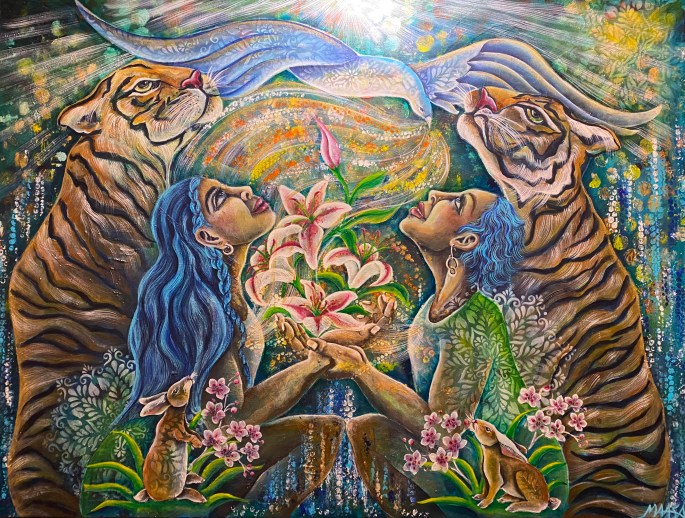
Banner painting “Of The Same” by Maasa. In the spirit of our Sameness, we celebrate what can’t be threatened or taken away. What we thought we forgot is redeemed in the remembrance that was never lost. More of my art mine may be seen @ http://www.maasa.ca