FROM WHAT IF’S TO WONDER

It is inspiring to learn that peace is something I can access within myself, but it requires a conscious choice. It may be fleeting—like the sea, calm one moment, turbulent the next, yet in the depths, it remains still—constant and ever-present beneath the moving waves. We thrash against what we cannot control, cling to what we don’t want to lose, and forget that deep below lies the safety we seek. When we focus only on what’s happening on the surface, it’s easy to get lost at sea.

It takes daily practice to train myself to believe that I am not a body, but it is the only idea that truly offers the kind of guarantee I seek. Every fear I’ve ever had comes from external circumstances affecting me, my loved ones, and the world at the physical level. So, I aim to manage how I think about the physical world in order to make peace with what I cannot control or understand.

Six years ago, right before the Labour Day long weekend, I left our beautiful campsite at Garland Bay on the shores of Kootenay Lake for a solo trip I’d been dreading for months. The lump in my breast had been growing, and I could no longer hide behind my stubborn denial. The biopsy was scheduled during our camping trip, just days before my daughter was to start Grade 4.

I didn’t want to be coddled or accompanied; I just wanted to slip into town, get it done, and return in time to savor our last summer hurrah together. She was only nine then. Today, she’s starting Grade 10—and here I am once again, waiting for scan results after the Labour Day long weekend. Interesting how cycles repeat, but this time I keep my peace close by.

I still feel the twinge of “scanxiety” lurking, trying to take hold with worries of the result. Each time fear rises, I anchor myself to my spiritual practice, drawing on the teachings that remind me of what is truly unshakable.

Mama and I decided to make the trip together to Kelowna, where I was scheduled for a PET scan at the B.C. Cancer Center. Seeing her navigate life with an uncomfortable ileostomy bag for months, after her emergency surgery for acute diverticulitis, reminds me of the resilience we both carry—and of the quiet strength it takes to live with open hearts amidst unknowns.

Mama rarely complains, even as the overburdened medical system made her wait long past when her reversal surgery was due. With thirty people ahead of her and a surgeon who works only twice a week, she has been patiently waiting her turn. We’ve both endured our share of bodily challenges but managed to stay afloat. That’s just how our family is—we don’t linger in self-pity; we strive to shift perspective until it becomes useful and meaningful. Together, we turned the trip to Kelowna into a celebration: good food, shopping, and the closeness we share.

Entering the Cancer Center, I leaned on my daily A Course in Miracles lesson. I’d started the 365 lessons at the beginning of the year, and that day’s—Lesson 240, “Fear is not justified in any form”—felt fitting for a waiting room full of uncertainty. I reminded myself that who I am, as God created me, can never be truly threatened, and that fear only arises when we believe something outside of us has power over our peace. Looking around, I felt a gentle compassion for everyone there, each facing their own mortal struggles just like me. The body is the ego’s most convincing disguise, yet beneath it, I held onto the awareness that our true nature is always safe—and silently shared what I believed with those around me.

Over the last two years, my main oncologist at the cancer center has been a steadfast ally. There is a mutual respect between us—one I might even venture to call a friendship. When I received the appointment for my PET scan at the Cancer Center, I asked if, by chance, she could see me for just a few minutes, assuming she was at work. The lovely ladies on her team conveyed the message, and my heart leapt when I saw her coming down the hall—I didn’t hold back my embrace, even though it was our first time stepping beyond the usual patient-doctor boundary.

I showed her the large scar where a third of my breast had putrefied and is now fully healed. She traced her fingers gently across it and congratulated me, and I couldn’t help but laugh at the absurdity of us standing in the hallway, admiring my scarred breast as patients and staff walked by. Her effort to come see me, even for those brief but meaningful minutes, reflected her genuine care—and I felt it. That kind of love is its own medicine. I hugged her again as I said goodbye and made my way to the nuclear medicine division.

With this scan, I will gain clarity on the source of the lumpy remnants in my breast and whether any cancer activity remains in my body. Even though the body is not who I truly am, I need it as a neutral vehicle through which to extend my love into the world while I am here. The PET scan nurse guides me into a room and injects me with radioactive sugar, which will light up areas in my body if there are any hungry cancer cells. She reminds me to avoid pregnant women, babies, and children for six hours, as I will still be radioactive. I go over my prayers and fill my mind with thoughts of peace for forty minutes, allowing them to take effect. Then I step into the tunnel, and lay down in the hands of God.

I remembered all the times I tried to manifest the life I thought I wanted—things, circumstances, comforts. How often did I get what I asked for, only to feel empty again? Manifesting has taught me that I don’t truly know what I want. What I long for most is a peace that cannot be disturbed, safety that is guaranteed, and a sense of wholeness that comes from within and spills outward. It can only come from returning to my Creator and creation itself, already present beneath the layers of the human story. This is what Lump led me to learn—the greatest gift to come from the messiest part of my life.

During this time, we were caring for the last of our four pet rats, whose body was riddled with tumors. She was in rough shape, yet her insatiable drive to eat and be touched made it unbearably difficult to decide to play God and end her life. Each day, I watched her struggle and felt a conflicted mix of trusting nature to take its course while confronting the unsettling echo of my own journey with cancer. It reminded me of the uncertainty I was still facing, and that no matter how much I practice, the fear of death and the attachment to the experience of being in this body remain primal. I played tug-of-war between loss and what cannot be lost as we prepared for our Labour Day camping trip to Silverton, B.C., the day after my return from Kelowna.

Standing on the paddleboard, gliding across the crystal, glassy water of Slocan Lake, the mountains rose in their majesty all around me—a reminder of my place in the vast mystery. I landed in the kind of peace I had been seeking, where the debris of “what ifs”—the scan results and all that I cannot know—settled to the bottom of the still lake. I realized how long I had been chasing the “whys” of this disease, trying to make sense of it. At last, it didn’t matter to me anymore.

After exploring many spiritual traditions throughout my adult life, I have chosen one path to study and practice. Following the teachings of A Course in Miracles helped me navigate what could have been the darkest time of my life, offering an alternative perspective that shone a light onto what feels timeless and real. It resonates with me deeply, even though it will likely require practice for the rest of my life. My experience has shown that as long as love, forgiveness and peace remain my priority, the way continues to unfold. In this light, I can relinquish the “why” and rest in the changeless.

As the light of our perfect day yielded to night, Al and I walked down to the beach, drawn by the splendor of the star-filled sky. Above us, space unfurled in deepening shades of blue, dissolving into velvet black. Millions of stars glittered overhead, and the Milky Way stretched like a luminous river, a bridge leading me into the mystery.

The Big Dipper was straight ahead in my sightline when my eyes caught a light racing across the sky at incredible speed. Just as I exclaimed, “What’s that?” Al locked on too. Out of millions of stars, he found the very one I had seen ripping across the night. “What is that?” he echoed.

Moments later, another appeared—this one wavering, flashing, and veering at an odd angle like a drunk driver. “Another one!” I cried. For an hour, we watched as lights darted, flared, and streaked in ways no plane or satellite ever could. Dozens of them moved with impossible speed and strange, erratic patterns, like vessels skipping across dimensions.

They would appear out of nowhere, often right where we were already looking. The most thrilling moment came when two streaks hurtled toward each other from opposite directions, seemingly destined to collide—only to miss by a hair’s breadth to our naked eyes. And the most mesmerizing part wasn’t just the spectacle itself, but that Al spotted each one only a heartbeat after I did, as if we shared the same mind. “Are you creating them?” he asked.

“Am I… or is it us out there creating us here in this moment?” I answered.

We sat in the darkness, gobsmacked and spellbound. We wanted answers. Our minds wanted to know—what were they, why were they there, and what they were doing? It is in our nature to ask, to seek safety within the confines of understanding. But by releasing the “why,” we received the gift of wonder in the mystery. In the vastness that cannot be explained, we can let our imagination roam, embracing what cannot be contained and can only be experienced—even with lingering question marks.

Opal, our ailing rat, was still hanging on when we returned—still eating feverishly, dragging her broken body to the food bowl as if her survival depended on it. I noticed a small ulceration under her armpit, exactly where mine had been. And then, out of nowhere, just like the lights in the sky, clarity appeared in my mind. I knew it was time. I made a phone call, and the decision was confirmed with an opening that very afternoon.

I was surprised at how emotional I became. She had become a symbol of facing the impermanence and suffering of this world—to feel it all, yet anchor to what I believe to be true: that there are no endings, even when it feels so out of reach. I stroked her feeble body and repeated the ideas that have given me solace from the Course: You are not a body. You are free, for you are still as God created you. Love created you like itself—unto love you will return. As I choked out these words through tears that would not stop, I found myself caught in the beautiful paradox of yes, I know—but it still hurts.

It took another lethal shot for her eyes to glass over, carrying the palpable sense that she had left. From her ending here to another beginning, wrapped in the blanket of mystery, I felt the same serenity I had felt paddling on the lake—the stillness of peace where everything settled into its rightful place. She rests alongside the ashes of my grandmother, two of my star babies who did not make it to term, and other fur babies who passed before her. I used to push death away, unable to be too close to endings, but now I understand that it is love that allows us to be fully present as life flows out and on.

AS WITHIN, SO WITHOUT

My doctors are careful to avoid words like miracle or cure during our monthly appointments. Living with stage 4 cancer that is currently inactive, they tread lightly, cautious not to spark false hope. They reinforce the same quiet disclaimer: for now, you’re doing well.

There are three doctors in rotation at my local clinic, each of whom I leaned on through the peak of my healing crisis. Whoever was on shift became my lifeline that day, meeting me wherever my crisis happened to land.

I will never downplay how profoundly grateful I am to live only five minutes from the hospital. Over time, I came to know most of the oncology nurses, and they came to know me—by name, by story, by the rhythm of my visits. They were always just a phone call away, always prioritizing me when my body went through its strange, frightening eruptions and changes.

This is one of the many blessings of living in a small town: care feels personal, human, and near.

The female doctor is warm and kind, yet she never sugarcoats the truth. She has a practiced way of sliding the tissue box toward me when my eyes well up, speaking plainly about what I’m facing, her soft eyes full of sympathy, even while she knows there is only so much she can do.

The younger male doctor has a bit of doom‑and‑gloom vibe, yet when it mattered most—like the day I reacted badly to the drugs in my IV—he became tender and human. I told him I was scared, and he anchored me with his steady presence, holding my hand and staying by my side until the heavy sedative finally pulled me under.

The doctor I’ve gravitated toward—maybe because he’s also a contractor like my husband and enjoys his band—is light, funny, and warm. He gives me hugs, reinforces what’s working, and encourages me to lean into optimism. He understands how I operate and does his best to support me, even when he doesn’t always agree. He’s a good match for me because, with him, I feel completely at ease to be myself. I’ve even shared some of my more ‘out there’ protocols with him, and although he sometimes raises an eyebrow, he never dismisses or downplays the way I approach my healing.

Each of them, in their own way, does their best to guide me with the wisdom their experience has given them, while staying within the boundaries of their profession—where “best‑case scenarios” are measured by statistics from funded research. But there aren’t many statistics for people like me: riding shotgun with Holy Spirit and focusing on healing the mind because I believe healing must first take place in the mind before the body can follow.

At my last appointment, I wasn’t expecting the young doctor—it was a Thursday, the day my easygoing doc usually works, but he was away. My heart raced a little faster, alerting me that my nerves were picking up the signal: I was uncomfortable. Sitting across from him always feels like breaking the ice. He carries a quiet sadness, as if he spends his days delivering news he’d rather not give, and suddenly I felt anxious—wondering if it had something to do with my blood test results.

As I waited for him to open my chart, I debated whether to ask the question that had been hovering over me—the one about wanting a goalpost for the end of my treatment.

Even with lingering restrictions from scar tissue left by the tumor’s ulceration on my right side and a frozen shoulder on my left, I’m on a mighty comeback—those unruly cells have receded and remembered their true function in a surprisingly short time. But miracle is not a word I can freely use in that room, so I hold it close as my own secret.

My tumor markers have been clear for months. My last two CT scans cautiously describe me as “responding exceptionally to treatment.” Not cancer-free—never that—but exceptional nonetheless. There were tiny nodules detected in my right breast, which could simply be scar tissue puckered into a four-inch seam where the wound finally closed—or it could be residual disease, the inevitable disclaimer.

It’s hard to know without a PET scan, which is more sensitive to metabolic activity and can better distinguish active cancer from scar tissue. But PET scans aren’t handed out lightly—they’re expensive and usually reserved for getting answers that could lead to a new direction in treatment.

Why do I need to know more if I’m responding so well? Because treatment indefinitely feels too permanent for my free spirit. I’d have to advocate for myself and convince my oncologist to get me that Cadillac scan.

“How long do I continue with treatment?” I asked, testing the air, careful not to wander into the dark territory where his answer might trap me.

“You’ll continue until it stops working, until the cancer mutates and we have to try something else.” He looks at me as if I’m a ticking time bomb.

I slammed my shell shut around the pearl of the life I’ve reclaimed—the bright, miraculous reality of surviving what I did and feeling like it’s finally behind me. I ended my line of questioning, course-correcting the trajectory back toward my happy life without disclaimers, where the only ticking is the joyful beat of my heart.

When I leave the clinic, I return to the place where my real processing happens—my canvas. Painting is both a spiritual practice and a mirror, reflecting the oscillation between what I want to release and what I want to embrace. It’s the dance between fear and love, the discomfort of not knowing, and the willingness to reach beyond that uncertainty to explore what is possible.

Facing a blank canvas feels much like facing the uncertainties of my life—grappling with the desire to grasp certainties where none exist, only to find clarity in the ebbs and flows as they come, which then shapes the terrain my mind will inhabit.

I’m not a formally trained painter. I don’t plan ahead; my ideas take shape gradually, layer by layer, percolating beneath the surface—some elements stay, others dissolve into the underpainting. Often, what I see in my mind or feel in my heart doesn’t translate through my hands, which is deeply frustrating. Sometimes, my inner critic is so harsh it makes me want to give up entirely.

This is the darkness that hovers beneath the bright light of my creative inspiration—the same kind of trap the mind sets when it dwells on the thought that this body may never be fully free of disease. It’s easy to get stuck, feeling down and out, if I let it have its way.

A respite from the circling back of my disclaimer came in the form of a woman who had purchased a painting from me. She had worked as a curator at the Tate in London and other prominent art institutions. She is launching a passion project—an advisory and curatorial platform born from her extensive experience in the art world—dedicated to creating space where underrepresented artists’ work is fully appreciated and thoughtfully presented.

She told me she’d been following my work and felt a deep spiritual connection to it—the light within it. She wants to represent me and help bring my art into the world, with plans for exhibitions in LA, New York, and London. I was thankful that I believe in miracles because this definitely felt like one landing right into my inbox.

During our Zoom call, I connected with her instantly. Through her eyes and passion, I saw my work anew. She spoke with sincerity and joy, and I felt the unmistakable stirrings of purpose—that I could extend my love through my creations beyond my little town, with her as an ally. A contract was promised, with her taking only a small commission, and I accepted, allowing myself to rest unguarded in the grace of it all.

But the contract didn’t come. Not the next day. Not the day after. Days stretched into silence. My mind turned violent on itself: She changed her mind. She saw how much of an amateur I am. How foolish to believe I could belong in that world.

Every time I sat at my canvas, my insecurity bled into the colors. My painting became chaos—a mirror of my spiraling thoughts. After four days, I finally sent a gentle reminder via text. Still nothing. I felt small and stupid.

Eventually, my sanity recognized that my ego gripped expectations and outcomes with white knuckles, spinning lies and judgments that made me miserable. I returned to my hourly spiritual practice with renewed vigor. I prayed to release the thoughts I did not want and anchored myself to a new perspective. I sent her love and gratitude for recognizing my light and released her from my expectations. I chose to return to the ample abundance already present in my life. I chose to love everything about my life in that release—and something shifted.

I approached my canvas with a willingness to let go, covering it with a bold layer of glaze. There would be no turning back after this move—I’d have to surrender the small part in the center that I loved and didn’t want to change. The rest was a busy swirl of colors.

Nervous but determined, I washed my canvas with a cool blue and a warm ochre. The chaos stilled instantly, creating a quiet space to begin again—from a different vantage point, this time guided by the eye of my heart. Creativity returned: tender, curious, and flowing.

The release I felt was palpable, and on that very day, the woman wrote back. She apologized—her mother had suffered a medical emergency that had consumed her attention. We can never truly know what others are going through, but what we can know is that everything we experience is a choice, and our choices shape how we perceive life. It was a powerful lesson in how easily the mind can distort reality, and how love and release can restore clarity.

I don’t know what will come of our relationship, and I will not cling to any expectation. What is clear is that painting is crucial medicine for me—a place where I can process and choose to trust that I’ll find a way through the muck in my mind to the purity of joy, peace, and beauty that reveals the essence of my spirit. I’ll keep painting, and I’ll keep finding my way, regardless of where it might lead.

So, I choose not to accept any disclaimers in my life. I choose to trust that I will know when it is time to change course, to glaze over what needs to shift, and that by seeking a better way through love and peace, I will always be shown the way.

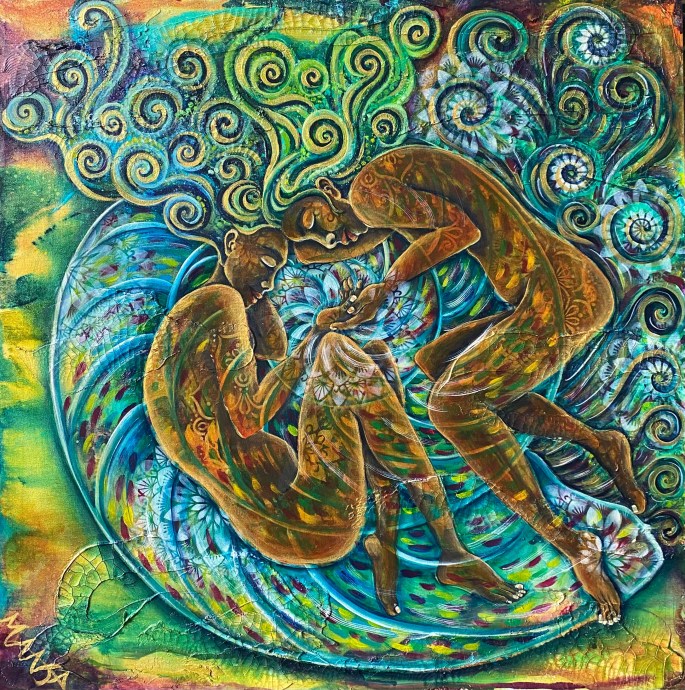
Above painting by Maasa: “As Within, So Without” – Inspired by teachings of A Course in Miracles. “Love created me like itself.” When we offer love to fill the space between us, it ripples outward— received by all, for love recognizes only itself.


THE GIFT OF SAYING ‘YES’

Being in a position where I regularly faced mortality gave me the gift of valuing what has always been free, yet so easily overlooked. My devotion to love was mostly reserved for my immediate family, nature, and a few very special friends I could probably count on one hand. I’ve never considered myself a particularly social person. Truthfully, I’d much rather hunker down at home—where all my needs are met—than seek out company.

But that part of me has shifted. I’ve come to deeply value what can unfold when I choose to connect and leave space for something new to reveal itself. So when I received an invitation to my cousin’s wedding—a cousin I hadn’t seen in years—I said yes. Even though the timing wasn’t ideal and the airfare would be costly, I recognized it as an opportunity to reconnect with extended family and chose to go.

The matriarchs of our clan—as we fondly call ourselves, being descendants of Scots—are now in their mid-80s and 90s. It’s a rare and precious occasion for all of us to be together, and who knows if there will be another opportunity to connect and celebrate in this way again.

I had once travelled through India with the cousin who now, at 61, was preparing to be married. After being a bachelor for most of his life, it felt like a miracle that he had found his greatest love. I knew I needed to be there—not just for him, but for myself. This precious life is meant to be shared, and my experience has taught me that it’s always worth making the initial effort to connect with others. The gift we give by showing up is also the gift we receive.

It’s been nearly six years since Lump came to mentor me. In that time, I thought I understood so much—yet ultimately, I still understood very little. I’d like to think I’m now closer to gaining a deeper understanding of the biggest question. That question has shifted—from asking why I got cancer to a deeper devotion to how I can stay on a path of love in a world that seems to be growing more loveless by the minute.

How can I nurture connection in a world so divided?
How do I discern whether I’m being guided by an intelligence that knows what’s best for me, rather than the voice in my head that simply wants to be right?

This is how I’ve been gauging my healing: by observing the thoughts that occupy my mind, and by my willingness to examine what’s dominating my mental space—and change it if it’s not in alignment with how I ultimately want to live.

I was at the airport on my way to the wedding when I ran into a friend I’d been thinking about. I had even considered reaching out after hearing she was going through a health crisis. But, like it happens for so many of us, I put it on the back burner—letting other things take priority over the persistent nudge I kept feeling.

The truth is, I was afraid. I was scared of how unwell she might be, and I didn’t want to face it—because it would stir up my own insecurities about my health. Then guilt would follow the avoidance, and denial would mask the act of looking away. This is the typical pattern of our default survival mechanism—and even as I become more aware of it, it still takes conscious effort to break the cycle.

The moment I saw her, I recognized it as my chance for a do-over. But the airport was busy—she was heading outside just as I was going in. I genuinely wanted to connect and told her she’d been on my mind. I could feel the moment slipping away, so I said, “Let’s talk in the waiting room once we’re through security.” There was only one flight into the city, so I knew we’d be on the same plane.

She agreed, and I went in first to clear security. The waiting room was packed, but I managed to find a seat with an open one beside it. I saved it for her, holding onto the hope that we’d get a chance to catch up.

The woman beside me started chatting with me. I’ve come to learn, through A Course in Miracles, that any encounter holds the potential to be a holy encounter—a moment where the barriers between two people dissolve. It is through these connections that we can begin to heal ourselves, each other, and ultimately the world. So I chose to be present and engage with her, even as my eyes continued to scan the room, hoping to spot my friend.

Our conversation came to a natural pause when the woman beside me turned her attention to her phone. I took it as a sign to look for my friend again. I thought about leaving my things on my seat to walk around the waiting room in hopes of finding her—but I noticed an almost anxious energy rising in me as I stood. I sat back down.

That’s when I heard a clear voice in my mind say, “Don’t worry, you’ll sit next to her on the plane.”
What? I responded internally.
Then came the doubt: “Here you go again, thinking you’re hearing the Holy Spirit. You’re just making it up.”
And then—quiet, steady—“You’ll find out. Now let it go.”

So I did. I let it go, sat back in my seat, and relaxed until it was time to board the flight.

I used to always strive to be early, driven by the stress of wanting to get ahead of everyone to save time. But knowing better now, I stayed in my seat until most people had boarded. Just as I leisurely made my way to the line, I spotted my friend doing the same from across the room.

There you are! I said. Too bad we only have a few minutes to catch up while we’re in line.

I asked about her health, and she gave me the shortest version as she pulled out her passport with the boarding pass tucked inside. My eyes caught sight of the seat number peeking out, and suddenly my heart burst open—tears welled up in my eyes.

As soon as the boarding agent cleared us through, I poured my heart out to my friend about how much it meant to me that I’d received the message we’d be sitting together. I didn’t hold back—she was the kind of person who would understand. In fact, she too had been gaining a similar understanding. As she put it, “We are not the ones in charge.”

It wasn’t just that the message turned out to be true. It was the confirmation I needed—that the way I’ve been learning to step aside, to get out of my own way and seek guidance in my healing journey—is the right way. The only way for me. Because the truth is, I’m never making these decisions alone.

We were both given the gift of a full hour sitting side by side, sharing our stories and the lessons we’d each gathered along our healing journeys—each echoing the same truth, spoken in our own way. There was a deep joy in realizing that we are waking up together—in ways we may not fully understand, but with a quiet faith that something we are seeking is unfolding. And I do believe it’s happening on a collective level.

The crazier the world seems to become, the more I sense a quieter, steadier voice within us all—beckoning us to choose again. To choose alignment with peace. With love. To remember that there is always another way to see—one that brings us closer to wholeness, and closer to each other, no matter who we seem to be on the outside.

The great clan gathering at my cousin’s wedding was the most love-filled icing on the cake. I had many heart-to-heart conversations that affirmed something we all seemed to know deep down: that love is the only answer to help us through the mess of the world. Attacking and dividing only create more of the same. The wise matriarchs of our clan radiated joy, wisdom, and steadfast love—and inspired me to age with that same kind of grace.

My heart swelled seeing my beloved cousin so deeply in love, so alive with excitement to begin this chapter with his bride. My two brothers were there, and I couldn’t help but feel proud to be their sister—two kind, thoughtful, and hard-working men who carry strong family values. I spent precious time with my three cousins, each of whom I’ve shared meaningful chapters of life with, and my favourite witchy aunties—shining gems and radiant examples of joyful, spiritually-rooted living. As an added joy, my beloved friend—and friend of the family—arrived in perfect timing, lighting up the gathering with her bright, beautiful presence.

There was so much love in that intimate gathering, and I silently thanked the Holy Spirit for guiding me there—to receive gifts meant not only for me, but for all of us.


NOW WHAT?

The acute phase of survival has since passed, and in its place, a gap has opened—space that wants to be filled. I feel the aftershock in residual tremors, my footing seeks traction in the space ahead. Now, life back to somewhat normal pulls me into the trap of restlessness—as if I need to make up for what I’ve been through by becoming someone of more value.

It’s ridiculous, but even after all this, it still comes to get me. I’m still getting duped by the habit of assigning value to what I do, instead of resting in the quiet grace of all that’s been given to me. Even as my intellect understands that I’m already at home base, the self I’ve constructed keeps me running—from the perfection of how I was created.

I feel the pressure to do something significant in return for the extension of my life. I thought I was done with the rhetoric of that harsh inner voice—the one that drives me to do more, to be better. But ego is loud, convincing, and insistent—sending me out in search, while I forget that I’ve already been claimed by an inherent happiness that asks for nothing in return.

Cancer takes up so much space—not just as an all-encompassing distraction, but as something that gave meaning through the effort to survive. The biological malfunction that became my greatest challenge also cracked me open, allowing light to come in. Now that I have a relationship with that light, I’m on alert for what blocks its shine.

I feel the tension of knowing that my scramble for purpose is rooted in fear—the fear that if I don’t fill the gap with what I make of myself, the disease might return and do it for me. So the focus shifts to the next problem—whether it’s the volatile state of the world, the financial pressure we’re all facing, or the endless causes I feel helpless to do anything about. It’s all an outward projection of the same thing: I’m still trying to fix it from the outside, instead of settling back in.

As I sit here after my quiet morning contemplation, I’m reminded that ego will have me seek but will make sure I never find. It distracts me with a sense of urgency to do something, anything for an illusion of a fix of what can’t be fixed from the same level where the problem was created.

I’m finally free of that horrendous pain that once felt like it would never end. But the gift of coming out of it is so easily forgotten as I latched onto the next mountain to climb.

The unsettling sense that I needed to do something should have been my cue to pause and examine the root of that urgency. Instead, I convinced myself that I could be of value by helping my husband, a developer, and jumped into a path entirely outside my norm—just as I was beginning to come up for air. The idea felt so far removed from my usual operating system that I mistook it for clear guidance. So I enrolled in a university-level course to become a licensed realtor, with the intention of selling the units he built.

It only took ten days of misery—battling my brain to retain information I had no desire to keep—before I could admit I’d made a mistake. The choice came from fear of the open space that was actually meant for my happiness. I’m still on the mend, still receiving ongoing treatment, and still hold my breath when I click open my blood test results every three weeks. My gratitude for my health had been misplaced in what I could do with it instead of simply basking in it.

I’m of value because I’m still here, doing my best to live and share what I’m learning. Even though I don’t fully understand how, I trust I’m doing my part for the healing of the collective. This is what I return to when I find myself spinning out of orbit. To come back home to happiness and shine out.

It’s important to mention that much of what I write is inspired by my ongoing study of A Course in Miracles. That said, studying it doesn’t mean I fully understand it. It continues to meet me exactly where I am, gently guiding me to live to love.

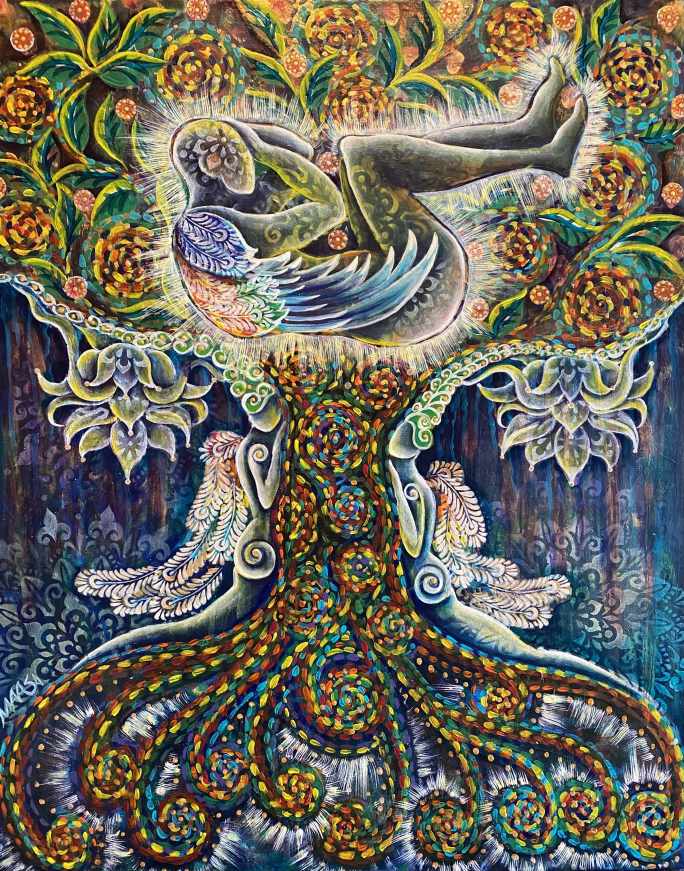
Above painting by maasa.ca

LIFE IN PRESENT TENSE

I regretted asking the moment the doctor responded. Until today, I had never inquired about my official diagnosis. Did it not matter to me because I’m focused on the work to get better, or did I simply not want to know? ‘It’s stage four,’ she said. She didn’t have to finish with an extended explanation and we both knew it. My stomach dropped as her words instantly filled the hollow in my gut. Though I knew this to be true, it had been tucked away in a no-access zone, hidden out of sight and out of mind.

My coping mechanism oscillates between faith and denial, with only a thin veil separating the two. I’m learning that adversity is an invitation to awaken to my response to life. Struggles only arise when I compare myself to my past self or when I’m overwhelmed by what might happen to me in the future. Both tendencies make me miss what’s possible now.

I was fine until I asked. I even impressed myself with my ability to detect the early stage of another staph infection, which was the reason I was sitting in the doctor’s office in the first place. Instead of being upset about another recurrence only a couple of weeks after the last, I chose to be grateful that I caught it early this time instead of landing in the ER again. Instead of resisting another round of antibiotics, I accepted what needed to be done given the circumstance. I showed her my breast, and she noted how much better it looked, confirming how I felt. But everything changed when I was put into a category.

The power of two words spoken aloud by someone else instantly created a different reality. It contradicted the feedback from my body, which suggested that despite the expected side effects, the treatment is working. I recognized my visceral reaction, which prompted a sudden shift in my state. The chill that ran through me seemed to extend into the future, yet it felt like just one of many potential versions, too elusive to keep me in a state of panic. My wise friend reminded me that a diagnosis is not a prognosis. With this reassurance, I return to the baseline of what I know to be true in this moment, focusing on all that is well within me rather than fearing what could go wrong.

I continue to meet myself as life unfolds before me. Today, I was granted the grace to observe my reaction and respond in a manner that felt more authentic than succumbing to the abyss of ‘what ifs.’ I became aware that I attributed meaning to those words based on conditioning that was not mine and not based on where I’m at now. There is no future, only now and now and now.

With the residue of Doc’s words still echoing in my mind, I drove home, recognizing the weight inside me. I allowed myself the catharsis of tears to release it. Seeking solace in the forest, I clung onto a sturdy tree. Shinrin-Yoku, the Japanese practice of forest bathing, has continually brought me home to myself. Amidst the trees, I felt the cleansing stillness wash away what was not serving me. Anchored in the solid embrace of a cedar, I calibrated to its unwavering presence. My senses opened to the palpable calm around me as I slowly exhaled.

I asked myself: ‘What is true in this very moment?’ The answer came with ease: ‘I’m safe, I’m okay, I am not in imminent danger.’ Such certainty is only available in present tense.

I’m aware that my grievances stem from reaching towards life without cancer, from being free from interruptions of symptoms, and from having limitations. Yet, my quest for purpose is unfolding in the present. This is my purpose—to find a way to meet myself as I am and find ease in the midst. There is always a choice to accept or resist. The gift lies in having a choice, even when it may not feel readily available. It’s okay to shake and shudder until the moment leads to something else. It always does.

Each moment serves as a meeting place for the full gradation of possibilities of how I can engage with my life. It’s a beautiful life, filled with the diverse shades of the human experience. To be asleep to it, lost in denial, is to miss the essence of my purpose. This, perhaps, is the most profound lesson showing me the way to liberation in any given moment. .