
I’m convinced that open-mindedness is the ticket to an alternative experience. The only way through an obstacle is to realise that a problem is only a problem because of the meaning we have assigned to it. My decision to choose chemotherapy as my medicine meant believing in it fully, getting behind my choice 100%. The alchemy lives in the power of decision and choosing to trust the path regardless of where it may lead. How we respond to life is the only true power we possess. I keep coming back to the clarity of that yes I felt. That is all I have to go on. No external forces persuaded nor forced me into that yes. It is that effortless yielding that I trust.
I remember the exact moment my trauma of chemo shocked through me. My beloved friend whom I sat with as she chose to die to end her cancer, was terrified of chemotherapy. I remember her telling me that her system was sensitive and that she just knew she would be the one it would affect the worst. She faced her fears, did it anyway and she was right.
She called me from the hospital, convinced chemo would kill her. I held her sobbing, shaking body as her terror filled me up. All we could do was hold onto each other, and in that moment of helplessness, my conviction that chemo was evil solidified. I swore to myself that I would find another way to heal without injecting poison into my body. I would never enter the dreaded chemo room and hook myself up to something that intentionally made people sick.
My healing journey has given me the opportunity to truly examine how belief systems I’d created could pigeonhole me, how my determination and stubbornness could render me deaf to guidance that was gently showing me another way. Time and time again, I have experienced grace when I loosen my grip on what I think I know. When I collide with fear, it is the fear itself that needs to be questioned. What is its source and what have I given power to? I’ve come to trust that light will enter when I open my mind to let it in.
I am learning to become like the Fool in the tarot deck. He is zero, belonging to no sequence. A nothing with everything, standing at the edge of a cliff with gleeful conviction, about to step into what cannot be seen. He continues on his path carrying almost nothing, even as his next step appears foreboding to everyone but him. His heart remains open to the journey. He holds a white rose between his fingers — a symbol of the innocence, purity, and beauty with which he moves through the world, unconcerned. He is not alone. His loyal companion, the white dog, trusts him completely. Animal instinct senses no danger abound, only the joy of following a friend. To release what I think I know is to fall off the cliff and believe I will land in grace.
When I eventually reached the point of finding myself in the chemo lounge last year, hooked up to multiple clear bags, I was able to accept it because it wasn’t chemo. It was a manageable step, knowing that what was going into me was not poison, but a blocker meant to stop feeding my cancer cells. I used that time in the chair to write and to re-frame it as my creative space.
Through monthly visits over the year, surrounded by genuine, caring nurses I came to know by name, the act of returning again and again to that green vinyl chair transmuted what I had once perceived as a hell space into a place of unexpected communion. I bless my liquid medicine bags with my willingness to let it be just that. I learned how to receive love from the most unexpected of places and also how to share it — through quiet conversation, a warm smile, or shared understanding with others finding their own way back toward wholeness. It no longer represented an electric chair, but a throne I sat on willingly.
There were two yew trees we needed to uproot on our property. Their roots would eventually infiltrate the foundation of our home. I am not a green thumb by any means; my approach is to plant something, give it the bare basics, and let the rest be up to the plants and trees to survive if they are meant to live with us. It felt wrong to dig up those young yew trees and dump them in the forest. My husband drove up the mini excavator to dig a couple of holes on the side of the mountainous hill, to stick them back in the ground and give them a fighting chance.
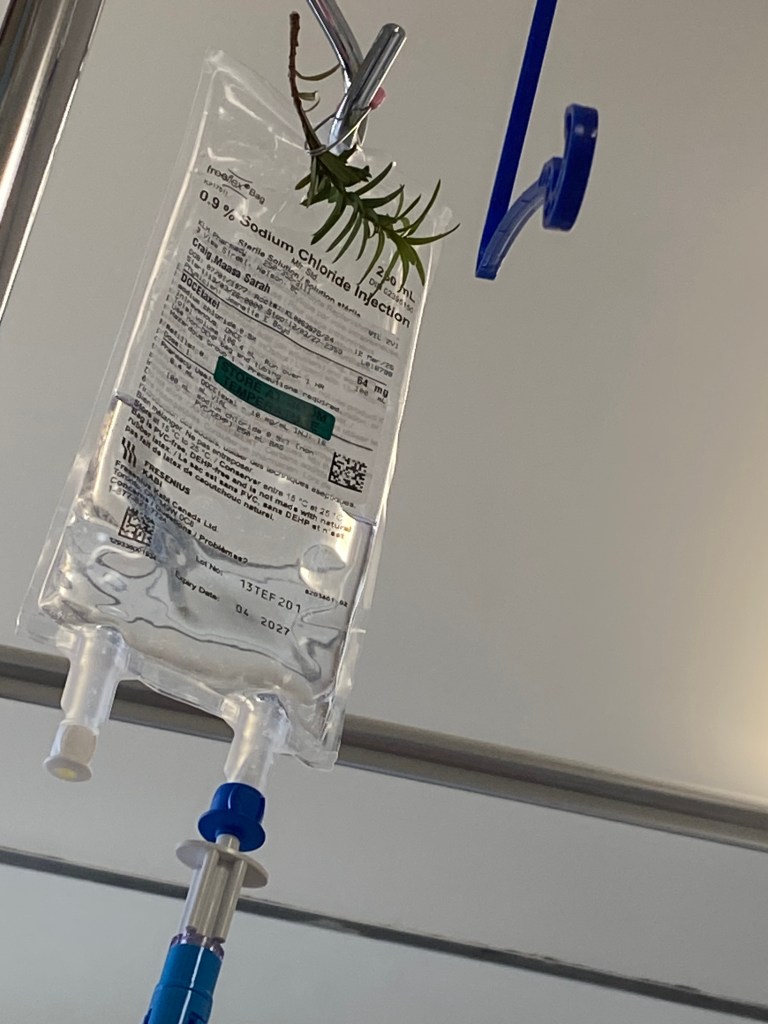
They not only survived, but made an ally of the unforgiving, hardened incline of earth and even grew. They look a little haggard, yet seem rooted to stay. On the morning of my first chemo round, I went to visit the trees. I wrapped my hand around a still-spindly trunk and held on tight, praying that their resilient spirit would enter me and ignite harmony and order — guiding my rogue cells to remember their original design, to forget what they had become, and to rejoin the remarkable synergy of the healthy cells around them. I asked permission to take a small needle branch with me, prayed over it, and tied it to my chemo bag. I sank into the chair and accepted the yew medicine, straight from Mother Earth and into me with welcome gratitude.
The yew tree is among the oldest and most resilient trees on Earth, having stood the test of time. Indigenous peoples have used yew medicine for pain and healing long before modern science isolated and studied its medicinal compounds. This extraordinary tree is a manifestation of holding paradox as its innate intelligence: it is one of the most toxic trees on Earth, producing poisons that can kill in its needles, bark, and seed- yet it is that very poison, alchemised into medicine, that has allowed it to exist for thousands of years, even through radical environmental changes and threats. The poison is what keeps pests, fungi, and disease from infiltrating its growth and survival.
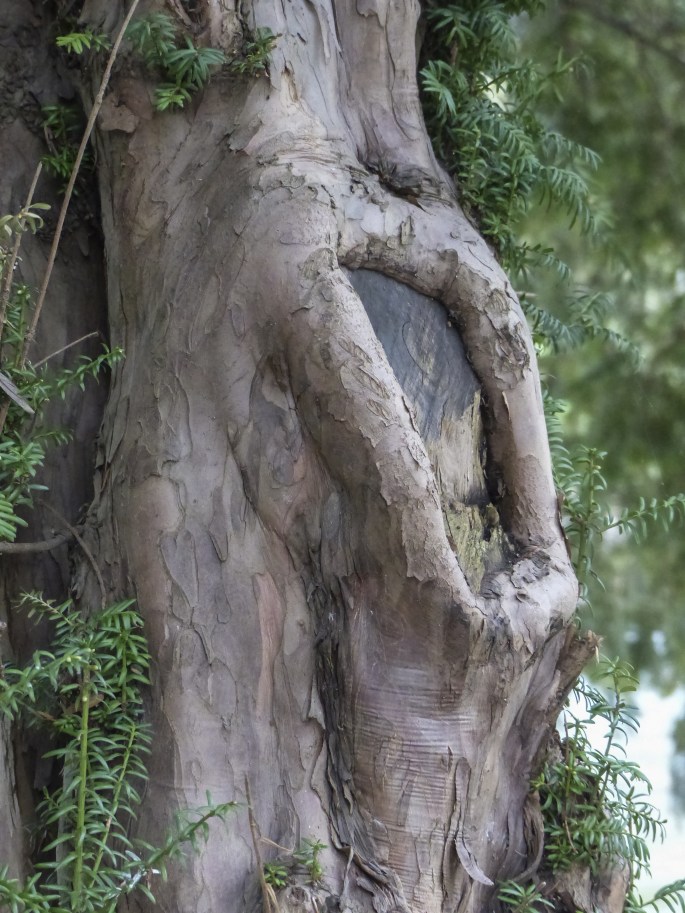
As the yew grows older, its centre becomes hollow. The heartwood rots away, yet the branches continue to be nourished and thrive. This is a powerful symbol of emptying out, of letting go in order to become stronger. Like my tumour, which needed to rot away as a process of survival.
In Druid and Celtic traditions, yews were often planted in graveyards not as symbols of death, but as guardians of transformation. Like the hollow within the tree, the parts of ourselves that decay create space for renewal. New growth emerges, making way for what continues on, where the death of one part of us becomes the beginning of the next.
The same toxins extracted from the needles of the European yew tree that ensure the long-standing survival of these ancient trees now enter through my vein. At the cellular level, their intelligence interrupts the rapid, relentless, chaotic division of egoic cancer cells. It halts the process of division, preventing them from replication and dominion over me.
Docetaxel is a medicine best known for its success with various types of breast cancer, with predictable, well-established results since the 1990s. At a cellular level, it carries the yew tree’s wisdom directly into the human body to bring order into chaos.
If it weren’t for my open-minded approach to accepting this as my medicine, I wouldn’t have given an iota of attention to researching what it was made of or what it did. I had invested years in this healing journey, researching countless alternative ways around conventional treatments. My determination was stubborn and strong, and it fuelled my spirit to walk the road less travelled. It empowered me and taught me a great deal, but looking back, I had bet everything on being right.
My powerful drive to avoid chemo at all costs led me through the darkest phase, one that came with excruciating pain and required me to mask the quiet terror brewing beneath my outer confidence. Going through that equipped me with the strength to get through just about anything. But now I know I don’t have to work so hard to be strong, because that strength is already inherent within me and I don’t need to fight for it. It comes from being the fool who follows the Holy Spirit in the freedom of admitting that I really don’t know anything.
I had made a giant stride by giving the infusion lounge a new meaning. Now the time feels ripe for my trauma around chemo to be healed, not just for myself, but for my sister too. Maybe as I accept this as my medicine, the utter helplessness I felt watching her can finally be hollowed out and released. In that way, we can both alchemize our fears into peace, and perhaps it reaches further backwards and forwards in time and space to help others too.
As I sit here writing this, it has been 3 weeks since my initial dose, potentially the first of eight. I’m due for the next one this week. When the initial yes to proceed with treatment came, it arrived with another clear message: begin with a half dose. This was confirmed by an oracle card my friend pulled for me, my heart welled up with gratitude for that guidance.
Often, these strong medicines are given at the highest standard dose and adjusted only if side effects become intolerable. I suppose even with my yes, there’s a bit of wiggle room, and that feels just right. I brought the idea to my oncologist, proposing three rounds at half dose followed by a PET scan to assess whether it was working. She agreed. When healthy cells are caught in the crossfire, it matters to know the treatment is actually effective, and even at half dose, we should see measurable change. Easing in gently felt like the right way to honour a yes I had resisted for so many years.
I don’t know whether it was the shift in my mind, beginner’s luck, or the yew alchemy working synergistically with my system, but I have managed to carry on with my life these past week. I’ve even gone as far as believing the yew medicine has gifted me its superpower, giving me extra energy not only to heal, but to continue with my workouts and massage practice. Thankfully, the roots of my hair follicles are still hanging on tight — although after all this, what I struggle with most is the impending possibility of losing my thick, wild, and curly hair after I finally got it back. I tend to my humanness while reminding myself that ultimately, I am not my body.
The most notable disruption has been digestive. When I mentioned having to run to the bathroom numerous times to a friend who had also been through chemo, she laughed and said, “Oh yeah, never trust a fart when you’re on chemo.” She saved me that day. I had felt the heebie-jeebies creeping in — dark thoughts about my mortality infiltrating, arriving alongside a more noticeable increase in pain around all the sites the PET scan had flagged for cancer activity.
I have been diligent about watching my mind, warding off frightening thoughts by meeting them with more powerful, eternal, and unchanging ones. Sometimes it takes a great deal of convincing and determination to make those thoughts stick. But that is the practice, and that is my life. It is one thing to hold a belief intellectually. The act of alchemising belief into something that can uphold us asks that we stay in the light even when darkness approaches. To keep looking for it, to tend to it even when it is barely a flicker, and even when it goes out entirely, to trust that somewhere beneath all the woes of the world, the light remains. And that is enough to get it lit again.




 LESSONS FROM MY LUMP