HUNGER AND HEALING

To celebrate the beginning of my 49th cycle and the new year, I gifted myself the opportunity to turn inward and honour my body with a cellular reset through a three-day water fast. I was intrigued by how fasting has been practiced across nearly every spiritual lineage as a means of quieting the mind and attuning beyond the physical. Only in recent times has scientific research begun to explore how fasting may also ignite the body’s innate capacity for self-healing.

The timing felt especially meaningful. The fast followed a wonderfully indulgent holiday in Mexico over the Christmas season, where I gave myself full permission to release my health routines. I spent my days taste-touring taco stands with my family, filling my belly late into the night, enjoying decadent desserts, savouring fresh, vibrant foods not in season or readily available in Canada, and even getting drunk on tequila—laughing and belting out classic Prince songs on the beach with old friends—all completely free of guilt. That conscious enjoyment, in itself, added to the richness of our holiday.

We returned home just in time for our annual New Year cleansing ritual in the frigid waters of Kootenay Lake. A large group of enthusiastic polar bear dippers gathered, many familiar faces from years past.

At the inception of this rather wild ritual over two decades ago, our bare feet stood on stacked snow, the cold biting fiercely at our gooseflesh. It took every ounce of courage to move once the go-time horn broke our frozen spell and ushered us forward. The first step into the grey, seemingly lifeless lake delivered a shock so sharp my breath and brain seized until I completed the task of dunking my entire body and head. Then, every ounce of energy that wasn’t frozen was sent to my extremities, motivating my rapid retreat back to shore.

I haven’t felt that kind of cold in years. Standing there on the first day of 2026, I couldn’t remember the last time there had been snow on the beach for this event. It was bloody cold, but a far tamer version of what I had experienced back before cancer marked me and before the effects of climate change became undeniable.

I reflected on how much can change in the short span of time, both in the world around me and within my body. Last year, on this very beach, facing the same lake at the same time, I stood with a singular prayer to live. Then, I was at the peak of survival—thin as a rack, my hairless head bare against the cold, my breast bandaged and sealed beneath layers of waterproof dressings to protect an oozing wound. My iron will to uphold our New Year ritual was stronger than how I felt. I refused to let the disease take away what made me me, even as I felt vulnerable, not only to the elements, but to how I might be perceived by others. And yet, my family held me up then, as they do now, ready to run together into a new year.

This year, I faced the lake vibrant and strong, crowned with a thick, unruly mass of wild curls, my bones supported by healthy muscles built through dedicated strength training. So much can change in just a year. I celebrated all of it, screaming in glee as I ran into the lake with my family. I emerged feeling purified, deeply connected to the life force that sustains me, and inspired to gallop forth into the year of the Fiery Horse.

I’ve been in a relationship with cancer for over six years now. Like any challenging relationship, it has been marked by trauma, conflict, and resistance. But time is a wonderful teacher, giving me the opportunity to choose another way and to recalibrate what it means to be in relationship. I’ve made peace with what I once wanted so badly to end, accepting that chasing the ending of things would have cost me the miracle of all that I have now. Over time, amplifying the gifts of the present is revealing a way forward that does not feel like sacrifice.

For the past few years, my focus has been primarily on my spiritual life, allowing it to guide me through the adversities I faced. Earlier in my diagnosis, I devoted myself to healing my body through strict and intense physical protocols that eventually proved unsustainable. Even though I aspired to be spiritually attuned, the core reason was to heal the malfunction of my body—to gain the knowledge to fix what was broken. Despite all that effort, I only became more confused. I overcompensated, doing so much for my body, yet Lump stayed and grew.

When things became especially difficult a couple of winters ago, I turned my attention and committed fully to nurturing my relationship with God. I had nowhere else to turn, so I invested in the highest order. I went all in, holding fast to the belief that true healing begins in the mind where God resides, and that as a result, may even ripple out into the body. It is a paradox to live in a body that can feel unreliable and vulnerable, yet its limitations inspire me to know myself beyond it.

As my birthday approached, I felt deep gratitude for my regained vitality and the abundance of love in my life. I’m convinced that love is the only medicine that works miracles, reciprocated in ways that seem to defy the laws of the world. I remind myself not to cling too tightly to anything but to honour balance: to tend to the body as the vessel that allows me to be here without letting it define my identity, and to care for it lovingly so it may remain an open conduit for what serves us all.

I received a wink from the universe in the fall when a woman at my gym insisted I read a book about fasting. I barely knew her, yet her conviction, paired with my own readiness to be guided by the Holy Spirit, urged me to listen. So I did. I bought Fast Like a Girl by Dr. Mindy Pelz and devoured the book.

Fasting itself was not new to me. I’d completed a month-long grape fast in response to a fresh diagnosis, an action I could take to give me a sense of control in a situation that felt completely out of my control. I understood fasting as a primal, natural phase of survival from the time of hunter-gatherers- a powerful state in which the body functions at its peak when food runs out and it is time to hunt. At the cellular level, when the body is not busy digesting, its innate ability to cleanse damaged and diseased cells becomes optimal.

My last MRI still showed remnants of the disease in my right breast. Eating to keep my hormones balanced, avoiding the sugars that cancer cells thrive on, and fasting to activate my body’s innate “superpower” didn’t feel like a sacrifice—it felt like an empowered way to keep my peace.

In the months I spent resetting my system using Dr. Mindy’s metabolic switching approach, I noticed an increase in energy and a return of my menstrual cycle to a steady 28-day rhythm, reminiscent of my younger years. Her research deeply resonated with me. The practice involves shifting the body’s primary energy source from glucose to ketones derived from healthy fats, while varying periods of eating and fasting to support the unique symphony of female hormones throughout our lunar cycle, even in seasons of life when we no longer bleed.

The keto diet that many claim is the best for fighting cancer never felt right for me, as it limits many of the nutrients and vitamins found in fruits and vegetables that feel integral to health. What was missing, I discovered, was not only what I ate, but when. Dr. Mindy’s ketobiotic approach prioritizes healthy fats, moderate protein, and low sugar intake, while drawing from macrobiotic traditions that honour seasonal foods, thoughtful preparation, and the body’s natural rhythms.

For women, intermittent fasting lengths shift depending on which hormones are predominant throughout our cycle. Longer fasts and ketobiotic foods are encouraged when sex hormones are at their lower points, during the first ten days of the menstrual cycle and again after ovulation. As hormones rise in between these phases, the focus turns to hormone-feasting foods that nourish the body with complex carbohydrates and fermented foods, while fasting windows are shortened.

Being part Japanese, I’ve had a complicated relationship with sugar, raised in a culture that lovingly celebrates refined carbohydrates like rice and noodles, which quickly convert to sugar in the body. In Japan, sweets also carry deep social meaning. Omiyage—the custom of gifting beautifully packaged treats—is a gesture of respect, gratitude, and care. These offerings are woven into daily life, making sugar not just a food, but a language of connection and appreciation.

It didn’t take long to not only metabolically switch, but to also shift my relationship with food with the understanding of how it would positively affect me. My brain fog began to lift, my energy blossomed, and knowing that I was caring for my body created more space to focus on what fuels my spirit.

Knowing what my body would be doing during days without food, as taught in Dr. Mindy’s work, helped me stay the course. I’d learned that fasting triggers the body’s repair mechanisms in stages. Around 16–18 hours without food, the body begins cellular cleanup and repair. By 24 hours, the gut benefits from a pause in digestion, creating favorable conditions to reduce harmful bacteria while supporting beneficial microbes and immune function. By roughly 36 hours, the body shifts more fully into fat-burning, drawing on stored sugar and fat that can accumulate around organs. Around 48 hours, dopamine pathways overstimulated by our instant-gratification culture move toward homeostasis—perhaps the restoration of balance holds clues to the rising prevalence of anxiety and depression. By 72 hours, stem cells may become more active, supporting regeneration and repair by responding to areas most in need of healing. This was where I aimed to arrive and offer my body the conditions in which it could express its innate intelligence and capacity to self-heal.

I didn’t use a glucose or ketone monitor, so I relied on paying attention to the signals my body gave me during the fast. In this way I felt like I was in a healthy relationship with it. Thirty-six hours in, on my birthday, I received a clear message to eat a small, intentional snack—one that wouldn’t break my fast. This willingness to listen and soften my iron will felt like another sign of healing. I became extremely lightheaded and shaky, and no amount of electrolytes seemed to help. Wanting to be fully present for the beautiful day planned at the hot springs with my family, I ate a tablespoon of almond butter.

The immediate sense of grounding I felt from that single spoonful revealed something profound: that even such a small amount, the right food at the right time, could entirely change the state of the body.

By the third day, close to the end of my fast, all I could think about was what I’d eat. Dr. Mindy stressed the importance of breaking the fast in stages- to take it slowly, intentionally and gently, to transition back into eating mode. Even though I could have scarfed down a three-course meal, I held back, patiently taking time to honour my body that felt charged from the experience.

I concluded my birthday with a deeply nurturing massage, during which I was visited by a friend who had passed on. Perhaps my fasted state allowed the veil between the physical world and infinite reality to join for that holy instant, or perhaps the trauma of loss, confusion, and regret stored in my body was finally ready to be released. I hadn’t realized it was still there; like remnants of disease that linger, emotional wounds can persist even when they are unconscious.

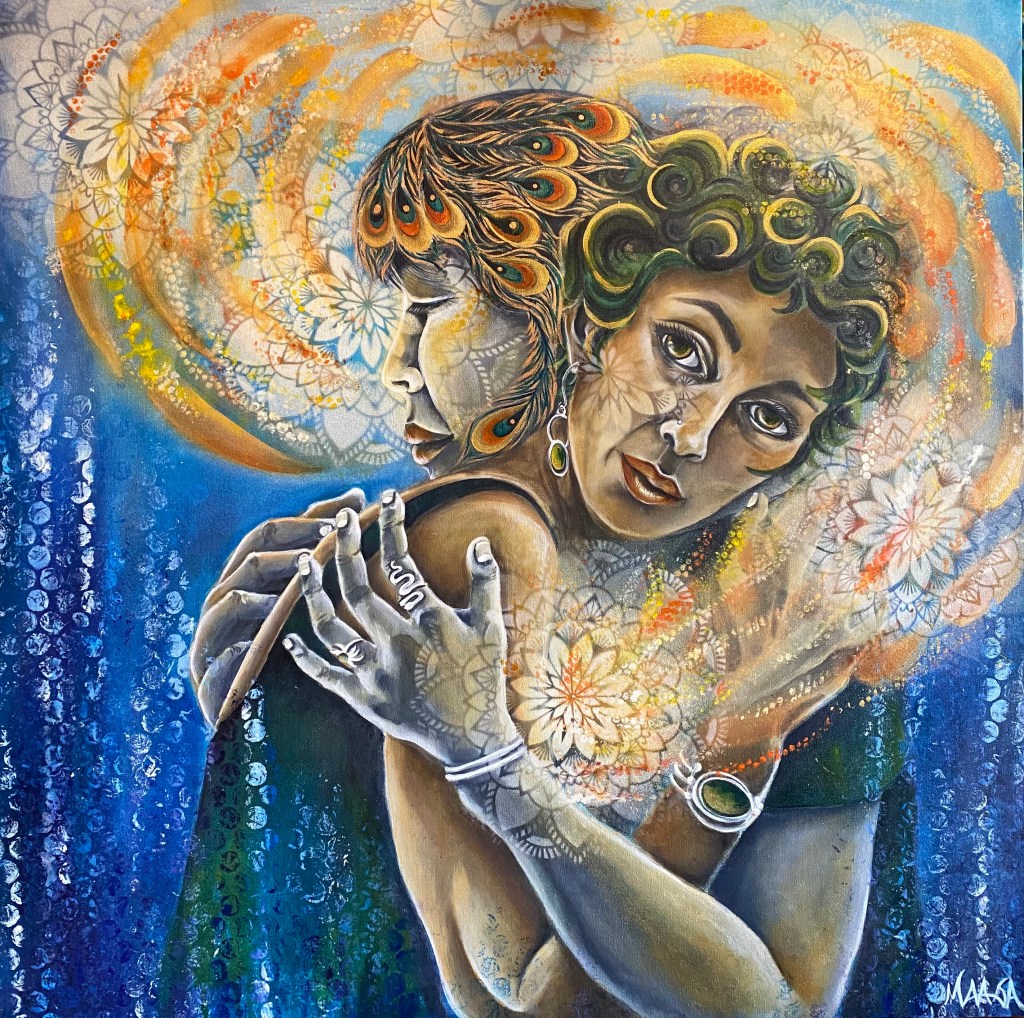
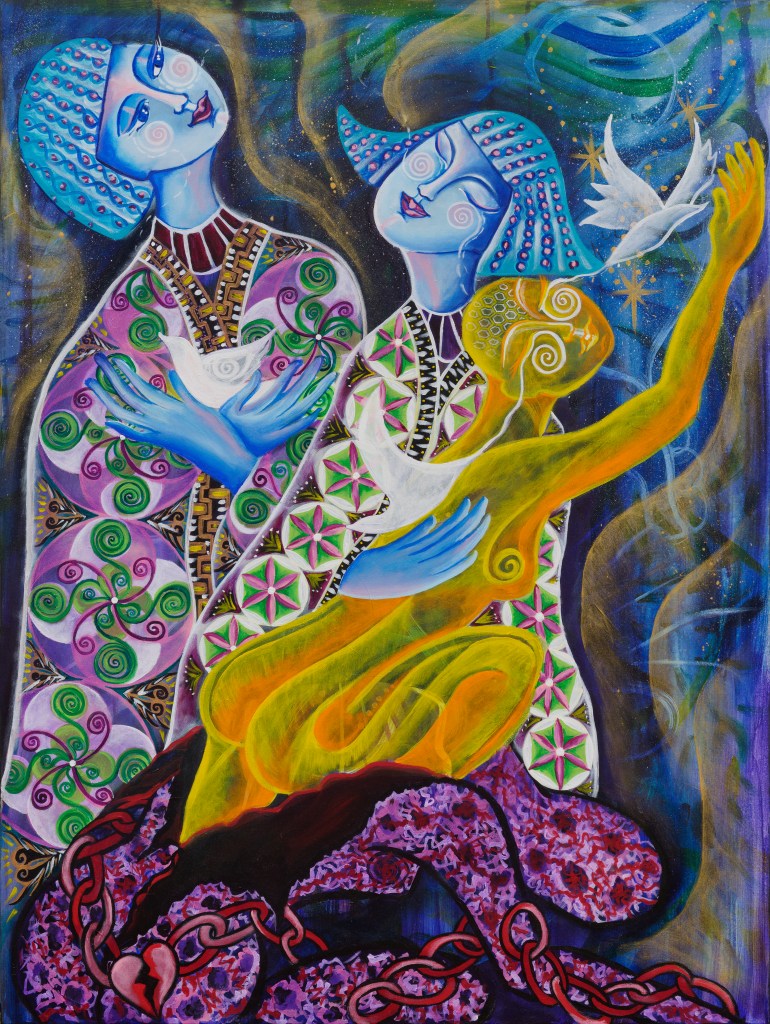
She had purchased an original painting of mine that I was ready to release, as it carried the weight of painful memories. I had titled the piece Transcendence. It depicted a woman leaving her broken body, liberated into her light body, and returning to her essential nature, guided by her ancestors. I was in the midst of completing this painting when I learned that a close friend, who had been on a similar healing journey with cancer, had been found dead alone in her apartment. The timing tethered the image to shock and grief, mingled with an eerie sense that I’d created some kind of visual premonition. What was meant to be a depiction of embracing our true identity became a constant reminder of the regret I carried for not checking in with her sooner. Grief likes to blame and point the finger, trying to convince you that you could have made a difference.

When the friend who later purchased the painting ended her life, the piece took on a darker presence in my psyche as the link to death and the fear of whatever lies beyond it. During the massage, she appeared in my field, imbued with a soft, luminous light. I instantly got the download that the reason she chose the painting was because it reflected her truth. It was an expression of herself unable to fully inhabit her earthly body and the longing to return to who she really is, which she is now.

In that moment, something within me released. A knotted vortex of suppressed emotion unwound, leaving me with understanding and compassion. What mattered was not whether the experience was real or imagined, born of a fasted state or a deeply nourishing massage, but that in receiving the gift of forgiveness, an old wound was healed on my birthday.

“Transcendence” – Acrylic on Canvas by maasa.ca

LIFE WITHOUT ANSWERS

I’ve been expecting the report from my most recent breast MRI to land in my inbox. I’m still in training—to receive these notes without letting them hijack my inner state. Reports that arrive like tarot cards, capable of projecting a future reality that contradicts the one I’m living.

My laptop rests on a tabletop made from massive slabs of hardwood, in a large tiled kitchen overlooking a garden of lush tropical plants that look as if they’re on steroids. We are halfway through our vacation in Mexico, escaping Nelson’s long winter in the laid-back village of Lo de Marcos. By now, we had acclimated to the unstructured rhythm where nothing happens in a hurry, and where the sun shines even on unwanted news.

I had requested a breast-specific MRI to give my body a break from medical imaging that uses radiation. I accepted that this meant traveling to a larger hospital in another town in order to have a look inside without that cost. There were two possible destinations, and one happened to be in the same city we would be flying out of for our trip to Mexico. The stars aligned. I booked the appointment for a Saturday—the day before we flew to Puerto Vallarta.

I decided to let it go. I wouldn’t give energy to anticipating the result until it was quite literally in my face, which is today. A deep meditation this morning left me with a quiet certainty: no matter what, I would continue on the path laid before me, guided by a way of interpreting my life that keeps me safe under all circumstances. I admit this is easier in the absence of pain or imminent danger, but experience has taught me it’s the only way forward without letting this disease take me hostage. I dropped my shoulders on the out-breath, repeated my A Course in Miracles lesson for the day, and clicked open the report.

The MRI confirmed what I already knew. It felt far-fetched to imagine a different outcome when I can still feel multiple lumps in my breast, embedded in scar tissue left behind by ulceration. Like barnacles clinging to the memory of my wound, they remind me of what I’ve been through—and that I’m still in it—even as my life continues to shine beyond it.

Any wish to one day receive the words cancer-free is no longer the destination of my path. Instead, I anchor myself to what fuels my soul and continue choosing the path that leads me toward peace now. Wishing does not belong in the present.

It makes sense to me that what was once a large mass, as my body broke it down, may have left small remnants scattered through the surrounding tissue. The scan also showed nearby lymph nodes in the right armpit that are likely involved. The left breast and its surrounding lymph nodes, which were affected not long ago, remain clear. I’m grateful there are no new frightening surprises, and that what miraculously disappeared on the left after the wound on the right closed has remained that way.

Given my history, the radiologist can only assume these scattered lesions are active cancer. Once labeled metastatic, that designation tends to stick, shaping future assumptions and forming the basis of treatment decisions. The only way to know for certain whether these current lumps are cancerous would be through biopsy. Because my cancer has mutated before, it’s possible I’m dealing with another variation. The familiar questions arise: Is my current treatment still effective? Do I undergo another biopsy? Would surgery even be an option? Would I have to consider a more aggressive treatment plan?

The analytical mind tries to navigate its way out of this maze, searching for certainty. But what I’m really seeking is higher ground—a vantage point that allows a wider view.

I haven’t thrown the baby out with the bathwater, per se. Years of learning about the disease process through German New Medicine, and experiencing its stages in my body in real time, have offered me an alternate way of understanding what my body might be doing. I hold this perspective as a lens—one that helps broaden my view and keeps fear from narrowing it.

In GNM, there isn’t a distinction between hormonal cancers and others, but rather an interpretation of how specific biological programs unfold through phases of conflict and repair. Much of what I came to understand was shaped through lived experience, recognizing patterns as they appeared in my own body. I only have my experience to reference. There is no right or wrong way—only the way I am no longer trying to dominate, especially since studying A Course in Miracles.

Because of that, I remind myself that decision-making has to come from a place not ruled by fear. I try to create enough space for difficult choices to settle, rather than forcing them into shape. That means listening beyond my conditioned thinking and first examining where the real conflict lies—always beginning in the mind.

What I’ve found is that when the way forward becomes clear, even if it isn’t what I wanted or expected, a sense of peace follows. There’s no pushing, nor being pushed. Instead, a quiet certainty settles in. I no longer hold many absolutes, except for the one thing that keeps me free in any situation—and that does not depend on my body.

I do not sense imminent danger. Quite the opposite. I feel vitally alive—nourished by sunshine, purified by the ocean, held by the abundance of love that surrounds me. What is yet to come has not arrived, and so I stay here, present, basking in the now. As the year closes, I recognize the same truth that has carried me along the river of life: let go, let God, and remember that nothing real can be threatened, and only love endures.

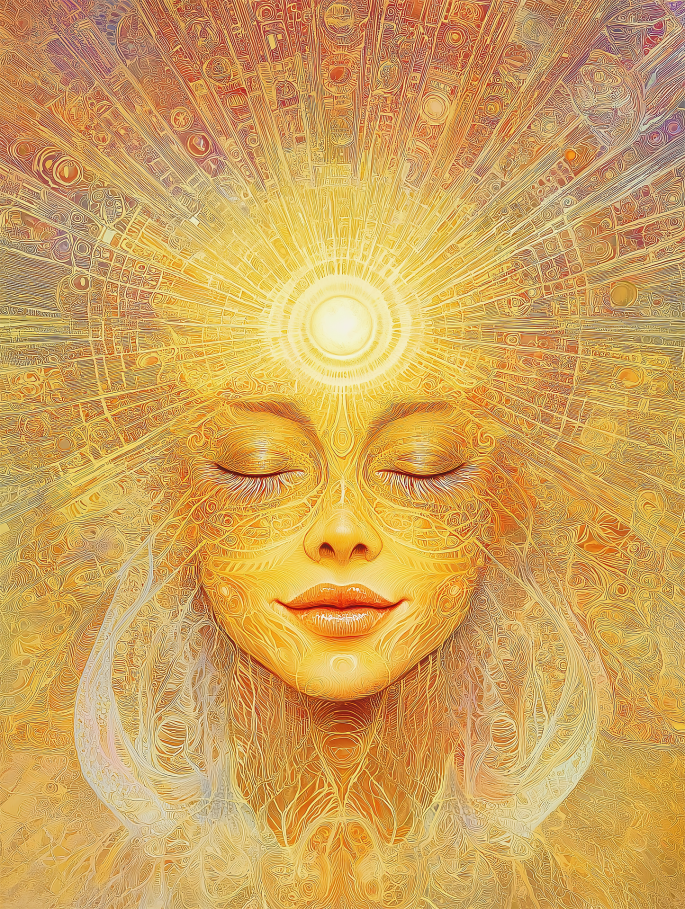
Above painting “Alchemy” by maasa.ca

THE GIFT OF SAYING ‘YES’

Being in a position where I regularly faced mortality gave me the gift of valuing what has always been free, yet so easily overlooked. My devotion to love was mostly reserved for my immediate family, nature, and a few very special friends I could probably count on one hand. I’ve never considered myself a particularly social person. Truthfully, I’d much rather hunker down at home—where all my needs are met—than seek out company.

But that part of me has shifted. I’ve come to deeply value what can unfold when I choose to connect and leave space for something new to reveal itself. So when I received an invitation to my cousin’s wedding—a cousin I hadn’t seen in years—I said yes. Even though the timing wasn’t ideal and the airfare would be costly, I recognized it as an opportunity to reconnect with extended family and chose to go.

The matriarchs of our clan—as we fondly call ourselves, being descendants of Scots—are now in their mid-80s and 90s. It’s a rare and precious occasion for all of us to be together, and who knows if there will be another opportunity to connect and celebrate in this way again.

I had once travelled through India with the cousin who now, at 61, was preparing to be married. After being a bachelor for most of his life, it felt like a miracle that he had found his greatest love. I knew I needed to be there—not just for him, but for myself. This precious life is meant to be shared, and my experience has taught me that it’s always worth making the initial effort to connect with others. The gift we give by showing up is also the gift we receive.

It’s been nearly six years since Lump came to mentor me. In that time, I thought I understood so much—yet ultimately, I still understood very little. I’d like to think I’m now closer to gaining a deeper understanding of the biggest question. That question has shifted—from asking why I got cancer to a deeper devotion to how I can stay on a path of love in a world that seems to be growing more loveless by the minute.

How can I nurture connection in a world so divided?
How do I discern whether I’m being guided by an intelligence that knows what’s best for me, rather than the voice in my head that simply wants to be right?

This is how I’ve been gauging my healing: by observing the thoughts that occupy my mind, and by my willingness to examine what’s dominating my mental space—and change it if it’s not in alignment with how I ultimately want to live.

I was at the airport on my way to the wedding when I ran into a friend I’d been thinking about. I had even considered reaching out after hearing she was going through a health crisis. But, like it happens for so many of us, I put it on the back burner—letting other things take priority over the persistent nudge I kept feeling.

The truth is, I was afraid. I was scared of how unwell she might be, and I didn’t want to face it—because it would stir up my own insecurities about my health. Then guilt would follow the avoidance, and denial would mask the act of looking away. This is the typical pattern of our default survival mechanism—and even as I become more aware of it, it still takes conscious effort to break the cycle.

The moment I saw her, I recognized it as my chance for a do-over. But the airport was busy—she was heading outside just as I was going in. I genuinely wanted to connect and told her she’d been on my mind. I could feel the moment slipping away, so I said, “Let’s talk in the waiting room once we’re through security.” There was only one flight into the city, so I knew we’d be on the same plane.

She agreed, and I went in first to clear security. The waiting room was packed, but I managed to find a seat with an open one beside it. I saved it for her, holding onto the hope that we’d get a chance to catch up.

The woman beside me started chatting with me. I’ve come to learn, through A Course in Miracles, that any encounter holds the potential to be a holy encounter—a moment where the barriers between two people dissolve. It is through these connections that we can begin to heal ourselves, each other, and ultimately the world. So I chose to be present and engage with her, even as my eyes continued to scan the room, hoping to spot my friend.

Our conversation came to a natural pause when the woman beside me turned her attention to her phone. I took it as a sign to look for my friend again. I thought about leaving my things on my seat to walk around the waiting room in hopes of finding her—but I noticed an almost anxious energy rising in me as I stood. I sat back down.

That’s when I heard a clear voice in my mind say, “Don’t worry, you’ll sit next to her on the plane.”
What? I responded internally.
Then came the doubt: “Here you go again, thinking you’re hearing the Holy Spirit. You’re just making it up.”
And then—quiet, steady—“You’ll find out. Now let it go.”

So I did. I let it go, sat back in my seat, and relaxed until it was time to board the flight.

I used to always strive to be early, driven by the stress of wanting to get ahead of everyone to save time. But knowing better now, I stayed in my seat until most people had boarded. Just as I leisurely made my way to the line, I spotted my friend doing the same from across the room.

There you are! I said. Too bad we only have a few minutes to catch up while we’re in line.

I asked about her health, and she gave me the shortest version as she pulled out her passport with the boarding pass tucked inside. My eyes caught sight of the seat number peeking out, and suddenly my heart burst open—tears welled up in my eyes.

As soon as the boarding agent cleared us through, I poured my heart out to my friend about how much it meant to me that I’d received the message we’d be sitting together. I didn’t hold back—she was the kind of person who would understand. In fact, she too had been gaining a similar understanding. As she put it, “We are not the ones in charge.”

It wasn’t just that the message turned out to be true. It was the confirmation I needed—that the way I’ve been learning to step aside, to get out of my own way and seek guidance in my healing journey—is the right way. The only way for me. Because the truth is, I’m never making these decisions alone.

We were both given the gift of a full hour sitting side by side, sharing our stories and the lessons we’d each gathered along our healing journeys—each echoing the same truth, spoken in our own way. There was a deep joy in realizing that we are waking up together—in ways we may not fully understand, but with a quiet faith that something we are seeking is unfolding. And I do believe it’s happening on a collective level.

The crazier the world seems to become, the more I sense a quieter, steadier voice within us all—beckoning us to choose again. To choose alignment with peace. With love. To remember that there is always another way to see—one that brings us closer to wholeness, and closer to each other, no matter who we seem to be on the outside.

The great clan gathering at my cousin’s wedding was the most love-filled icing on the cake. I had many heart-to-heart conversations that affirmed something we all seemed to know deep down: that love is the only answer to help us through the mess of the world. Attacking and dividing only create more of the same. The wise matriarchs of our clan radiated joy, wisdom, and steadfast love—and inspired me to age with that same kind of grace.

My heart swelled seeing my beloved cousin so deeply in love, so alive with excitement to begin this chapter with his bride. My two brothers were there, and I couldn’t help but feel proud to be their sister—two kind, thoughtful, and hard-working men who carry strong family values. I spent precious time with my three cousins, each of whom I’ve shared meaningful chapters of life with, and my favourite witchy aunties—shining gems and radiant examples of joyful, spiritually-rooted living. As an added joy, my beloved friend—and friend of the family—arrived in perfect timing, lighting up the gathering with her bright, beautiful presence.

There was so much love in that intimate gathering, and I silently thanked the Holy Spirit for guiding me there—to receive gifts meant not only for me, but for all of us.


ANGELS AMONG US

Mama loves to shop. What used to annoy me now brings me joy, as I’ve learned to nurture our relationship by appreciating what lights her up. Our closeness was forged in the volatile years when my cancer dominated our lives — years that taught us both to drop our armour and revealed the gift of holding each other in our vulnerability.

I finally feel that the gap between us is nearly closed — the gap that perhaps began the day I was cut out of her belly and taken away. The gap that widened during the three long days it took to return to the familiar sound of her heartbeat.

I used to yearn for her to hold me in a way that made me feel loved — not through the gifts she showered on me, but through presence. For a long time, love felt disguised in things. But now I know better. I understand that her love was always there, potent in its truth no matter how it was given.

I was happy to be on an outing in the next town over, where we planned to have lunch and visit Canadian Tire — a store that would satiate most of her shopping needs. Knowing her particular taste for good food, I chose a Thai restaurant that I knew would meet her high standards, hoping to nourish her well before setting her free in the aisles of that giant store.

She hadn’t had an episode of her debilitating stomach issue in months — the kind of attack that would double her over in pain and cold sweat. They were frightening to witness. Every time Da and I tried to convince her to get it checked out, she recovered soon after and brushed it off. Deep down, I knew something serious was going on. But I also knew I couldn’t force her to look inside — not when I was well aware of the scanxiety that comes with medical screenings.

I convinced myself the homemade probiotic yogurt I’d been making for her had healed her. Every week, I’d buy organic half-and-half, carefully heat it to pasteurize, then combine Lactobacillus reuteri and Lactobacillus casei Shirota — probiotic strains known for supporting gut health and promoting restful sleep. I fermented the mixture for thirty-six hours in the SousVide I’d invested in to make our medicine. Because of the heavy use of antibiotics I’d taken over time to treat chronic infections from my ulcerating tumor, I’d become susceptible to colitis. I was determined to heal my gut — which I did — and I truly thought Mama’s had healed too… until she ate that spring roll.

She took two bites and gave me that unmistakable “uh-oh” look, instinctively clutching her gut. A wave of foreboding settled into my own stomach. Not here, not now, I thought. Our red curry was still on its way, but even as I tried to distract her with conversation, we both knew it wouldn’t be wise to fuel more heat into her already-agitated system. I took a few bites and asked to have it packed to go while Mama visited the washroom for the second time.

“Maybe we should just go home,” I suggested.
“No, I’m fine,” she said, slowly getting to her feet.

The best medicine was only a few blocks away, where she could tick off everything on her shopping list. Torn between my fear and my better judgment, I decided to let her lead, trusting she knew what was best for her.

She leaned heavily on the shopping cart, pausing and wincing between aisles. Breathing through her pain, she still managed to find the best deals for what she was after. I was impressed, but I still feared that if she escalated to the level I’d witnessed before, we’d be in serious trouble. I rubbed the small of her back, feeling the heat radiating through her shirt, beads of sweat collecting at her brow.

We still had to pick up my car from the detailers yet another town over, which meant we wouldn’t be home for at least a couple more hours — including the stop we had planned at our favourite discount grocery store. She was adamant we stick to the plan, even as it became clear the digestive meds from the drugstore had done absolutely nothing.

Our ride home was cloaked in her quiet endurance, punctuated by sharp breaths over the bumpy roads. Da was already deep into teaching a four-hour seminar online by the time I got her home. I still had the morphine I’d relied on to manage my acute pain for so long, and we’d used this strategy before — a small dose had taken the edge off, and she’d usually be fine by the next day. I practically had to carry her to bed. After setting her up with a heating pad, I gave her the opiate. Let’s wait and see was our family’s go-to plan, always reluctant to face the ordeal of going to emergency.

I’d just settled back at home when my phone rang — Mama on the other end, asking if she could take another pill. Without hesitation, I got back into my car and drove the short distance to her house. I could hear Da’s voice, still presenting in Japanese, coming from the basement. He couldn’t have known that his wife was upstairs, grimacing against the pain that was stealing her breath away. The moment I saw her — her hair plastered to her sweaty, pale, crumpled face — I made the decision. “I’m taking you to emergency, now,” I said, switching to Japanese so she would really hear me. She did not have the strength to argue.

I’m convinced that angels were watching over us, especially after what Mama shared with me a few days later, following her emergency open surgery. Had I not taken her in that moment, had she not been seen quickly in the ER, had I not pushed for a CT scan so adamantly, we may have lost her. She had ruptured her intestinal lining due to an infection that even a strong dose of IV antibiotics couldn’t tame. A severe case of diverticulitis had her ambulanced to a bigger hospital where a surgeon was waiting to assess her.

The connection between thought, feeling, and experience became painfully clear as I battled my fear, clinging to the lessons I’d learned throughout my own healing journey. What was supposed to be a two-hour surgery was now stretching into four. What had the surgeon found once he opened her up? How bad was it? Could she die? My belief in the worst-case scenario truly tested my faith in what cannot be taken away.

I finally got the call I’d been waiting for.
“She’s out. She’s okay,” Da said.
“I’ll be there tomorrow morning,” I replied with a huge exhale.

The surgeon had told Da she could have died without the emergency operation. He’d removed a large section of her badly perforated sigmoid colon and attached a temporary ostomy bag. A long line of bulky staples was etched down her belly where the incision had been made.

When I saw her the next day, I knew — both in what I felt and what I saw — that she had touched something otherworldly.

“There are angels everywhere, Maasa,” she said.
“What? You can see them?” I asked.
“Yes. I can’t see their faces, but they’re like flowing, transparent curtains — and there are so many of them. They’re rushing to help the nurses, helping the people here.”

Her eyes glassed over with emotion as she spoke. “One of them came to me and whispered in my ear.”

She couldn’t understand what was said, but she was completely assured that everything — no matter what — would be okay. And then, she told me, Jichan and Bachan — her parents who had long since passed — came to let her know that there is nothing to fear on the other side. That they are all there — the ones who passed.

I’ve rarely seen my mother cry, but these were tears I recognized — the same kind I’d shed when I felt closest to God during my own brush with death. Goosebumps rose on my arms; I knew she was telling the truth.
“I also saw you with the angels,” she said. “But you weren’t transparent. You walked right by my room, looking for me, and I kept calling out to you.”

I hadn’t been to that hospital until then, but she accurately described the hat I’d worn the day before. I believe prayer can override the laws of the physical world. Somehow, as I clung to faith that my prayers were being heard, I had found my way to be close to Mama.

“Then the strangest thing happened,” she continued. “I found myself hanging upside down… among smoked kippers. And I was completely at peace.”

“Kippers? Like herring?” I asked, puzzled.

I didn’t connect the dots — until Da did. His father had spent much of his life working in a kipper smokehouse in Scotland. Mama felt his presence watching over her in that very place, as if he had come to reassure her himself — confirming what she’d already been told: there is nothing to fear beyond this life.

After a week in the hospital, Mama came home. She’d lost her voice from the tube that had helped her breathe during the long hours of surgery. It feels like she still has one foot in the world where angels abide. Something has shifted in her — a quiet certainty born of what she experienced, which only deepens the ground where I’ve placed my own faith.

MIRACLE SHIFT

“Your CT scan shows that you’ve responded exceptionally well to treatment,” my oncologist said excitedly over the phone. “There doesn’t appear to be any tumours in either breast although, It’s hard to assess the right one due to extensive scar tissue from the ulceration. What spread into your chest wall has receded, the thickening in your upper sternum is stable, and your lymph nodes look clear.”

I was surprised by how calmly I received the wonderful news—perhaps because it simply confirmed the profound shift I’ve been feeling lately.

Three months ago, my CT scan showed disease progression from my right breast into my chest wall, in the sternum, and in my lymph nodes. The tumor in my left breast was also evident. Due to my chronic infections, I was able to forgo the chemotherapy portion, which would have depleted my immune response, and instead gave my body the chance to fight back against the infections. With stage four metastatic breast cancer, the recommended treatment was aggressive. My unique situation gave me the chance to stumble upon a miracle.

After two targeted immunotherapy treatments with minimal side effects, all four of my tumor markers dropped below the normal range for the first time in five and a half years. I requested a CT scan after my third treatment, knowing I’d likely be recommended to add chemotherapy for the following round since my infections had cleared. I needed to know if my insides reflected how I was feeling—and they did! My doctors believe that the targeted immunotherapy was solely responsible for this miraculous turn of events. I have my own belief, which I attribute to a higher order I’d placed my bet on.

“I still advise you to do chemo and take advantage of this window to clear out whatever may be left of the cancer,” my oncologist continued. I’m incredibly grateful to have been matched with an oncologist who respects my decision-making process. For now, I declined the chemo, as my body is relishing the vitality that had been absent for so long. The thought of compromising my entire system, just as it was moving towards homeostasis, felt more like a risk than a benefit. However, I’m careful not to cling, as I need to remain open to pivot when necessary.

The only “barometer” I’ve put my faith in is the level of peace I feel in the choices I make. I’m talking about the kind of peace that can’t be manufactured for safety’s sake—the kind that is all-encompassing, a ‘yes!’ that I can fall into and feel held by. That’s what I felt after I declined chemo for my next round.

I’m learning that the only power worth giving is the Power I lovingly surrender to. Time and time again, I’ve been shown that when I do this, I’m being taken care of. I know when I’m not doing this because I feel a tightening around the reality I want to control. So, when I notice, I let go again and again, praying to be shown the way. The way has at times been scary, painful, confusing, and messy- it’s only from this vantage point that I can see the meaning in all of those experiences. This is what I need to trust as I keep following the way. This is what Da calls a miracle shift.

I hadn’t disclosed to my doctors the other ‘therapies’ I believe contributed to my ‘exceptional response.’ A fringe protocol, showing great promise as a cancer cure, came onto my radar last year. I began it as a last-ditch effort to make a difference on my own before seeking help from the conventional system. However, I didn’t use it long enough to give it a fair trial. The use of repurposed drugs—existing drugs originally developed for one condition but used to treat another—was gaining momentum and showing great promise for healing even the most aggressive and untreatable cancers.

The research I’ve done has given me enough confidence to test these therapies on myself, especially since, based on what I’ve gathered, they won’t interfere with the efficacy of my treatment and are relatively harmless. I’ve also been taking Artemisinin, derived from the sweet wormwood plant, often referred to as ‘herbal chemo’ due to its potent anticancer properties. Alongside this, I’ve maintained a steady regimen of herbal tinctures, teas, vitamins, high doses of anti-inflammatory supplements, and antioxidants to neutralize free radicals.

I also take time for my daily ritual of forest bathing and prioritize having meaningful, heartful connections. I can feel the power of the prayers from those who pray for me. I’m sure all of these have contributed significantly to my current state, but what I give the most credit to has nothing to do with what I put into my body.

My day begins with aligning my will with the greater will of God. It is only from this place that I can live fully and flourish, even with this disease. I need to recalibrate throughout the day because it’s so easy to get lost in our mortal predicament. So, I keep coming back, and I keep placing my faith in what I can never fully understand but can trust. I trust because I keep finding my way.

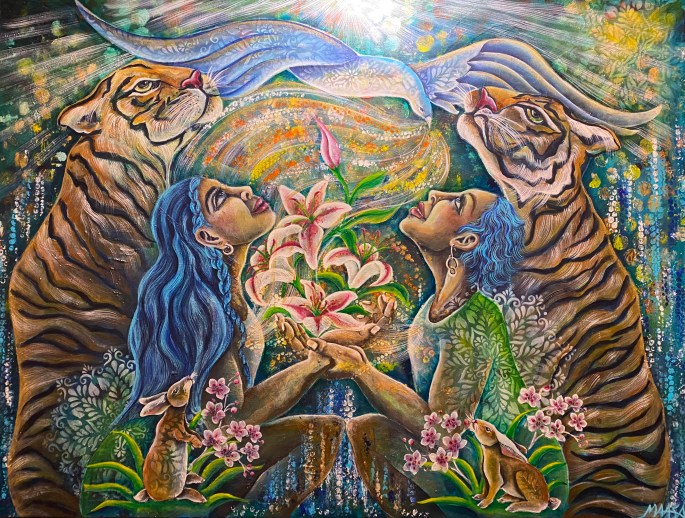
Banner painting “Of The Same” by Maasa. In the spirit of our Sameness, we celebrate what can’t be threatened or taken away. What we thought we forgot is redeemed in the remembrance that was never lost. More of my art mine may be seen @ http://www.maasa.ca

THE MIDDLE WAY

My first call to action upon waking on Mother’s Day was to reach over to my bedside table, gather the orange bottles of opiates, and put them away out of reach. It was a conscious decision to let go, a psychological statement that I didn’t need them anymore. I had relied on those pills to get me through intolerable nights of pain. As I placed them in a drawer in the bathroom, my sense of liberation from dependency was tinged with the fear of possibly needing them again.

I had strung together a few weeks, delighted by my capacity to accomplish what I could not fathom only a couple of months ago. I moved my parents into their new home, spending three full days proactively creating the next rendition of their sanctuary. I noticed that my pace in approaching life is much slower yet more meaningful, and with this approach, I managed to get more done in a day than when I used to run around like a headless chicken. Time bends when I’m synced in the moment.

My heart stalled in anticipation when the doctor called to discuss my most recent PET scan result. The test would indicate my biological response to the initial three months of treatment. I’ve noticed that I’m much more cautious about trusting my own experience now. Cancer has taught me that I am not the one in charge—that clinging to any rigid way of thinking or being will become a trap. In order to continue on this path, I must always leave room to pivot. If I cling too hard, I won’t be able to let go and flow with what is happening.

I had to repeat what she said to anchor the meaning. ‘One of my tumors shrunk by half?’ I asked. ‘Yes,’ she replied, ‘it looks as though you are responding well to treatment.’ She continued to explain that the spread in my sternum, pec, lymph nodes, and chest wall had all shrunk in varying degrees. Additionally, she noted that the numerous suspicious spots in my liver and lungs appear to be inactive. ‘We certainly have to keep an eye on your liver and lungs, but all in all, this is good news,’ she said. Beyond the positive news, I nestled into the relief that I could trust the signals my body was giving me. It’s as if I’m also healing the part of myself that feels like I don’t know anything anymore.

Finding the middle way in response to life has proved to be effective in navigating all this. In respect to who I am, it’s important to still have a ‘w’holistic approach with an eagle eye expansive view. I’ve followed the doctors’ advice to forgo supplements, herbs, and protocols that stimulate my immune system while I acclimate to treatment. However, these powerful drugs I’m taking have potentially concerning long-term side effects that I want to address. Now, it’s time to adopt a collaborative approach to assist healing while promoting longevity.

The master herbalist I connected with has decades of experience using herbs and medicinal foods as powerful allies in cancer care. When we spoke, I immediately felt a connection. We both agreed on the importance of supporting my immune response while fortifying the function of my organs. She will also be prescribing ‘herbal chemo’ to seek and destroy cancer cells. I particularly appreciated her collaborative approach and her knowledge of pharmaceutical drugs used in oncology treatments. She confirmed that I should absolutely stay on my current treatment plan and strengthen its effectiveness with her protocol.

It’s important to me to be transparent with my oncology team and to receive their support. My herbalist would need regular blood testing to ensure that the herbs are beneficial, a process that my doctors may or may not initiate. As I continue to embrace vulnerability and reach out for assistance when needed, I’ve been overwhelmed by the heartfelt support from those around me. I’m discovering that the more I allow myself to be seen authentically, help finds its way to me in one way or another. Now, I find myself surrounded by a diverse circle of powerful allies – from the experienced professionals guiding my treatment to the unwavering love and support of my family and friends, and to the One listening to my prayers and showing me the way.

After the liberty of pain-free days, the return of what feels like electric jellyfish shocks bouncing around my sternum and breast is a hard pill to swallow. While pain is never welcomed, my intuition tells me that the herbal protocol is working because it feels like the cancer cells are agitated and on the run. It feels like they are contracting and wanting to escape from inside of me. The inflamed, angry cherry on the contour of my breast has opened up, weeping blood and contributing to the burning pain. From the loss of my hair to my lopsided swollen boob with a protruded discharging lump, my ego has been kept well in check. My sense of humour remains intact.

In the spirit of the middle way, I’m leaning on the knowledge of German New Medicine as it now serves as a kind of safety net for me. I’ve learned that the healing phase in any tissue is usually painful, swollen, and messy, much like how a wound heals. Even emotional healing often precedes a messy and painful period. I’m straddling between what I think is happening and who the fuck knows, while conscious of how easy it is to fall into the dark territory of fear. So… I continue to pray. Instead of morphine pills to manage the discomfort, I’m drinking herbal poppy concoctions which takes the edge off and assists me into sleep without the nasty side effects. Currently, this plan is manageable as I ride out this wave.

The Middle Way forges a path between the known and unknown. The practice of finding neutral ground and doing whatever it takes to stay there. It’s about finding balance between what my spirit yearns for and what my body needs. It’s about appreciating my vitality without pushing it too far into expectation, and about not assuming anything while respecting change. Understanding that there is no ‘right’ way to do anything, only opportunities to respond to life without pushing it away or clinging too hard.