THE CONCEPT OF ME

Aren’t so many of us in search of meaning in our lives? Isn’t that quest ultimately driven by the age-old question, Who am I?

When we’re born, most of us don’t yet know who we are. As we move through life, we begin to fill that blank space with ideas shaped by our experiences and the people around us. We form an image of who we should be—one that reflects inherited beliefs about what makes us worthy, safe, and special. Over time, we find ourselves striving toward that image or resisting anything that threatens it.

Our sense of good and bad is shaped entirely by experience. Some of us are even taught to mold ourselves into someone else’s version of “good,” or to believe that what another person calls “bad” is actually right.

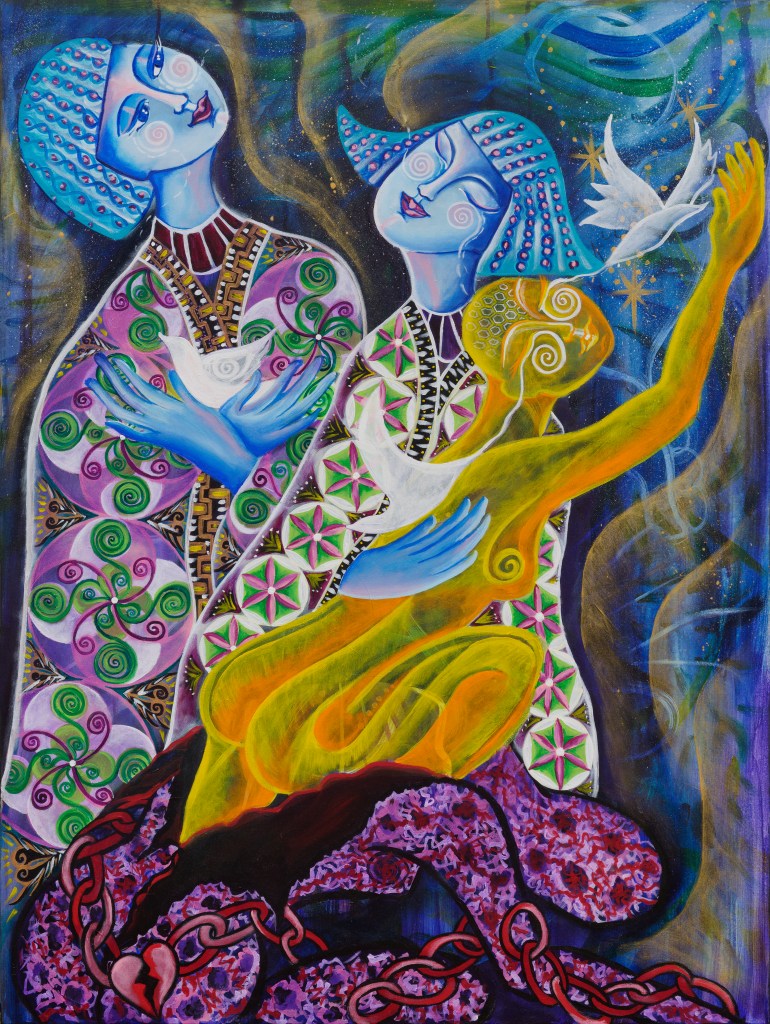
Being born can feel like beginning a painting on a blank canvas. At first, each brushstroke is our own, but as life unfolds, other hands begin touching the canvas—through influence, circumstance, and expectation. Eventually the shapes and colors morph into something foreign, something other than me.

So we keep painting, layering new strokes in search of meaning, hoping to finally create something magnificent. Yet the more we add, the more we forget what was there before the first stroke—the untouched space that quietly recognizes itself completely.

Perhaps our longing comes from that remembrance. In this way, the world becomes the practice ground—to learn to unlearn the belief that we must become something in order to find peace. We gently undo every version of ourselves we thought we needed, each one an avatar created for a different chapter of the dream. But who is the one dreaming the life lived through them?

It can feel mind-bending, especially when our senses insist that only matter is real. Yet suffering always arises at the borders of the self-concepts that make up the collective—the places where we divide and separate. When the little “i” of separation becomes the center of perception, we can’t fathom the all-inclusive reality of Love—a Love so abundant it breaks the laws of this world, where one’s gain must come at another’s loss. In the realm of the shared Self, what is given is also received, because the giving and receiving happen within the same One.

When I scrutinize what version of myself would finally make me happy, I see that I can never be truly satisfied, no matter what I overcome, do, or achieve. Fulfillment based on what my body does—or fails to do—is always temporary. I find myself asking: What are these values for? What version of myself am I protecting, and why am I so afraid of losing it? Perhaps it’s because I made it and it feels so precious.

The healthy self, the creative self, the strong self, the generous self—all exist beside their opposites, each quietly in conflict with the other. Life becomes a dance between these selves, each grasping at fleeting ideas of happiness and safety.

My state fluctuates with my mind. My vitality can be snatched away in an instant when old fears catch up with me in a single thought. Even when nothing around me has changed, the thought I don’t want this to change can take my healthy self hostage, seized by the one facing the formidable unknown.

These moments remind me, viscerally, that no version of my constructed self can protect me from impermanence. Peace can only be found through trust in divine law—the truth that we are already perfect, whole, and eternally safe as we were created, of the same essence, beyond any concept of ourselves we could imagine.

I can only begin to envision that everlasting beauty, and so I practice believing—trusting that what is real has never changed.

When I contemplate my true identity as a perfect creation untouched by what I think or do, I feel immense relief. Whatever I believe I am—or should be—has nothing to do with what I truly am. Beneath all layers of self-concept lies the original, unalterable holy Self, exactly as Love created me. This same unchanging Self lives in everyone, quietly waiting to be remembered. And because our minds are ultimately joined, remembering it in myself and choosing to recognize it in others helps reveal it in all. This is no easy feat, especially in the face of pain or injustice, nor does it turn me into a passive bystander to be tossed about. It does, however, give me the sense that I’m standing for something meaningful—something that points toward a freedom resting on stable ground.

Duality—the yin and yang of life—reflects the tension of opposites that governs this finite world. But what if duality was a choice we made with the first stroke on our canvas? What if we set in motion a painting meant to contain everything we thought we wanted, only to discover that no canvas could ever hold what we truly are?

And yet, beneath every shifting stroke, something changeless remains. The shared Self is untouched by striving, fear, or judgment. The world continues to teach and challenge us, but we can look beyond its rules for solutions—to step back, breathe, and question what is determining our state.

When the insanity and heartbreak of this world bring me to my knees, my practice is to return home—to divine reality—where our shared essence holds us, and peace is all there is.

Holding this paradox—the life we experience and the perfection of our true identity—is where I seek freedom. As we release the layers of self-concept that shift with every experience, we find steadier ground within. Each moment of awareness becomes an opportunity to return to that quiet, unchanging Self—the part of us that has never been lost. Even for an instant. And that instant can lengthen into the next, and the next.

Life is not about finishing the painting or capturing every detail perfectly. It is about remembering that the masterpiece already exists within us—the quiet assurance that nothing we do or fail to do can alter what is already complete.

This blog was inspired by my reflections on my weekly ACIM Essentials class, “A Case of Mistaken Identity,” taught by Robert and Emily Perry at the Circle of Atonement. They have a vast selection of podcasts exploring A Course In Miracles here https://circleofa.org/podcast/

GOD’S GUARANTEE

I was searching for God in my dream last night. Where are You? I need to know that You are there. I need to know that I’ve invested in what is real. I need to know that Your promise is the truth. I need to experience it in a tangible way — through my felt senses, here and now.

And then, in an instant, He answered my call.

From the room of my dreamscape, I was lifted and suspended in the open space of my mind — my back to what I’d left behind, my heart open to the light that filled the sky. A surge of ecstatic love rippled through every cell of my being until I became it. God’s love filled all the cracks of fear and doubt within me. The joy I felt broke the lineage of time and folded into itself to always. The jubilation of receiving proof that I had placed my trust in Truth was the only answer I ever wanted.

I can still feel the realness of that dream — how my prayer was answered in a way so certain and strong that it carried into waking life. Its presence now is a guiding light through the trials we are to navigate. Our collective ailment of fear is like a house of mirrors, reflecting our individual plights in distorted ways — each of us wrestling with different shapes of the same illusion. Fear convinces us we are alone, fending for ourselves, while love reminds us that we belong to a unified force far greater than anything we face on our own.

What makes us feel so alone? It can only come from believing we are separate from each other. A Course in Miracles teaches that we were born from perfect love, created with limitless potential. Yet somewhere along the way, the idea of a separate self arose — what was One seemed to become many — a choice made through our own free will.

Making the choice to separate from the love that held us all is where our initial sense of guilt took root. Fear then becomes the fuel that keeps the illusion of separation alive. The Course helps me see that an all-loving God didn’t create suffering — we did, through the limitations we place upon ourselves, and by guarding the idea of the self we made.

It’s that time of year again — when autumn’s changing colors remind me that we’re moving into the season where darkness begins to dominate the day. It’s shedding time. The trees make it look effortless to let go and dare to be bare, but it’s not so easy for me to stand naked amid the landscape of my scurrying thoughts.

As the light gives way to darkness, so do my thoughts. My mind keeps hooking into where I was this time last year. Old stories have a way of repeating, creating more of the same — especially when a trigger appears. Yesterday gets dragged into tomorrow, skipping the beauty of today. The body follows wherever the mind gets caught. Fear travels that line and embeds itself in the tissues, plucking a string like a note on a guitar — echoing the story I thought I’d left behind. I feel the familiar tightening in my chest wall, and my breath hitches.

Unconsciously, my hand traces the smooth contour of what remains of my right breast — a stark contrast to the rough terrain of bound-up scar tissue beside it. The small leftover lumps that appeared on the PET scan lie beneath the part I got to keep. To feel them, I used to have to press my fingertips deep, but that has changed as of late. They are moving toward the surface, pronounced and making their presence known. My fingers anxiously feel them, a habit from before, which is taking root in the fertile soil of my mind. How easy it is to falter beneath the snowball effect of fear, to get lost in “what ifs” and “what to do?”

Nothing in my present state even comes close to where my mind tries to take me. Physically, I feel vital — stronger than I have in years. Yet fear, born in the past, has the power to erase all proof of truth in the now. The anxiety of having my current blessings robbed by what this could mean is a ball and chain that can easily take me down.

I anchor to God’s guarantee that I felt in my dream — that my true Self is not my body or the things that happen to it in the passing of time. I carry a small treasury of A Course in Miracles lessons within me — teachings that help me unhook fear’s grip and return to refuge. I steady my runaway thoughts with a remedy found in a lesson: I can be hurt by nothing but my thoughts. I breathe it in, examine my thoughts, and ask gently: What thought am I believing in?

At the root of them all is the fear that God would abandon me.

I have to admit — my faith is not yet whole. Somewhere in the shadows lurks a quiet terror: what if I’m wrong?

So I begin again — the slow, steady work of untying the knots in my thoughts. Finding freedom in reaffirming what I’ve learned and experienced. The evidence of receiving guidance and finding my way is held in God’s love, extended through His Sons and Daughters no matter what I am up against.

I want to affirm that my body’s sole purpose is to extend love — that life’s work is to forgive the false concepts we’ve made of ourselves and others, the ones that make us forget what we are really made of. Even when fear trickles in when I keep God at arm’s length, somehow His grace always invites me back Home, to where love lives and where I am forever safe.

AS WITHIN, SO WITHOUT

My doctors are careful to avoid words like miracle or cure during our monthly appointments. Living with stage 4 cancer that is currently inactive, they tread lightly, cautious not to spark false hope. They reinforce the same quiet disclaimer: for now, you’re doing well.

There are three doctors in rotation at my local clinic, each of whom I leaned on through the peak of my healing crisis. Whoever was on shift became my lifeline that day, meeting me wherever my crisis happened to land.

I will never downplay how profoundly grateful I am to live only five minutes from the hospital. Over time, I came to know most of the oncology nurses, and they came to know me—by name, by story, by the rhythm of my visits. They were always just a phone call away, always prioritizing me when my body went through its strange, frightening eruptions and changes.

This is one of the many blessings of living in a small town: care feels personal, human, and near.

The female doctor is warm and kind, yet she never sugarcoats the truth. She has a practiced way of sliding the tissue box toward me when my eyes well up, speaking plainly about what I’m facing, her soft eyes full of sympathy, even while she knows there is only so much she can do.

The younger male doctor has a bit of doom‑and‑gloom vibe, yet when it mattered most—like the day I reacted badly to the drugs in my IV—he became tender and human. I told him I was scared, and he anchored me with his steady presence, holding my hand and staying by my side until the heavy sedative finally pulled me under.

The doctor I’ve gravitated toward—maybe because he’s also a contractor like my husband and enjoys his band—is light, funny, and warm. He gives me hugs, reinforces what’s working, and encourages me to lean into optimism. He understands how I operate and does his best to support me, even when he doesn’t always agree. He’s a good match for me because, with him, I feel completely at ease to be myself. I’ve even shared some of my more ‘out there’ protocols with him, and although he sometimes raises an eyebrow, he never dismisses or downplays the way I approach my healing.

Each of them, in their own way, does their best to guide me with the wisdom their experience has given them, while staying within the boundaries of their profession—where “best‑case scenarios” are measured by statistics from funded research. But there aren’t many statistics for people like me: riding shotgun with Holy Spirit and focusing on healing the mind because I believe healing must first take place in the mind before the body can follow.

At my last appointment, I wasn’t expecting the young doctor—it was a Thursday, the day my easygoing doc usually works, but he was away. My heart raced a little faster, alerting me that my nerves were picking up the signal: I was uncomfortable. Sitting across from him always feels like breaking the ice. He carries a quiet sadness, as if he spends his days delivering news he’d rather not give, and suddenly I felt anxious—wondering if it had something to do with my blood test results.

As I waited for him to open my chart, I debated whether to ask the question that had been hovering over me—the one about wanting a goalpost for the end of my treatment.

Even with lingering restrictions from scar tissue left by the tumor’s ulceration on my right side and a frozen shoulder on my left, I’m on a mighty comeback—those unruly cells have receded and remembered their true function in a surprisingly short time. But miracle is not a word I can freely use in that room, so I hold it close as my own secret.

My tumor markers have been clear for months. My last two CT scans cautiously describe me as “responding exceptionally to treatment.” Not cancer-free—never that—but exceptional nonetheless. There were tiny nodules detected in my right breast, which could simply be scar tissue puckered into a four-inch seam where the wound finally closed—or it could be residual disease, the inevitable disclaimer.

It’s hard to know without a PET scan, which is more sensitive to metabolic activity and can better distinguish active cancer from scar tissue. But PET scans aren’t handed out lightly—they’re expensive and usually reserved for getting answers that could lead to a new direction in treatment.

Why do I need to know more if I’m responding so well? Because treatment indefinitely feels too permanent for my free spirit. I’d have to advocate for myself and convince my oncologist to get me that Cadillac scan.

“How long do I continue with treatment?” I asked, testing the air, careful not to wander into the dark territory where his answer might trap me.

“You’ll continue until it stops working, until the cancer mutates and we have to try something else.” He looks at me as if I’m a ticking time bomb.

I slammed my shell shut around the pearl of the life I’ve reclaimed—the bright, miraculous reality of surviving what I did and feeling like it’s finally behind me. I ended my line of questioning, course-correcting the trajectory back toward my happy life without disclaimers, where the only ticking is the joyful beat of my heart.

When I leave the clinic, I return to the place where my real processing happens—my canvas. Painting is both a spiritual practice and a mirror, reflecting the oscillation between what I want to release and what I want to embrace. It’s the dance between fear and love, the discomfort of not knowing, and the willingness to reach beyond that uncertainty to explore what is possible.

Facing a blank canvas feels much like facing the uncertainties of my life—grappling with the desire to grasp certainties where none exist, only to find clarity in the ebbs and flows as they come, which then shapes the terrain my mind will inhabit.

I’m not a formally trained painter. I don’t plan ahead; my ideas take shape gradually, layer by layer, percolating beneath the surface—some elements stay, others dissolve into the underpainting. Often, what I see in my mind or feel in my heart doesn’t translate through my hands, which is deeply frustrating. Sometimes, my inner critic is so harsh it makes me want to give up entirely.

This is the darkness that hovers beneath the bright light of my creative inspiration—the same kind of trap the mind sets when it dwells on the thought that this body may never be fully free of disease. It’s easy to get stuck, feeling down and out, if I let it have its way.

A respite from the circling back of my disclaimer came in the form of a woman who had purchased a painting from me. She had worked as a curator at the Tate in London and other prominent art institutions. She is launching a passion project—an advisory and curatorial platform born from her extensive experience in the art world—dedicated to creating space where underrepresented artists’ work is fully appreciated and thoughtfully presented.

She told me she’d been following my work and felt a deep spiritual connection to it—the light within it. She wants to represent me and help bring my art into the world, with plans for exhibitions in LA, New York, and London. I was thankful that I believe in miracles because this definitely felt like one landing right into my inbox.

During our Zoom call, I connected with her instantly. Through her eyes and passion, I saw my work anew. She spoke with sincerity and joy, and I felt the unmistakable stirrings of purpose—that I could extend my love through my creations beyond my little town, with her as an ally. A contract was promised, with her taking only a small commission, and I accepted, allowing myself to rest unguarded in the grace of it all.

But the contract didn’t come. Not the next day. Not the day after. Days stretched into silence. My mind turned violent on itself: She changed her mind. She saw how much of an amateur I am. How foolish to believe I could belong in that world.

Every time I sat at my canvas, my insecurity bled into the colors. My painting became chaos—a mirror of my spiraling thoughts. After four days, I finally sent a gentle reminder via text. Still nothing. I felt small and stupid.

Eventually, my sanity recognized that my ego gripped expectations and outcomes with white knuckles, spinning lies and judgments that made me miserable. I returned to my hourly spiritual practice with renewed vigor. I prayed to release the thoughts I did not want and anchored myself to a new perspective. I sent her love and gratitude for recognizing my light and released her from my expectations. I chose to return to the ample abundance already present in my life. I chose to love everything about my life in that release—and something shifted.

I approached my canvas with a willingness to let go, covering it with a bold layer of glaze. There would be no turning back after this move—I’d have to surrender the small part in the center that I loved and didn’t want to change. The rest was a busy swirl of colors.

Nervous but determined, I washed my canvas with a cool blue and a warm ochre. The chaos stilled instantly, creating a quiet space to begin again—from a different vantage point, this time guided by the eye of my heart. Creativity returned: tender, curious, and flowing.

The release I felt was palpable, and on that very day, the woman wrote back. She apologized—her mother had suffered a medical emergency that had consumed her attention. We can never truly know what others are going through, but what we can know is that everything we experience is a choice, and our choices shape how we perceive life. It was a powerful lesson in how easily the mind can distort reality, and how love and release can restore clarity.

I don’t know what will come of our relationship, and I will not cling to any expectation. What is clear is that painting is crucial medicine for me—a place where I can process and choose to trust that I’ll find a way through the muck in my mind to the purity of joy, peace, and beauty that reveals the essence of my spirit. I’ll keep painting, and I’ll keep finding my way, regardless of where it might lead.

So, I choose not to accept any disclaimers in my life. I choose to trust that I will know when it is time to change course, to glaze over what needs to shift, and that by seeking a better way through love and peace, I will always be shown the way.

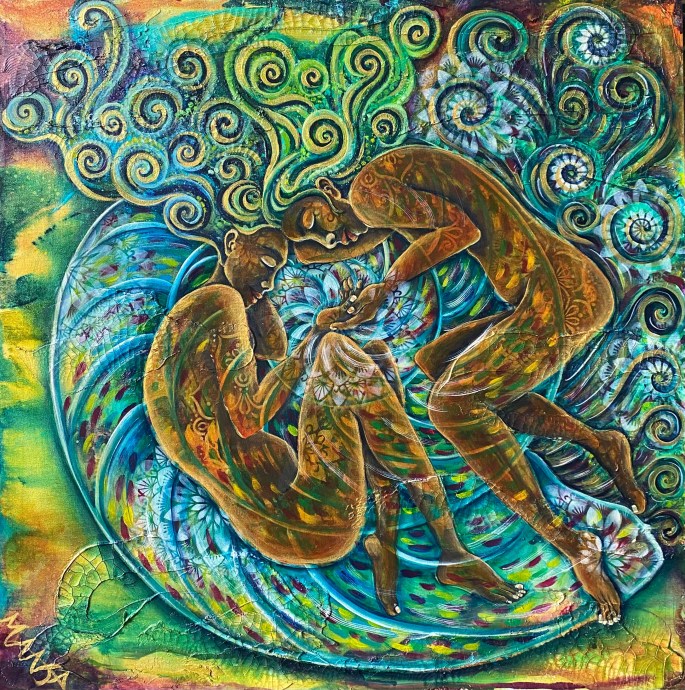
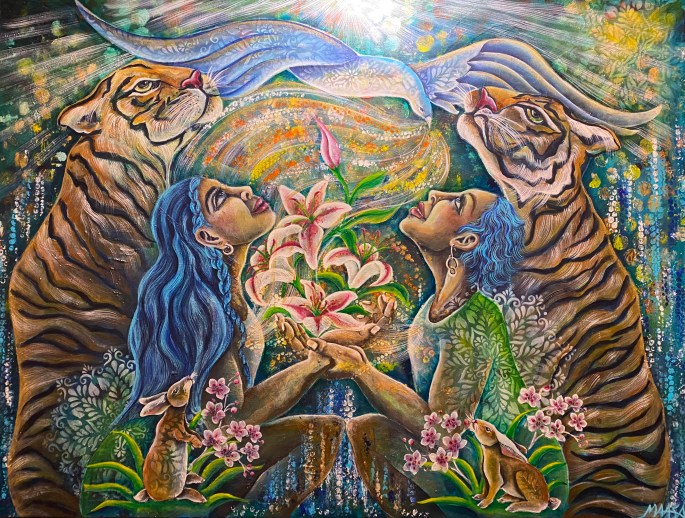
Above painting by Maasa: “As Within, So Without” – Inspired by teachings of A Course in Miracles. “Love created me like itself.” When we offer love to fill the space between us, it ripples outward— received by all, for love recognizes only itself.


THE GIFT OF SAYING ‘YES’

Being in a position where I regularly faced mortality gave me the gift of valuing what has always been free, yet so easily overlooked. My devotion to love was mostly reserved for my immediate family, nature, and a few very special friends I could probably count on one hand. I’ve never considered myself a particularly social person. Truthfully, I’d much rather hunker down at home—where all my needs are met—than seek out company.

But that part of me has shifted. I’ve come to deeply value what can unfold when I choose to connect and leave space for something new to reveal itself. So when I received an invitation to my cousin’s wedding—a cousin I hadn’t seen in years—I said yes. Even though the timing wasn’t ideal and the airfare would be costly, I recognized it as an opportunity to reconnect with extended family and chose to go.

The matriarchs of our clan—as we fondly call ourselves, being descendants of Scots—are now in their mid-80s and 90s. It’s a rare and precious occasion for all of us to be together, and who knows if there will be another opportunity to connect and celebrate in this way again.

I had once travelled through India with the cousin who now, at 61, was preparing to be married. After being a bachelor for most of his life, it felt like a miracle that he had found his greatest love. I knew I needed to be there—not just for him, but for myself. This precious life is meant to be shared, and my experience has taught me that it’s always worth making the initial effort to connect with others. The gift we give by showing up is also the gift we receive.

It’s been nearly six years since Lump came to mentor me. In that time, I thought I understood so much—yet ultimately, I still understood very little. I’d like to think I’m now closer to gaining a deeper understanding of the biggest question. That question has shifted—from asking why I got cancer to a deeper devotion to how I can stay on a path of love in a world that seems to be growing more loveless by the minute.

How can I nurture connection in a world so divided?
How do I discern whether I’m being guided by an intelligence that knows what’s best for me, rather than the voice in my head that simply wants to be right?

This is how I’ve been gauging my healing: by observing the thoughts that occupy my mind, and by my willingness to examine what’s dominating my mental space—and change it if it’s not in alignment with how I ultimately want to live.

I was at the airport on my way to the wedding when I ran into a friend I’d been thinking about. I had even considered reaching out after hearing she was going through a health crisis. But, like it happens for so many of us, I put it on the back burner—letting other things take priority over the persistent nudge I kept feeling.

The truth is, I was afraid. I was scared of how unwell she might be, and I didn’t want to face it—because it would stir up my own insecurities about my health. Then guilt would follow the avoidance, and denial would mask the act of looking away. This is the typical pattern of our default survival mechanism—and even as I become more aware of it, it still takes conscious effort to break the cycle.

The moment I saw her, I recognized it as my chance for a do-over. But the airport was busy—she was heading outside just as I was going in. I genuinely wanted to connect and told her she’d been on my mind. I could feel the moment slipping away, so I said, “Let’s talk in the waiting room once we’re through security.” There was only one flight into the city, so I knew we’d be on the same plane.

She agreed, and I went in first to clear security. The waiting room was packed, but I managed to find a seat with an open one beside it. I saved it for her, holding onto the hope that we’d get a chance to catch up.

The woman beside me started chatting with me. I’ve come to learn, through A Course in Miracles, that any encounter holds the potential to be a holy encounter—a moment where the barriers between two people dissolve. It is through these connections that we can begin to heal ourselves, each other, and ultimately the world. So I chose to be present and engage with her, even as my eyes continued to scan the room, hoping to spot my friend.

Our conversation came to a natural pause when the woman beside me turned her attention to her phone. I took it as a sign to look for my friend again. I thought about leaving my things on my seat to walk around the waiting room in hopes of finding her—but I noticed an almost anxious energy rising in me as I stood. I sat back down.

That’s when I heard a clear voice in my mind say, “Don’t worry, you’ll sit next to her on the plane.”
What? I responded internally.
Then came the doubt: “Here you go again, thinking you’re hearing the Holy Spirit. You’re just making it up.”
And then—quiet, steady—“You’ll find out. Now let it go.”

So I did. I let it go, sat back in my seat, and relaxed until it was time to board the flight.

I used to always strive to be early, driven by the stress of wanting to get ahead of everyone to save time. But knowing better now, I stayed in my seat until most people had boarded. Just as I leisurely made my way to the line, I spotted my friend doing the same from across the room.

There you are! I said. Too bad we only have a few minutes to catch up while we’re in line.

I asked about her health, and she gave me the shortest version as she pulled out her passport with the boarding pass tucked inside. My eyes caught sight of the seat number peeking out, and suddenly my heart burst open—tears welled up in my eyes.

As soon as the boarding agent cleared us through, I poured my heart out to my friend about how much it meant to me that I’d received the message we’d be sitting together. I didn’t hold back—she was the kind of person who would understand. In fact, she too had been gaining a similar understanding. As she put it, “We are not the ones in charge.”

It wasn’t just that the message turned out to be true. It was the confirmation I needed—that the way I’ve been learning to step aside, to get out of my own way and seek guidance in my healing journey—is the right way. The only way for me. Because the truth is, I’m never making these decisions alone.

We were both given the gift of a full hour sitting side by side, sharing our stories and the lessons we’d each gathered along our healing journeys—each echoing the same truth, spoken in our own way. There was a deep joy in realizing that we are waking up together—in ways we may not fully understand, but with a quiet faith that something we are seeking is unfolding. And I do believe it’s happening on a collective level.

The crazier the world seems to become, the more I sense a quieter, steadier voice within us all—beckoning us to choose again. To choose alignment with peace. With love. To remember that there is always another way to see—one that brings us closer to wholeness, and closer to each other, no matter who we seem to be on the outside.

The great clan gathering at my cousin’s wedding was the most love-filled icing on the cake. I had many heart-to-heart conversations that affirmed something we all seemed to know deep down: that love is the only answer to help us through the mess of the world. Attacking and dividing only create more of the same. The wise matriarchs of our clan radiated joy, wisdom, and steadfast love—and inspired me to age with that same kind of grace.

My heart swelled seeing my beloved cousin so deeply in love, so alive with excitement to begin this chapter with his bride. My two brothers were there, and I couldn’t help but feel proud to be their sister—two kind, thoughtful, and hard-working men who carry strong family values. I spent precious time with my three cousins, each of whom I’ve shared meaningful chapters of life with, and my favourite witchy aunties—shining gems and radiant examples of joyful, spiritually-rooted living. As an added joy, my beloved friend—and friend of the family—arrived in perfect timing, lighting up the gathering with her bright, beautiful presence.

There was so much love in that intimate gathering, and I silently thanked the Holy Spirit for guiding me there—to receive gifts meant not only for me, but for all of us.


MIRACLE SHIFT

“Your CT scan shows that you’ve responded exceptionally well to treatment,” my oncologist said excitedly over the phone. “There doesn’t appear to be any tumours in either breast although, It’s hard to assess the right one due to extensive scar tissue from the ulceration. What spread into your chest wall has receded, the thickening in your upper sternum is stable, and your lymph nodes look clear.”

I was surprised by how calmly I received the wonderful news—perhaps because it simply confirmed the profound shift I’ve been feeling lately.

Three months ago, my CT scan showed disease progression from my right breast into my chest wall, in the sternum, and in my lymph nodes. The tumor in my left breast was also evident. Due to my chronic infections, I was able to forgo the chemotherapy portion, which would have depleted my immune response, and instead gave my body the chance to fight back against the infections. With stage four metastatic breast cancer, the recommended treatment was aggressive. My unique situation gave me the chance to stumble upon a miracle.

After two targeted immunotherapy treatments with minimal side effects, all four of my tumor markers dropped below the normal range for the first time in five and a half years. I requested a CT scan after my third treatment, knowing I’d likely be recommended to add chemotherapy for the following round since my infections had cleared. I needed to know if my insides reflected how I was feeling—and they did! My doctors believe that the targeted immunotherapy was solely responsible for this miraculous turn of events. I have my own belief, which I attribute to a higher order I’d placed my bet on.

“I still advise you to do chemo and take advantage of this window to clear out whatever may be left of the cancer,” my oncologist continued. I’m incredibly grateful to have been matched with an oncologist who respects my decision-making process. For now, I declined the chemo, as my body is relishing the vitality that had been absent for so long. The thought of compromising my entire system, just as it was moving towards homeostasis, felt more like a risk than a benefit. However, I’m careful not to cling, as I need to remain open to pivot when necessary.

The only “barometer” I’ve put my faith in is the level of peace I feel in the choices I make. I’m talking about the kind of peace that can’t be manufactured for safety’s sake—the kind that is all-encompassing, a ‘yes!’ that I can fall into and feel held by. That’s what I felt after I declined chemo for my next round.

I’m learning that the only power worth giving is the Power I lovingly surrender to. Time and time again, I’ve been shown that when I do this, I’m being taken care of. I know when I’m not doing this because I feel a tightening around the reality I want to control. So, when I notice, I let go again and again, praying to be shown the way. The way has at times been scary, painful, confusing, and messy- it’s only from this vantage point that I can see the meaning in all of those experiences. This is what I need to trust as I keep following the way. This is what Da calls a miracle shift.

I hadn’t disclosed to my doctors the other ‘therapies’ I believe contributed to my ‘exceptional response.’ A fringe protocol, showing great promise as a cancer cure, came onto my radar last year. I began it as a last-ditch effort to make a difference on my own before seeking help from the conventional system. However, I didn’t use it long enough to give it a fair trial. The use of repurposed drugs—existing drugs originally developed for one condition but used to treat another—was gaining momentum and showing great promise for healing even the most aggressive and untreatable cancers.

The research I’ve done has given me enough confidence to test these therapies on myself, especially since, based on what I’ve gathered, they won’t interfere with the efficacy of my treatment and are relatively harmless. I’ve also been taking Artemisinin, derived from the sweet wormwood plant, often referred to as ‘herbal chemo’ due to its potent anticancer properties. Alongside this, I’ve maintained a steady regimen of herbal tinctures, teas, vitamins, high doses of anti-inflammatory supplements, and antioxidants to neutralize free radicals.

I also take time for my daily ritual of forest bathing and prioritize having meaningful, heartful connections. I can feel the power of the prayers from those who pray for me. I’m sure all of these have contributed significantly to my current state, but what I give the most credit to has nothing to do with what I put into my body.

My day begins with aligning my will with the greater will of God. It is only from this place that I can live fully and flourish, even with this disease. I need to recalibrate throughout the day because it’s so easy to get lost in our mortal predicament. So, I keep coming back, and I keep placing my faith in what I can never fully understand but can trust. I trust because I keep finding my way.

Banner painting “Of The Same” by Maasa. In the spirit of our Sameness, we celebrate what can’t be threatened or taken away. What we thought we forgot is redeemed in the remembrance that was never lost. More of my art mine may be seen @ http://www.maasa.ca