LIFE WITHOUT ANSWERS

I’ve been expecting the report from my most recent breast MRI to land in my inbox. I’m still in training—to receive these notes without letting them hijack my inner state. Reports that arrive like tarot cards, capable of projecting a future reality that contradicts the one I’m living.

My laptop rests on a tabletop made from massive slabs of hardwood, in a large tiled kitchen overlooking a garden of lush tropical plants that look as if they’re on steroids. We are halfway through our vacation in Mexico, escaping Nelson’s long winter in the laid-back village of Lo de Marcos. By now, we had acclimated to the unstructured rhythm where nothing happens in a hurry, and where the sun shines even on unwanted news.

I had requested a breast-specific MRI to give my body a break from medical imaging that uses radiation. I accepted that this meant traveling to a larger hospital in another town in order to have a look inside without that cost. There were two possible destinations, and one happened to be in the same city we would be flying out of for our trip to Mexico. The stars aligned. I booked the appointment for a Saturday—the day before we flew to Puerto Vallarta.

I decided to let it go. I wouldn’t give energy to anticipating the result until it was quite literally in my face, which is today. A deep meditation this morning left me with a quiet certainty: no matter what, I would continue on the path laid before me, guided by a way of interpreting my life that keeps me safe under all circumstances. I admit this is easier in the absence of pain or imminent danger, but experience has taught me it’s the only way forward without letting this disease take me hostage. I dropped my shoulders on the out-breath, repeated my A Course in Miracles lesson for the day, and clicked open the report.

The MRI confirmed what I already knew. It felt far-fetched to imagine a different outcome when I can still feel multiple lumps in my breast, embedded in scar tissue left behind by ulceration. Like barnacles clinging to the memory of my wound, they remind me of what I’ve been through—and that I’m still in it—even as my life continues to shine beyond it.

Any wish to one day receive the words cancer-free is no longer the destination of my path. Instead, I anchor myself to what fuels my soul and continue choosing the path that leads me toward peace now. Wishing does not belong in the present.

It makes sense to me that what was once a large mass, as my body broke it down, may have left small remnants scattered through the surrounding tissue. The scan also showed nearby lymph nodes in the right armpit that are likely involved. The left breast and its surrounding lymph nodes, which were affected not long ago, remain clear. I’m grateful there are no new frightening surprises, and that what miraculously disappeared on the left after the wound on the right closed has remained that way.

Given my history, the radiologist can only assume these scattered lesions are active cancer. Once labeled metastatic, that designation tends to stick, shaping future assumptions and forming the basis of treatment decisions. The only way to know for certain whether these current lumps are cancerous would be through biopsy. Because my cancer has mutated before, it’s possible I’m dealing with another variation. The familiar questions arise: Is my current treatment still effective? Do I undergo another biopsy? Would surgery even be an option? Would I have to consider a more aggressive treatment plan?

The analytical mind tries to navigate its way out of this maze, searching for certainty. But what I’m really seeking is higher ground—a vantage point that allows a wider view.

I haven’t thrown the baby out with the bathwater, per se. Years of learning about the disease process through German New Medicine, and experiencing its stages in my body in real time, have offered me an alternate way of understanding what my body might be doing. I hold this perspective as a lens—one that helps broaden my view and keeps fear from narrowing it.

In GNM, there isn’t a distinction between hormonal cancers and others, but rather an interpretation of how specific biological programs unfold through phases of conflict and repair. Much of what I came to understand was shaped through lived experience, recognizing patterns as they appeared in my own body. I only have my experience to reference. There is no right or wrong way—only the way I am no longer trying to dominate, especially since studying A Course in Miracles.

Because of that, I remind myself that decision-making has to come from a place not ruled by fear. I try to create enough space for difficult choices to settle, rather than forcing them into shape. That means listening beyond my conditioned thinking and first examining where the real conflict lies—always beginning in the mind.

What I’ve found is that when the way forward becomes clear, even if it isn’t what I wanted or expected, a sense of peace follows. There’s no pushing, nor being pushed. Instead, a quiet certainty settles in. I no longer hold many absolutes, except for the one thing that keeps me free in any situation—and that does not depend on my body.

I do not sense imminent danger. Quite the opposite. I feel vitally alive—nourished by sunshine, purified by the ocean, held by the abundance of love that surrounds me. What is yet to come has not arrived, and so I stay here, present, basking in the now. As the year closes, I recognize the same truth that has carried me along the river of life: let go, let God, and remember that nothing real can be threatened, and only love endures.

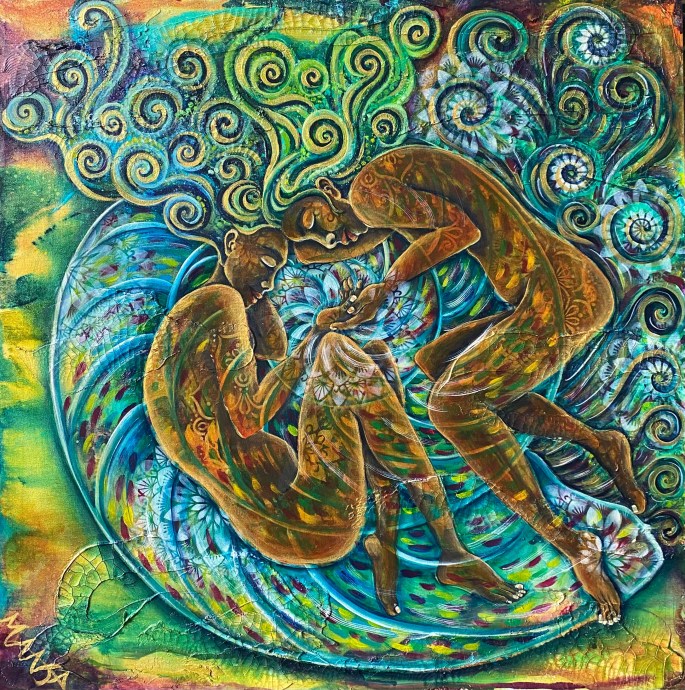
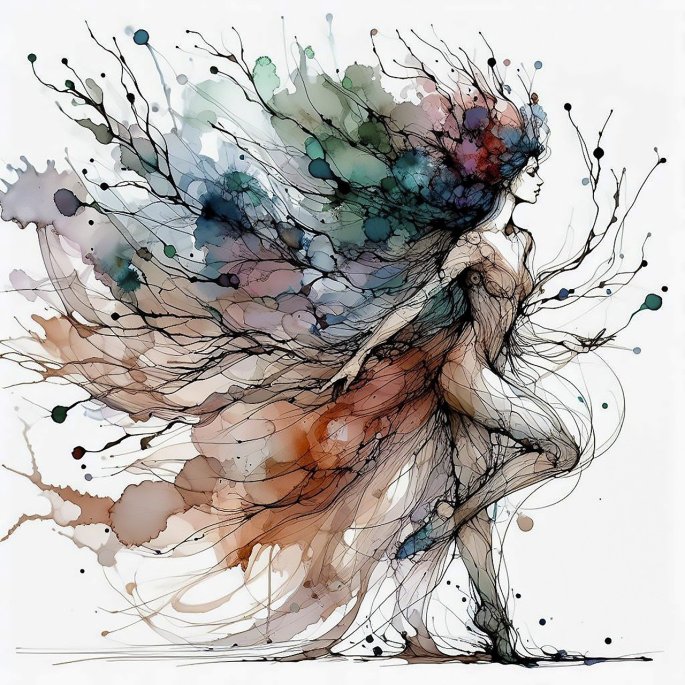
Above painting “Alchemy” by maasa.ca

POLKA DOT ORANGE LIGHTS

“I’m happy about your results,” my oncologist says over the phone. She’s relaying the radiologist’s report from my recent PET scan. I’m surprised by the felt sense of release, even though I had convinced myself that this time I wouldn’t let it get to me. I wouldn’t let the anticipation of the result become an invisible weight I carried. But it was still there. The difference is, I’m stronger now, and I can carry it without letting it drag me down.

Still, my light-as-a-feather release moment was short-lived. My quick translation of what she said was, “I’m done, I’m cancer free! Whoopee! Finally!!” But then she proceeded with what I didn’t want to hear which meant: it ain’t over yet.

The Coles Notes version is that there are lumpy remnants of disease bound up in my scar tissue. There are still a few small nodules left over from the breakdown of the big tumour. I focused on the positive: it’s no longer in my other breast, sternum, liver, lymph nodes, or in the suspicious activity that showed up in my right lung several months ago.

“There is a new lesion in your spine at T4 that we are going to have to keep an eye on,” she continued. It’s a game of give and take, and what is left over is where I have to count my blessings. My mind quickly grasped for an explanation.

I had two terrible falls last year where my heels went over my head and I smashed hard onto my back. Both involved slipping and landing on solid slabs of wet rock. The first time, I broke my fall with my left arm, which fractured my humerus and left me with a frozen shoulder I’m still patiently thawing out.

The second time was a classic ass-over-teakettle slip down the stone steps to my garden. That time I remember lying there motionless, afraid to move, praying that I hadn’t broken my back.

“Could a fracture or major trauma in that area cause a higher glucose uptake in the scan?” I ask. I can hear the desperation in my voice and feel my heart squeezing around panic. “It could,” she replies, “but the formal report says that it is likely a metastasis.”

This is how it starts: fear finds a crack to get in. If I look away and let it in, it will take hold—and that is what metastasizes and spreads. That is what alters my experience from being free to becoming a prisoner. I know I have to nip it in the bud—not with denial, but by shifting my awareness to a greater Reality that will guarantee my safety.

This is the thing: the radiologist is commenting only on the supposition in cases like mine. The last PET scan was done over a year ago, when the orange glows of sugar uptake in my report were polka dotted in too many places. Assuming that cancer “spreads,” all the orange glows led to the presumption that it was all cancer — even though healing tissue also takes up sugar. This is my own disclaimer on these super sensitive machines that pick up everything. I was never completely sure that was the case, but I didn’t want to biopsy bones and organs, so I went along with it, hoping it wasn’t as bad as it seemed. It was most likely denial, but at the time, it was the only defense I had to keep going.

The radiologist comments on my scarring as a “surgical site,” which it is not. The scar tissue was not from a clean cut surgery. I wanted him to know what I endured—that I didn’t have the option for a quick and easy removal of my problem. It’s more like a mesh of healed tissue from a decomposition site. I find it mildly annoying that the guy writing this report has no idea what I’ve been through and writes without considering my falls as a possible explanation for the T4 light-up. I recognize my annoyance is guarding what I want to keep safe, so I let it go with my next out breath.

My oncologist is thorough and pulls up the last three PET scans, spanning two years, to compare them on her screen. “Maasa, you really should see the changes in the imaging. You can literally see those orange globes of light around your body dissipating with each scan. I think you would feel really encouraged if you could see what I see,” she says. I love this woman, especially because she wants me to just keep doing what I’m doing. And even though there is no real end to talk about in terms of treatment, I decide that this is good news—because really, it doesn’t change anything. I can keep living the way I am.

I had decided I wouldn’t live suspended on “what ifs.” There will be more tests, and the only constant is change in whatever direction life flows, so I’m training my mind to anchor to what is steady and forever. It’s ongoing daily work — practicing permanence in a world that only guarantees impermanence.

I was nervous when I signed up for a workout class that I used to do in my twenties. I’d been feeling the nudge to get strong, to push healthy oxygenated blood through my system for a house clean. To feel those endorphins combat the restrictions in my body, to be told what to do by a guy that inspires me.

Coach tells me not to ask questions and just do what he says. That is exactly what I need: just show up, do the work, and get on with it. I survived the first week of a strenuous, sweaty workout, which confirmed for me that so much of how I feel depends on the limits I place on myself. Sure, I have to modify here and there, but my body followed the state of my mind that chose not to let anything get in the way.

My monthly treatment in the chemo lounge was right after class on Friday. My veins were so pumped that, for the first time, the nurse couldn’t get an IV into me. It gave me a funny sense of satisfaction—even though it hurt to have her poke and prod until I finally relaxed and let her in.

It’s helping my mindset to know that the cocktail of two drugs for my targeted therapies does not damage my healthy cells. Instead of attacking fast-dividing cells like chemo, they target and block the receptors that fuel the cancer cells. The hope is that, without fuel to grow, those unruly cells will weaken. With me strengthening my own immune defense through everything I’m doing—mostly mindset, herbs, supplements, and exercise—they may eventually remember their true function and return to behaving like healthy cells.

My life can easily be defined by tests and the shifting statuses of this disease. What I’ve learned from the latest PET scan is that I’m still reaching for the finish line — and I don’t want to be in a race. My path is the one I’m on, and anticipating it to be any different will only cause me grief.

Tests come in three-month increments. Thankfully, the next one is an MRI, which I requested because I need a break from the radiation of these nuclear medicine machines. Rather than reaching for a different kind of life or pinning my hopes on a better scan result each time, I’m practicing being here now — finding perfection even in the nooks and crannies. To be an expression of the good stuff I want to share — and for the rest, I place the future in the hands of God.

AS WITHIN, SO WITHOUT

My doctors are careful to avoid words like miracle or cure during our monthly appointments. Living with stage 4 cancer that is currently inactive, they tread lightly, cautious not to spark false hope. They reinforce the same quiet disclaimer: for now, you’re doing well.

There are three doctors in rotation at my local clinic, each of whom I leaned on through the peak of my healing crisis. Whoever was on shift became my lifeline that day, meeting me wherever my crisis happened to land.

I will never downplay how profoundly grateful I am to live only five minutes from the hospital. Over time, I came to know most of the oncology nurses, and they came to know me—by name, by story, by the rhythm of my visits. They were always just a phone call away, always prioritizing me when my body went through its strange, frightening eruptions and changes.

This is one of the many blessings of living in a small town: care feels personal, human, and near.

The female doctor is warm and kind, yet she never sugarcoats the truth. She has a practiced way of sliding the tissue box toward me when my eyes well up, speaking plainly about what I’m facing, her soft eyes full of sympathy, even while she knows there is only so much she can do.

The younger male doctor has a bit of doom‑and‑gloom vibe, yet when it mattered most—like the day I reacted badly to the drugs in my IV—he became tender and human. I told him I was scared, and he anchored me with his steady presence, holding my hand and staying by my side until the heavy sedative finally pulled me under.

The doctor I’ve gravitated toward—maybe because he’s also a contractor like my husband and enjoys his band—is light, funny, and warm. He gives me hugs, reinforces what’s working, and encourages me to lean into optimism. He understands how I operate and does his best to support me, even when he doesn’t always agree. He’s a good match for me because, with him, I feel completely at ease to be myself. I’ve even shared some of my more ‘out there’ protocols with him, and although he sometimes raises an eyebrow, he never dismisses or downplays the way I approach my healing.

Each of them, in their own way, does their best to guide me with the wisdom their experience has given them, while staying within the boundaries of their profession—where “best‑case scenarios” are measured by statistics from funded research. But there aren’t many statistics for people like me: riding shotgun with Holy Spirit and focusing on healing the mind because I believe healing must first take place in the mind before the body can follow.

At my last appointment, I wasn’t expecting the young doctor—it was a Thursday, the day my easygoing doc usually works, but he was away. My heart raced a little faster, alerting me that my nerves were picking up the signal: I was uncomfortable. Sitting across from him always feels like breaking the ice. He carries a quiet sadness, as if he spends his days delivering news he’d rather not give, and suddenly I felt anxious—wondering if it had something to do with my blood test results.

As I waited for him to open my chart, I debated whether to ask the question that had been hovering over me—the one about wanting a goalpost for the end of my treatment.

Even with lingering restrictions from scar tissue left by the tumor’s ulceration on my right side and a frozen shoulder on my left, I’m on a mighty comeback—those unruly cells have receded and remembered their true function in a surprisingly short time. But miracle is not a word I can freely use in that room, so I hold it close as my own secret.

My tumor markers have been clear for months. My last two CT scans cautiously describe me as “responding exceptionally to treatment.” Not cancer-free—never that—but exceptional nonetheless. There were tiny nodules detected in my right breast, which could simply be scar tissue puckered into a four-inch seam where the wound finally closed—or it could be residual disease, the inevitable disclaimer.

It’s hard to know without a PET scan, which is more sensitive to metabolic activity and can better distinguish active cancer from scar tissue. But PET scans aren’t handed out lightly—they’re expensive and usually reserved for getting answers that could lead to a new direction in treatment.

Why do I need to know more if I’m responding so well? Because treatment indefinitely feels too permanent for my free spirit. I’d have to advocate for myself and convince my oncologist to get me that Cadillac scan.

“How long do I continue with treatment?” I asked, testing the air, careful not to wander into the dark territory where his answer might trap me.

“You’ll continue until it stops working, until the cancer mutates and we have to try something else.” He looks at me as if I’m a ticking time bomb.

I slammed my shell shut around the pearl of the life I’ve reclaimed—the bright, miraculous reality of surviving what I did and feeling like it’s finally behind me. I ended my line of questioning, course-correcting the trajectory back toward my happy life without disclaimers, where the only ticking is the joyful beat of my heart.

When I leave the clinic, I return to the place where my real processing happens—my canvas. Painting is both a spiritual practice and a mirror, reflecting the oscillation between what I want to release and what I want to embrace. It’s the dance between fear and love, the discomfort of not knowing, and the willingness to reach beyond that uncertainty to explore what is possible.

Facing a blank canvas feels much like facing the uncertainties of my life—grappling with the desire to grasp certainties where none exist, only to find clarity in the ebbs and flows as they come, which then shapes the terrain my mind will inhabit.

I’m not a formally trained painter. I don’t plan ahead; my ideas take shape gradually, layer by layer, percolating beneath the surface—some elements stay, others dissolve into the underpainting. Often, what I see in my mind or feel in my heart doesn’t translate through my hands, which is deeply frustrating. Sometimes, my inner critic is so harsh it makes me want to give up entirely.

This is the darkness that hovers beneath the bright light of my creative inspiration—the same kind of trap the mind sets when it dwells on the thought that this body may never be fully free of disease. It’s easy to get stuck, feeling down and out, if I let it have its way.

A respite from the circling back of my disclaimer came in the form of a woman who had purchased a painting from me. She had worked as a curator at the Tate in London and other prominent art institutions. She is launching a passion project—an advisory and curatorial platform born from her extensive experience in the art world—dedicated to creating space where underrepresented artists’ work is fully appreciated and thoughtfully presented.

She told me she’d been following my work and felt a deep spiritual connection to it—the light within it. She wants to represent me and help bring my art into the world, with plans for exhibitions in LA, New York, and London. I was thankful that I believe in miracles because this definitely felt like one landing right into my inbox.

During our Zoom call, I connected with her instantly. Through her eyes and passion, I saw my work anew. She spoke with sincerity and joy, and I felt the unmistakable stirrings of purpose—that I could extend my love through my creations beyond my little town, with her as an ally. A contract was promised, with her taking only a small commission, and I accepted, allowing myself to rest unguarded in the grace of it all.

But the contract didn’t come. Not the next day. Not the day after. Days stretched into silence. My mind turned violent on itself: She changed her mind. She saw how much of an amateur I am. How foolish to believe I could belong in that world.

Every time I sat at my canvas, my insecurity bled into the colors. My painting became chaos—a mirror of my spiraling thoughts. After four days, I finally sent a gentle reminder via text. Still nothing. I felt small and stupid.

Eventually, my sanity recognized that my ego gripped expectations and outcomes with white knuckles, spinning lies and judgments that made me miserable. I returned to my hourly spiritual practice with renewed vigor. I prayed to release the thoughts I did not want and anchored myself to a new perspective. I sent her love and gratitude for recognizing my light and released her from my expectations. I chose to return to the ample abundance already present in my life. I chose to love everything about my life in that release—and something shifted.

I approached my canvas with a willingness to let go, covering it with a bold layer of glaze. There would be no turning back after this move—I’d have to surrender the small part in the center that I loved and didn’t want to change. The rest was a busy swirl of colors.

Nervous but determined, I washed my canvas with a cool blue and a warm ochre. The chaos stilled instantly, creating a quiet space to begin again—from a different vantage point, this time guided by the eye of my heart. Creativity returned: tender, curious, and flowing.

The release I felt was palpable, and on that very day, the woman wrote back. She apologized—her mother had suffered a medical emergency that had consumed her attention. We can never truly know what others are going through, but what we can know is that everything we experience is a choice, and our choices shape how we perceive life. It was a powerful lesson in how easily the mind can distort reality, and how love and release can restore clarity.

I don’t know what will come of our relationship, and I will not cling to any expectation. What is clear is that painting is crucial medicine for me—a place where I can process and choose to trust that I’ll find a way through the muck in my mind to the purity of joy, peace, and beauty that reveals the essence of my spirit. I’ll keep painting, and I’ll keep finding my way, regardless of where it might lead.

So, I choose not to accept any disclaimers in my life. I choose to trust that I will know when it is time to change course, to glaze over what needs to shift, and that by seeking a better way through love and peace, I will always be shown the way.

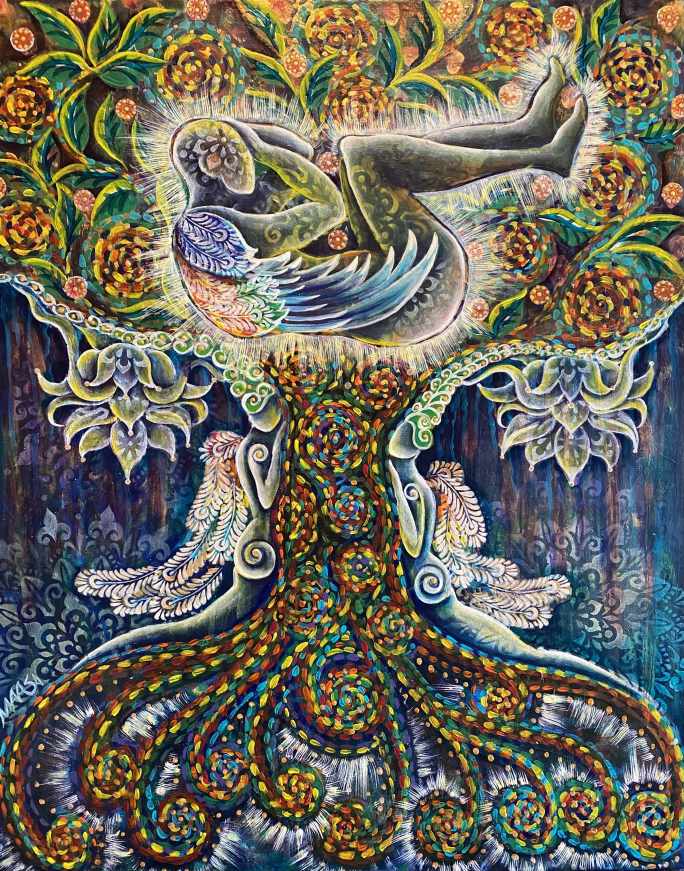
Above painting by Maasa: “As Within, So Without” – Inspired by teachings of A Course in Miracles. “Love created me like itself.” When we offer love to fill the space between us, it ripples outward— received by all, for love recognizes only itself.


NOW WHAT?

The acute phase of survival has since passed, and in its place, a gap has opened—space that wants to be filled. I feel the aftershock in residual tremors, my footing seeks traction in the space ahead. Now, life back to somewhat normal pulls me into the trap of restlessness—as if I need to make up for what I’ve been through by becoming someone of more value.

It’s ridiculous, but even after all this, it still comes to get me. I’m still getting duped by the habit of assigning value to what I do, instead of resting in the quiet grace of all that’s been given to me. Even as my intellect understands that I’m already at home base, the self I’ve constructed keeps me running—from the perfection of how I was created.

I feel the pressure to do something significant in return for the extension of my life. I thought I was done with the rhetoric of that harsh inner voice—the one that drives me to do more, to be better. But ego is loud, convincing, and insistent—sending me out in search, while I forget that I’ve already been claimed by an inherent happiness that asks for nothing in return.

Cancer takes up so much space—not just as an all-encompassing distraction, but as something that gave meaning through the effort to survive. The biological malfunction that became my greatest challenge also cracked me open, allowing light to come in. Now that I have a relationship with that light, I’m on alert for what blocks its shine.

I feel the tension of knowing that my scramble for purpose is rooted in fear—the fear that if I don’t fill the gap with what I make of myself, the disease might return and do it for me. So the focus shifts to the next problem—whether it’s the volatile state of the world, the financial pressure we’re all facing, or the endless causes I feel helpless to do anything about. It’s all an outward projection of the same thing: I’m still trying to fix it from the outside, instead of settling back in.

As I sit here after my quiet morning contemplation, I’m reminded that ego will have me seek but will make sure I never find. It distracts me with a sense of urgency to do something, anything for an illusion of a fix of what can’t be fixed from the same level where the problem was created.

I’m finally free of that horrendous pain that once felt like it would never end. But the gift of coming out of it is so easily forgotten as I latched onto the next mountain to climb.

The unsettling sense that I needed to do something should have been my cue to pause and examine the root of that urgency. Instead, I convinced myself that I could be of value by helping my husband, a developer, and jumped into a path entirely outside my norm—just as I was beginning to come up for air. The idea felt so far removed from my usual operating system that I mistook it for clear guidance. So I enrolled in a university-level course to become a licensed realtor, with the intention of selling the units he built.

It only took ten days of misery—battling my brain to retain information I had no desire to keep—before I could admit I’d made a mistake. The choice came from fear of the open space that was actually meant for my happiness. I’m still on the mend, still receiving ongoing treatment, and still hold my breath when I click open my blood test results every three weeks. My gratitude for my health had been misplaced in what I could do with it instead of simply basking in it.

I’m of value because I’m still here, doing my best to live and share what I’m learning. Even though I don’t fully understand how, I trust I’m doing my part for the healing of the collective. This is what I return to when I find myself spinning out of orbit. To come back home to happiness and shine out.

It’s important to mention that much of what I write is inspired by my ongoing study of A Course in Miracles. That said, studying it doesn’t mean I fully understand it. It continues to meet me exactly where I am, gently guiding me to live to love.

Above painting by maasa.ca

Hold Fast

We are wired to problem-solve, but what happens when the problem affects everyone, yet the solutions feel different for each of us? How do we navigate the collective terror of impending doom—the world vibrating with angst and division?

Fear reigns over what we cannot control, convincing us that we can escape it or defeat it. But how can we “win” if we’re operating from the same mindset that created the problem? Chaos persists because everyone has their own truth to defend. As long as there’s someone or something on the other side of the battlefield, any victory will be short-lived. A Course in Miracles teaches that we must leave the battlefield entirely, beyond the mind that believes in the battle.

So, where do we find our security? At the root of my dis-ease lies scarcity, loss, pain, and death. It’s where I land when the reality I created feels like it’s crumbling into nothing. How can peace be found in what we cannot control? No amount of running, hiding, or fighting against the manifestations of fear will bring lasting assurance. True safety can’t be found through opposition. As long as we fight to protect what we inevitably can’t keep, we lose—like sand slipping through our fingers.

Why do we seek love, happiness, and joy? Because these are the essence of our making, and we long to return to them. Yet, we perceive them as fleeting—things that can be taken or lost.

Often, our gains come at the expense of someone else’s loss. For example, I may celebrate my health by comparing it to someone else’s suffering. This is how ego tries to make me feel safe, but it’s a sham. It convinces me that I’ve escaped a similar fate, while instilling the fear that it could still happen to me. What kind of assurance is that?

But what if the truth is that we already have all we need? What if our inheritance cannot be lost? If the body is what separates us and our identification with it is the source of all our problems, can we look past it? In that understanding, we would no longer be bound by our mortal predicament.

My survival instincts peaked during my own battles with fear. No amount of effort could overcome its formidable force as long as I believed what it was trying to convince me of. What was it trying to tell me? That I am a speck of dust in the grand scheme of things, destined to suffer and fade into being forgotten—with that being the end. But what if the thought that believed I was a speck changed?

All problems originate in the human mind, shaped by a survival-based perspective. Even billionaires feel they need more to secure their existence, just as those struggling for their next meal or seeking escape from unbearable circumstances. The form may differ, but the underlying fear remains the same.

I’m learning to anchor myself in what cannot be shaken—in the intangible realm beyond the part of my mind that feels threatened. It exists in a space where no imaginable worst-case scenario can affect it, untouched by forces I could ever conjure. This requires faith.

I keep holding fast to what I can’t fully understand, yet it miraculously keeps my light lit. I’ve learned that everything I long for is just a thought away—if only I can grasp it. If I succumb to the fear of the possibility of cancer coming to get me again, if I believed I was ‘incurable,’ life would just be a ticking time bomb. That’s no life at all.

There is a way out of nightmares if I recognize that I’m in one and choose to open my eyes. The evidence of this in my life inspires me to keep trusting, even without knowing where it’s leading me. All I know is that this is the only way I know how to do this—whatever this is. My only job is to leave the battleground within myself and bridge the divides in my everyday life, however they appear.

Anything I hold against myself or others only brings pain, even if it’s unconscious. Perhaps the helplessness of witnessing the chaos in our world can only be healed by seeing it for what it truly is—a beast born from the errors of our thinking, and therefore, something that can be undone. Each time we catch ourselves in attack mode and respond with loving forgiveness for what we’ve forgotten, we create an opportunity for change—a change that serves us all, starting with each mind choosing peace.

Does this mean I roll over and don’t take a stand? No, but I can take a stand while holding fast to what can’t be changed in a world dominated by change. A radical shift is necessary in these unprecedented times, which amplify our collective fear. Isn’t it time to try something different to break this cycle of division? I trust in a mighty force that works through each and every one of us when we remember what can’t be taken.

If every interaction reflected the larger whole, and we had the choice to mend the divide—regardless of how things appeared on the surface—would it be a practice worth engaging in? If we viewed conflict as an expression of fear and a desire for safety, recognizing that, in this way, we are all the same- would it shift our perspective on how to approach it? Wouldn’t we help each other from that place? If we are truly connected, then human relationships become the mirror through which we see our relationship with ourselves at the deepest level—and an opportune place to heal from.

Perhaps miracles happen when we step onto a playing field where no one needs to win and fear cannot enter. But first, we must allow the possibility of such a place to exist in our minds. I believe that as we shift from fear to the safety of love, the ripple will spread—benefiting us all. What I’m certain of is that the paradigm of pointing fingers only repeats the same patterns. A Course in Miracles is gently guiding and inspiring me to question the dominance of fear. That’s where the real healing is taking place, and I believe it’s extending outward and beyond.

DON’T ASSUME ANYTHING

As I sauntered into the frigid water amidst the flurry of screams, splashes, and gooseflesh, I was reminded of the simple yet profound lesson: don’t assume anything. The annual polar bear dip in the lake has become the only real symbolic tradition our family shares.

It began during the debaucherous phase of my husband and my early courtship over two decades ago. Still thoroughly inebriated from the epic party of New Year’s Eve, we impulsively jumped into the bone-chilling glacial waters of Kootenay Lake, desperate for a cure from our horrible hangovers.

Unbeknownst to us at the time, this impulsive act would evolve into something far more meaningful. What started as a way to rid the debris of toxicity transformed into a symbolic ritual—clearing the slate for a fresh start each new year. I had so much to release from the most challenging year of my life.

Leading up to the grand event, I was still pleading for respite from the debilitating pain induced by my chronically infected wound. It was outrageous to even consider jumping into a lake already laden with bacteria, made worse by a slew of people transforming it into a cesspit of infection-loving agents. Not to mention, I was on standby for a palliative mastectomy, which wasn’t for a curative cause but rather a necessary step, with its own unknowns, in order to proceed to the next phase of treatment that would hopefully nuke the cancer.

I had reached—or so I thought—a stalemate with my eight-month ordeal of enduring the gruesome ulceration of my tumour. Only in hindsight can I see the blessings hidden within periods of doubt, suffering and fear. I wouldn’t have been eligible for surgery if not for the recurring infections. I wouldn’t have started the new treatment had my cancer not mutated into a different kind. I was ready to let go, my hands open.

But my hands gripped, white knuckled in the darkness. At night, my trust waned, smashing against fears and contradictions of my own making. My heart raced with the terror of losing parts of myself. What security was there in what I was willing to give? My mind fought, freaked, and froze around runaway thoughts that I could not control. Would I regain mobility in my already compromised arm? Would I be left with a Frankenstein version of my current wound, along with a donor site that might not heal properly? Would my cancer run rampant? Death lurked close by, and faith was but a whisper in my shallow breath.

With a new day and along with the light, I pray to strengthen my trust in letting go. The more I release the need to control and arrange the world around me to feel safe, the freer I become to recognize the path unfolding for me. I’m learning to trust this way because I feel at peace with the next step—only as it unfolds. When I analyze and weigh my options, mingling them with combative emotions, all that happens is that I go around in vicious circles. Decision making brings only anxiety and uncertainty. I cannot be trusted operating from this place.

In my right-mindedness, I see how my perceived safety net is hooked onto anchors that aren’t secured deeply. My constant attempts to rearrange and stay on top of what I’m trying to control only make the net tremble, precariously holding everything together.

This is why A Course in Miracles teaches me to let go of what I think I know and offer my free will for guidance—to see beyond the mind I have constructed and trust in what I don’t yet have the capacity to understand. It’s a big ask, one I often meet with resistance: to take responsibility for all that I don’t want to feel, while finding empowerment in giving up what I’ve given power to.

The help I’ve received has come in ways I could never have planned or imagined for myself. My nemesis, the staph infections that prevented me from getting chemo, instead allowed me to receive the gentler targeted therapy portion of the IV cocktail.

I never would have imagined that one treatment of the targeted therapy would reroute me into the lake. By the time the surgeon called me back just after Christmas, my wound had transformed from an angry, oozing mess into something that actually looked like it was healing. Before I could share this update, he gravely explained that I would need invasive surgery to remove my breast, cut into my pectoral muscle, and go deeper into the chest wall. This would be followed by extensive reconstructive surgery requiring specialists. I’d have to carve out parts of myself to remake what had been taken away—all with the looming risk of poor healing or the cancer compromising me further.

He was surprised and excited when I told him that my wound looked better than it ever had—that it actually seemed to be closing with healthy tissue. For the first time in over a year, I no longer needed morphine to manage my pain! He agreed that the best path forward was to get on with treatment as soon as possible.

My path continues to twist and turn in surprising ways, reminding me that a higher working order is in play when I choose to trust. The onslaught of antibiotics for my infection had concerning repercussions on my gut. When another three weeks passed, I received the same unorthodox treatment without the harsh chemotherapy. Truth be told, I’m still terribly afraid of chemo. Even though the infection and gut issues looked horrible from the outside, on the inside, I felt as though I was being gently guided to not be afraid.

The genetic testing result I’d been waiting for over two months might be ready before the next round of treatment. Knowing I have a good match would give me the courage to shift my perspective and fully accept chemo as medicine, not poison. I’m placing my trust in divine timing and also leaving room to have no set plan in place.

My practice is to remember to stay open, even when I feel the urge to close tightly around all that is precious to me in an attempt to protect it. There is a paradox in handing it all over, where freedom intertwines with the terror of letting go, until the moment both hands open. I keep coming up for air on a regular basis. I forget, and then, by the grace of God, I remember that life cannot be truly lived while fearing the loss of what we love. A Course In Miracles teaches that Love is the absence of fear.

I’d triple-secured waterproofing over what was left of the open wound—an upside-down heart-shaped opening where my breast used to curve. Below it, a bridge of healthy tissue between another meaty section that’s shaped like a semicolon. The deep, long and narrow bottom of the crevice, prone to infection- hidden for months, had finally widened and risen to the surface to dry out. I couldn’t even remember the last time I’d fully submerged in water.

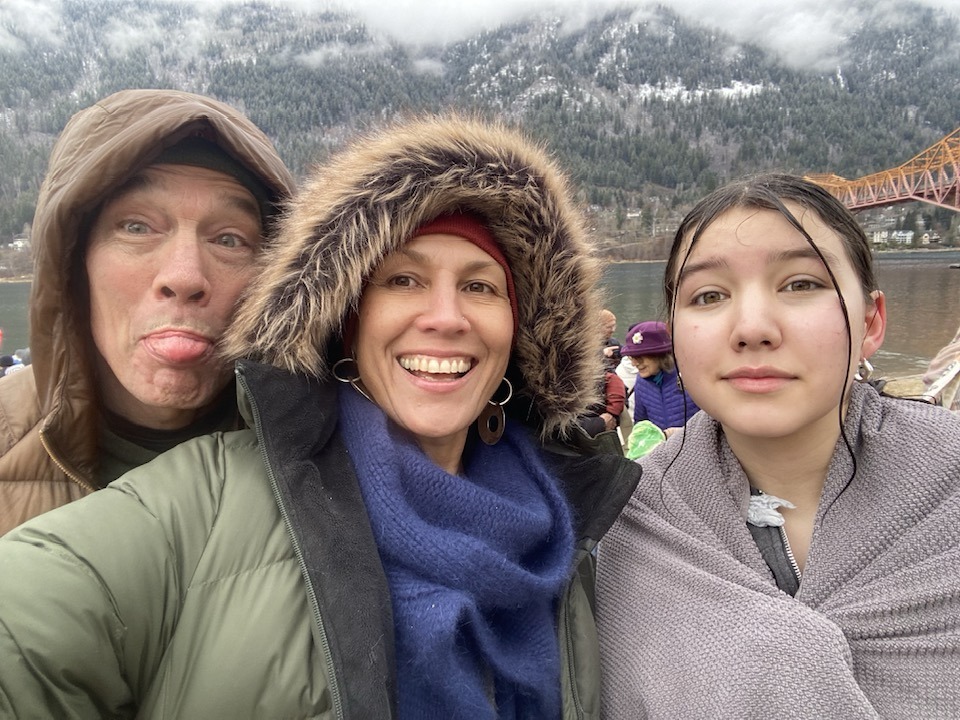
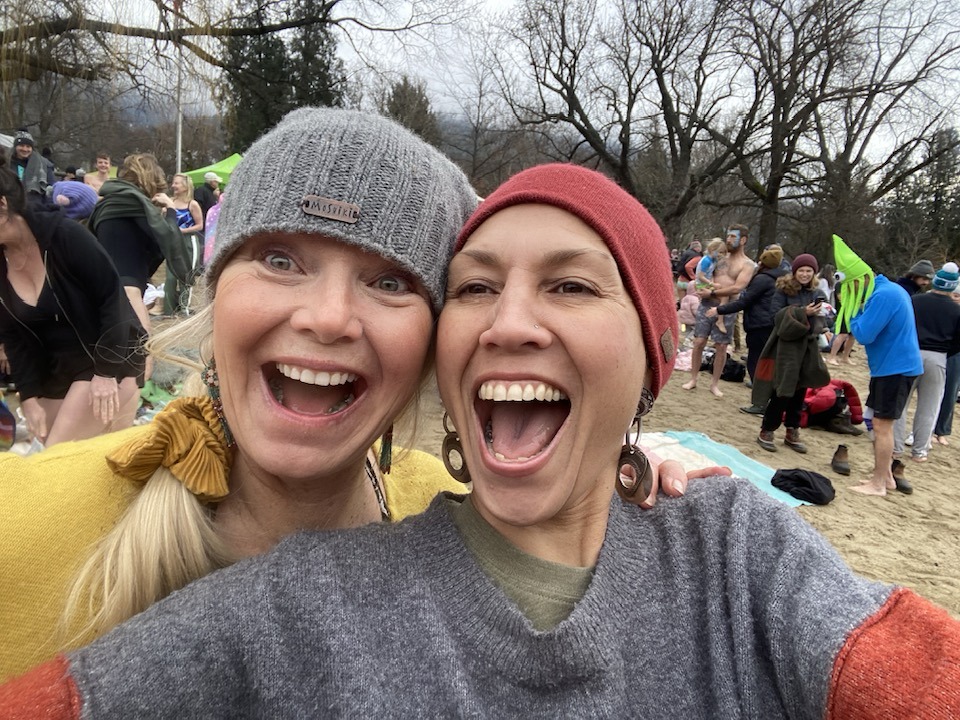
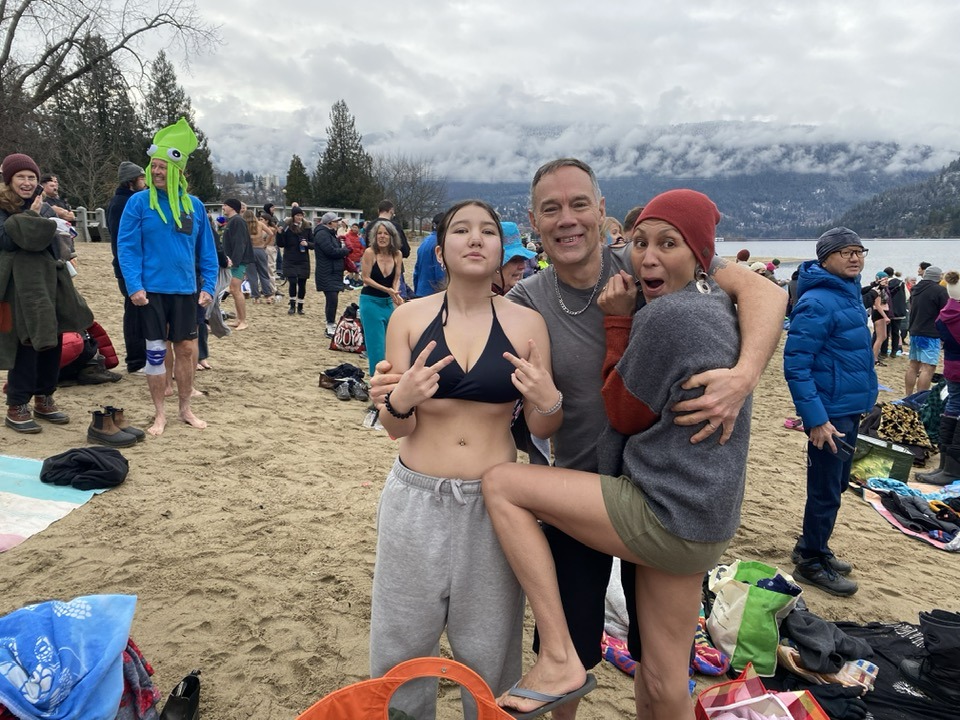
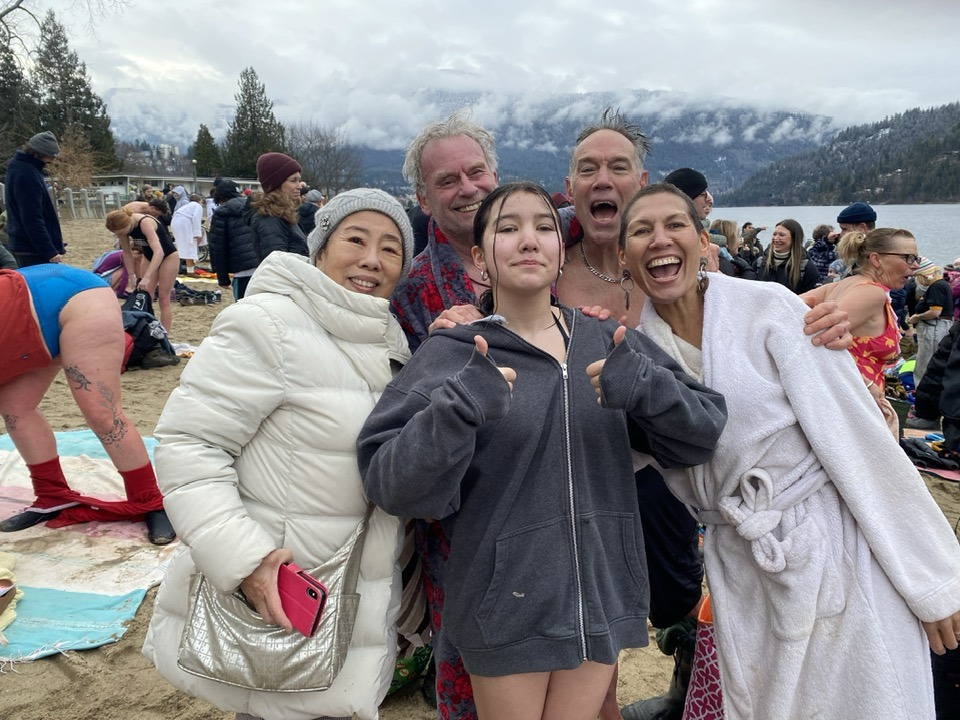
Albeit the middle of a Canadian winter, the beach was devoid of snow. While the weather was milder than in other years, I still hopped between my bare feet, stripped down to my bathing suit. A sizable crowd had gathered, many of whom I recognized as seasoned veterans, shrieking with excitement. Da danced around in his bathing knickers, my husband hollered, Mama was, as always, ready to document with camera in hand, and my teenage daughter grimaced against the cold. Together, we prepared for the plunge, my family by my side.

This was it—we all needed to press the reset button, and this time, I would do it with focused intention. For the first time, I didn’t rush in and out. I took in every step of the way into whatever comes next, and found my way back to shore.

WAILING THERAPY

I’ve been waiting for my husband and daughter to leave for the day. The house is still, amplifying the sound of my pacing feet. I feel as though I’m going mad, squeezed by a vise grip made of my own flesh. My shallow breath crashes against the tight wall of my chest with nowhere to go. Anxious and writhing in pain, I feel that something is going to snap. I don’t feel right inhabiting this tight and torqued body. The urgency of something needing to happen overwhelms me. I don’t know what—until I open my mouth.

At first, I’m stunned by the sound. It comes from the deepest, darkest cavern of my being. Every ounce of my energy is behind it, driving it out from a place that has been dormant. Once the channel to the exit is open, it moves with force. The ceaseless sound of anguish reverberates against the vaulted ceilings as waves of crying, wailing, howling, and screaming crash against the walls around me. It’s a cathartic symphony, raw and primal.

Somehow, my fur kids, Apollo and Tuzzo, instinctively keep their distance, as if sensing this for what it is—an animal release. The vocal purging eventually stops, followed by a silence broken only by my panting breath. From this untamed ceremony, I’ve discovered newfound space within the constriction of my body—a respite from something other than the focus on my suffering. A gift from chaos.

This is yet another edge I have to find my way around, through or over. No matter what it looks like on the outside, energy needs to move.

I’ve been sounding out what I’m up against—my wailing therapy is not just about release; it’s a reaching toward life. I must keep moving toward life, even as the intensity of these last few weeks tries to pull me away. Even through hardship, I’m visited by angels always close by.

They have been showing up through people and moments that remind me I’m still here—precious and deeply loved. People are pouring their prayers over me, bringing me beautiful meals, offering meaningful gifts, sending fortifying messages, giving me deep heart-to-heart touch and soulful conversations. I hold fast to the life and love that make this wild ride bearable.

My heart has cracked open through adversity, creating space for love to funnel through. It tends to the sharp edges, where tears of agony alchemize into beams of light. My heart is wildly awake, with an incredible capacity to feel it all—the mix bag of everything—and still keep pumping for life.

I’ve never felt closer to my family and friends. I prioritize to be free of grievances and the trivial things that used to bother me. I no longer feel intimidated by beautiful, powerful women—I want to draw them in and shine their beauty back to them. I’m drawn to elders to hold me in their wisdom. I give myself permission to present myself as I am. I don’t avoid talking to people I don’t know. I cherish taking time to do just about anything, giving value to what I can do, and doing my best to let go of what I can’t. I’m learning to forgive…mostly myself. I’m not afraid to express that I’m scared and to claim that I don’t know anything, which fortifies my faith in God.

I’ve changed my mind about many things, allowing me to bend with what’s happening. These are profound gifts bestowed upon me during the most challenging of times.

This post has come together in fits and starts, mirroring the rhythm of my days lately. My daughter and husband shaved off my hair as I declared my readiness for chemo, only to find out the day before that I had another bout of a nasty staph/strep infection that postponed it. It turned out my body had become resistant to the last round of antibiotics. The persistence of this infection is what needs to be addressed before the nuking of cancer cells. This deep-seated inflammation surely contributed to the maddening pain.

This chronically festering open wound poses a challenge for chemo, as the treatment will wipe out my immune system, leaving me dangerously vulnerable to the effects of this recurrent infection. I had to laugh at the irony of my premature hair shave in the middle of winter. Still, I’ll offer it up as a symbol of my readiness—a gesture of my willingness to do whatever it takes. I was able to proceed with the immunotherapy portion of my treatment, and a meeting with a surgeon was quickly arranged to discuss the possibility of debridement or a “palliative mastectomy.”

The word “palliative” has come up a couple of times now. I’ve deflected it, swatting it away like a bee that wants to sting me. This word has the power to make me retract from life if I let it. So, I am choosing to see it as I would the word “may”—a word that leaves room for possibilities, for this or that, and everything in between.

Now, as we approach the time of the birth of Christ, I search for the light of Christ within—the light we all carry, the light that connects us to each other and to this crazy, beautiful life. What else can I do but seek and follow this light? What else can I do but keep reaching for love and life? Though I may not know where I’m going, I keep finding jewels in the most unlikely places. That tells me I’m on the right path. That tells me to just keep going.

I close this year celebrating what I’ve gained through what I’ve endured and what I’ve let go of. I’m doing what I can and accepting a whole lot of unknowns. I’m learning, making mistakes, getting real messy, while striving to keep my heart open. I don’t want to leave anything important unsaid. I hold ambition and inspiration in keeping my dreams alive.

I move toward a new year by placing one foot in front of the other, step by step and breath by breath. I send my deepest gratitude for all the love and support I’ve been given. I believe in the power of love as the most potent medicine to do this dance of life. We’re all dancin’ in our unique ways, but we’re doin’ it together. And when the music shifts, breaks, and stops as it naturally does, may we remember to keep dancing—however we may, even if it is only on the inside.

THE FALLEN NIPPLE

I’m examining a part of myself that has been with me all my life, now detached and between the tips of my tweezers. It’s surreal that this blackened, shrivelled raisin of a thing once served as my daughter’s comfort and source of nourishment, nurturing her growth for over two years.

“Should we say something?” my husband asks. My stomach churns in a strange brew of fascination, disbelief, and horror. My nipple has fallen off and it is no longer a part of me.

There have been so many levels of letting go. A year ago, I was finally ready for a mastectomy only to learn I wasn’t eligible. For the last six months, my body has been breaking down this fist-sized ball of unruly cells in a painful, gruesome process—my body’s own way of giving me a mastectomy.

The fleshy crevice is nearly closed, and the sheer force of tissue pulling together brings the most intense pain, surpassing even the avulsion fracture in my left humerus from my recent fall. After my third staph infection due to this open wound and low immunity, I’ve accepted antibiotics as part of my treatment plan. Once my foe, antibiotics are now my ally—a testament to the softening of my once-rigid way of thinking.

The right side of my torso and arm feels like it’s rusting—heavy, creaky, and persistently achy. It’s a diversion from the new lump growing in my other breast. This unwelcome newcomer has a genetic twist, playing by a different set of rules from the other side. I’m not sure if experience has lessened the shock of another cancer or if I’ve simply become immune to adversity. Either way, there’s nowhere to go but toward acceptance, mustering the fortitude to keep going.

“Thank you for being a part of me. Go in peace,” I say. I package up my nipple to be buried with our son, whom I miscarried years ago. What I’m sharing may seem like tragedy and hardship, but I’m seeing it differently. I’m recognizing how much I’ve let go of, which has helped me grow in ways I may not have otherwise. I’m finding confirmation of this in how I navigate these experiences.

There are only two ways of being. In this cocoon of metamorphosis, I can be trapped in darkness or held in light, depending on how I perceive my experience. I’ve started simplifying my approach to life: whatever is not of peace must be examined, and it’s my work to practice finding my way back to peace if it’s absent.

Some days, I crumble under the weight of it all. In the catharsis of unyielding pain and exhaustion, I cry out for mercy. There are thoughts I dare not voice—because if I say them aloud, they might become real. My mind swings like a pendulum between what I have gained and what I have lost. Tonight, I mourned the loss of what was once my perky pink nipple. Tomorrow, I hope to gain something that will illuminate my way forward.

I’m managing my pain while readying myself for the next stage of treatment. There are many moving parts, and they can only be organized from an eagle-eye perspective. Looking back over the last five years, I see that my milestones of growth have come through loosening my grip on what I think I know, acceptance, and my willingness to see things differently—to choose a perspective that doesn’t trap me with nowhere to go.

Now I’m waiting to have my sternum biopsied. We need to determine if the metastasis there is related to the hormone-driven cancer or the new one. If it’s connected to the original cancer and the other is contained without spread, surgery may be recommended. If there is spread, I’ll need to consider systemic treatment for both. The thought of surgery no longer terrifies me. My attachment to appearance no longer enslaves me. Accepting help no longer feels like defeat.

I’ve decided to be proactive and use the remaining funds that this incredible community raised for me towards genetic testing. If I’m to have faith in conventional treatment, knowing that guesswork is minimized would be helpful. FoundationOne, an FDA-approved lab, uses biopsied tissue to identify mutations, amplifications, and other alterations to match targeted treatments. Though it’s unfortunately not covered by our healthcare system and comes at a high cost, this step feels essential for my peace of mind and the best way forward.

I didn’t want to fight to get my oncologist’s sign-off on this or to help me apply for the grant. Her support is essential in moving forward and incorporating this information into my treatment plan. After a four-hour drive and praying for a smooth meeting, I was met with warmth and her full support.

I’m not the same person who once held strong judgments and rigid beliefs. Reflecting on who I was, I see how much I’ve softened the boundaries of what I thought I knew. On a good day, I as Spirit feel more real than I as body. In surrendering my attachments—to appearances, outcomes, and certainty—I’ve discovered that guidance often arrive in the most unexpected and affirming ways. I yearn for connection, to bridge the gap of differences, and to find refuge in the love that unites us all. In this way, I feel closer to God and all of creation, and in this connection, I find my peace.

CHAOS TO LOVE

The process of biological changes manifests as loud, outer expressions, screaming for attention. It’s so easy to be swept away by these acute sensations and fall victim to them. When my focus latches on, it’s like a ravaged dog clamping onto a bone, unwilling to let go. Escaping the madness of what all this could mean requires a quantum shift in awareness.

Now, both breasts are mutating. For months, I’ve been witness to the gruesome disintegration of a mass that, depending on my mindset, can look like healing or like cells spiralling completely out of control. My awareness has evolved, revealing just how easily I can be whisked into victimhood and pulled into dark, unsettling territory. This new lump on my other breast is a different cancer—its subtle emergence allowed it to slip under the radar of my current treatment. It is not hormonally driven which means I’ll have to consider an alternate plan.

The use of my right arm now has limitations due to the swelling of trapped lymphatic fluid under my armpit. This breast has shrunk to half its size as the tumour corrodes. My right wing feels taut, wrapped tightly, like it’s encased in saran wrap. I’m quite certain there’s tearing in my tissue from all the stretching thats causing the edema. The open crevice reveals a dark abyss where there is a battle taking place. The other day, I pulled out a piece of rotted flesh the size of a loonie, and the sight of it made me woozy. Is this process of tissue dying off a form of healing, or am I slowly breaking down?

Yesterday, nearing the end of a peaceful forest walk, a distressed call from my daughter coincided with my dog getting into a vicious dogfight, instantly changing my state. Whirling around, I stepped onto a slippery rock, sending my phone and legs flying into the air. I broke my fall with my good arm and went into immediate shock. It felt as if the opening on my breast ripped wide open, while pain shot through my shoulder and wrist on the other side. The tranquil forest suddenly became a stage for my screams, echoing alongside the brutal sounds of the dogs fighting—a symphony of chaos amidst the silent trees that my daughter heard on the phone lying nearby.

The thing with chaos is that it can feel like the entirety of time, pulling us into its trap. The dogs stopped when my boy, Apollo, sensed I was in trouble. Somehow, he knew I was more important than the fight and came right to my side, whimpering and crying with concern. I lay there, terrified of the damage beneath my bandage, now with both arms compromised. All I could think was, ‘Are you fucking serious? More pain?’ My mind quickly spiralled into blame—the wrong shoes, the dog fight, the phone call—but I caught myself and changed my mind. That road will take me nowhere but down.

Becoming something of an avid traveler in my mindscape, I recognize the familiar downward spiral. Each descent reveals traps and my entire existence hinges on if I can step over the traps and respond to life in an affirmative way. Can I find peace amid so many frightening, moving pieces? No, not always and not right away. What I’ve noticed is that when I strip everything down to this very moment, I’m okay. Nothing is imminently ending. If I separate myself from the pain as an external experience, I can find pockets of respite simply by being here.

As I type, each press of a key reminds me of what’s wrong with me, but I counter it with, ‘Well, at least I’m writing, at least no bones are broken, my boob is still in one piece, I’m eating, and above all, I am so deeply loved by so many.’ What’s truly scary is not knowing what will happen. Grounding myself in what I do know is the only solid counteraction I can hold onto. As long as I anchor myself in love without clinging to it as something I might lose one day, I have the magic antidote to get me through the toughest of days.

I have been stripped down in a way that has allowed me to love myself by truly accepting love from others. Suffering is the sickness of feeling utterly alone. I’ve finally allowed love in. I feel the sparkle of all my relationships shining bright like a lantern, guiding my way forward. In this torn-up world of differences, love is the only medicine. It’s the glue that binds us to life, enduring through whatever is thrown at us and staying with us always.

WOUNDED HEALING

I can now stick the tip of my pinky finger into the black crater of my putrefying tumour and watch my nail disappear. My curiosity meets my repulsion as I wiggle my finger around, discovering new caverns of hollow spaces. I remind myself that although the foul-smelling decomposition of my flesh brings me to the brink of losing whatever foothold I have, I’ve been primed and ready for this by what I’ve learned through German New Medicine. Belief is also a choice, and right now I’m anchoring myself to whatever keeps me steady in the wild terrain of my mind.

I’m cautious about certainty, but my intuition tells me that I’m witnessing evidence of cancer cells dying off and my tumour shrinking. This gruesome biological process seems to be nature’s way of degrading what is unhealthy and unwanted. I can feel the tight ball of unruly cells retreating into itself, pulling on the network of connective tissue and causing inflammation that blocks lymphatic pathways. The tension is felt from the ribs below my breast, up my inner arm, and wrapping around to my lats. The squeezing of nerves sends sharp echoes into my bones.

I recognize that the details I’m sharing may be offensive or interpreted as a cry for help. Perhaps it is. I write as a way to release the pressure building in my mind and to alchemize dark thoughts into clarity. Space is crucial for me to orbit. My intention to be transparent and honest is to invite what wants to be revealed, giving me the opportunity to heal both my mind and body. Whether driven by my ego, a need to document my journey, or as a necessary form of therapy to keep going, I also hope it may serve others in some way, as I utilize creativity as my rose compass on my healing journey.

I’m still learning to balance what fuels my spirit with the patience and care my body needs. I’m getting better at gauging whether I’m overextending myself or being too cautious and limiting my experiences. There’s always room to pivot and respond if I allow myself the space to change my mind. If I impose too many boundaries on how I think I should be or what I can and can’t do, it creates a cage that leads to self-induced suffering.

I knew that a full weekend of vending my visionary crafts, dancing flamenco, and consciously connecting with those who attended the opening of my art exhibit would test my capacity for output. Needless to say, it was a testament to how love and the joy of heartfelt connection are precious medicines for my soul.

Bare-breasted, I sit as the wound clinic nurse cleans my oozing opening. I feel deeply irritated when she asks why I haven’t had the tumor removed. I haven’t seen this nurse before; her curt foreign accent makes her sound harsh and too direct for my sensitive state after a big weekend. The sleepless nights, punctuated by sharp pain and the emotional toll of the drugs I took to manage it, along with a general feeling of being ‘over it,’ contributed to my irritation. Instead of lashing out or retreating into myself, which is what I wanted to do, I course-corrected and calmly stated that surgery is not an option for me while treating metastasis. That response seemed to soften her; perhaps the softness was already there, but I only noticed it after my intentional remark.

I can easily fall into the trap of associating what’s happening to my body as my only experience of self, especially as my keen sense of smell constantly reminds me of a part of me that is rotting away. It’s easy to feel self-conscious about the smell, but that’s the beauty of transparency: there’s no need to hide. The practice is in finding safety in the wide open.

My mind is most vulnerable when day slips into night and pain lures me into the territory of fear and uncertainty. Until recently, I relied on my superpower of being able to sleep and shut off adversity. Now, that power has been hijacked, bringing new nighttime anxieties about losing the natural ability to rest and reset.

I’ve made peace with the tiny teal-colored pellet of morphine that I’ve accepted as my ally for now. I’m having a harder time with the little aqua-colored ones that can easily send me off to sleep. There is a price to pay for this assured reset, as it amps up my already medically induced volatile hormones. It makes me question and quake.

I’m into the seventh month of treatment, and although there are days where I feel like I still don’t have a handle on anything, I’m getting better at being kind to myself. I am more patient than I used to be and have faith in what can’t be fully known but deeply felt as truth. I seek opportunities where I can open to love instead of repelling, shrinking or hiding. I do my best to remember that that pain happens, but fear and suffering is a choice. I ask for help to surrender what is in the way of trusting what can’t be threatened.

While on a walk, I saw a round of a cut-up fallen tree. Looking closer, I was amazed to see bright green foliage sprouting from what I would have otherwise thought was dead. It led me to reflect on how the will to exist and express can blossom from the most unlikely places. The force of creation is a power to behold, sustained by the remembrance of its indestructible nature.

Joy captured by photographer Clinton Johnson.