THE CONCEPT OF ME

Aren’t so many of us in search of meaning in our lives? Isn’t that quest ultimately driven by the age-old question, Who am I?

When we’re born, most of us don’t yet know who we are. As we move through life, we begin to fill that blank space with ideas shaped by our experiences and the people around us. We form an image of who we should be—one that reflects inherited beliefs about what makes us worthy, safe, and special. Over time, we find ourselves striving toward that image or resisting anything that threatens it.

Our sense of good and bad is shaped entirely by experience. Some of us are even taught to mold ourselves into someone else’s version of “good,” or to believe that what another person calls “bad” is actually right.

Being born can feel like beginning a painting on a blank canvas. At first, each brushstroke is our own, but as life unfolds, other hands begin touching the canvas—through influence, circumstance, and expectation. Eventually the shapes and colors morph into something foreign, something other than me.

So we keep painting, layering new strokes in search of meaning, hoping to finally create something magnificent. Yet the more we add, the more we forget what was there before the first stroke—the untouched space that quietly recognizes itself completely.

Perhaps our longing comes from that remembrance. In this way, the world becomes the practice ground—to learn to unlearn the belief that we must become something in order to find peace. We gently undo every version of ourselves we thought we needed, each one an avatar created for a different chapter of the dream. But who is the one dreaming the life lived through them?

It can feel mind-bending, especially when our senses insist that only matter is real. Yet suffering always arises at the borders of the self-concepts that make up the collective—the places where we divide and separate. When the little “i” of separation becomes the center of perception, we can’t fathom the all-inclusive reality of Love—a Love so abundant it breaks the laws of this world, where one’s gain must come at another’s loss. In the realm of the shared Self, what is given is also received, because the giving and receiving happen within the same One.

When I scrutinize what version of myself would finally make me happy, I see that I can never be truly satisfied, no matter what I overcome, do, or achieve. Fulfillment based on what my body does—or fails to do—is always temporary. I find myself asking: What are these values for? What version of myself am I protecting, and why am I so afraid of losing it? Perhaps it’s because I made it and it feels so precious.

The healthy self, the creative self, the strong self, the generous self—all exist beside their opposites, each quietly in conflict with the other. Life becomes a dance between these selves, each grasping at fleeting ideas of happiness and safety.

My state fluctuates with my mind. My vitality can be snatched away in an instant when old fears catch up with me in a single thought. Even when nothing around me has changed, the thought I don’t want this to change can take my healthy self hostage, seized by the one facing the formidable unknown.

These moments remind me, viscerally, that no version of my constructed self can protect me from impermanence. Peace can only be found through trust in divine law—the truth that we are already perfect, whole, and eternally safe as we were created, of the same essence, beyond any concept of ourselves we could imagine.

I can only begin to envision that everlasting beauty, and so I practice believing—trusting that what is real has never changed.

When I contemplate my true identity as a perfect creation untouched by what I think or do, I feel immense relief. Whatever I believe I am—or should be—has nothing to do with what I truly am. Beneath all layers of self-concept lies the original, unalterable holy Self, exactly as Love created me. This same unchanging Self lives in everyone, quietly waiting to be remembered. And because our minds are ultimately joined, remembering it in myself and choosing to recognize it in others helps reveal it in all. This is no easy feat, especially in the face of pain or injustice, nor does it turn me into a passive bystander to be tossed about. It does, however, give me the sense that I’m standing for something meaningful—something that points toward a freedom resting on stable ground.

Duality—the yin and yang of life—reflects the tension of opposites that governs this finite world. But what if duality was a choice we made with the first stroke on our canvas? What if we set in motion a painting meant to contain everything we thought we wanted, only to discover that no canvas could ever hold what we truly are?

And yet, beneath every shifting stroke, something changeless remains. The shared Self is untouched by striving, fear, or judgment. The world continues to teach and challenge us, but we can look beyond its rules for solutions—to step back, breathe, and question what is determining our state.

When the insanity and heartbreak of this world bring me to my knees, my practice is to return home—to divine reality—where our shared essence holds us, and peace is all there is.

Holding this paradox—the life we experience and the perfection of our true identity—is where I seek freedom. As we release the layers of self-concept that shift with every experience, we find steadier ground within. Each moment of awareness becomes an opportunity to return to that quiet, unchanging Self—the part of us that has never been lost. Even for an instant. And that instant can lengthen into the next, and the next.

Life is not about finishing the painting or capturing every detail perfectly. It is about remembering that the masterpiece already exists within us—the quiet assurance that nothing we do or fail to do can alter what is already complete.

This blog was inspired by my reflections on my weekly ACIM Essentials class, “A Case of Mistaken Identity,” taught by Robert and Emily Perry at the Circle of Atonement. They have a vast selection of podcasts exploring A Course In Miracles here https://circleofa.org/podcast/

GOD’S GUARANTEE

I was searching for God in my dream last night. Where are You? I need to know that You are there. I need to know that I’ve invested in what is real. I need to know that Your promise is the truth. I need to experience it in a tangible way — through my felt senses, here and now.

And then, in an instant, He answered my call.

From the room of my dreamscape, I was lifted and suspended in the open space of my mind — my back to what I’d left behind, my heart open to the light that filled the sky. A surge of ecstatic love rippled through every cell of my being until I became it. God’s love filled all the cracks of fear and doubt within me. The joy I felt broke the lineage of time and folded into itself to always. The jubilation of receiving proof that I had placed my trust in Truth was the only answer I ever wanted.

I can still feel the realness of that dream — how my prayer was answered in a way so certain and strong that it carried into waking life. Its presence now is a guiding light through the trials we are to navigate. Our collective ailment of fear is like a house of mirrors, reflecting our individual plights in distorted ways — each of us wrestling with different shapes of the same illusion. Fear convinces us we are alone, fending for ourselves, while love reminds us that we belong to a unified force far greater than anything we face on our own.

What makes us feel so alone? It can only come from believing we are separate from each other. A Course in Miracles teaches that we were born from perfect love, created with limitless potential. Yet somewhere along the way, the idea of a separate self arose — what was One seemed to become many — a choice made through our own free will.

Making the choice to separate from the love that held us all is where our initial sense of guilt took root. Fear then becomes the fuel that keeps the illusion of separation alive. The Course helps me see that an all-loving God didn’t create suffering — we did, through the limitations we place upon ourselves, and by guarding the idea of the self we made.

It’s that time of year again — when autumn’s changing colors remind me that we’re moving into the season where darkness begins to dominate the day. It’s shedding time. The trees make it look effortless to let go and dare to be bare, but it’s not so easy for me to stand naked amid the landscape of my scurrying thoughts.

As the light gives way to darkness, so do my thoughts. My mind keeps hooking into where I was this time last year. Old stories have a way of repeating, creating more of the same — especially when a trigger appears. Yesterday gets dragged into tomorrow, skipping the beauty of today. The body follows wherever the mind gets caught. Fear travels that line and embeds itself in the tissues, plucking a string like a note on a guitar — echoing the story I thought I’d left behind. I feel the familiar tightening in my chest wall, and my breath hitches.

Unconsciously, my hand traces the smooth contour of what remains of my right breast — a stark contrast to the rough terrain of bound-up scar tissue beside it. The small leftover lumps that appeared on the PET scan lie beneath the part I got to keep. To feel them, I used to have to press my fingertips deep, but that has changed as of late. They are moving toward the surface, pronounced and making their presence known. My fingers anxiously feel them, a habit from before, which is taking root in the fertile soil of my mind. How easy it is to falter beneath the snowball effect of fear, to get lost in “what ifs” and “what to do?”

Nothing in my present state even comes close to where my mind tries to take me. Physically, I feel vital — stronger than I have in years. Yet fear, born in the past, has the power to erase all proof of truth in the now. The anxiety of having my current blessings robbed by what this could mean is a ball and chain that can easily take me down.

I anchor to God’s guarantee that I felt in my dream — that my true Self is not my body or the things that happen to it in the passing of time. I carry a small treasury of A Course in Miracles lessons within me — teachings that help me unhook fear’s grip and return to refuge. I steady my runaway thoughts with a remedy found in a lesson: I can be hurt by nothing but my thoughts. I breathe it in, examine my thoughts, and ask gently: What thought am I believing in?

At the root of them all is the fear that God would abandon me.

I have to admit — my faith is not yet whole. Somewhere in the shadows lurks a quiet terror: what if I’m wrong?

So I begin again — the slow, steady work of untying the knots in my thoughts. Finding freedom in reaffirming what I’ve learned and experienced. The evidence of receiving guidance and finding my way is held in God’s love, extended through His Sons and Daughters no matter what I am up against.

I want to affirm that my body’s sole purpose is to extend love — that life’s work is to forgive the false concepts we’ve made of ourselves and others, the ones that make us forget what we are really made of. Even when fear trickles in when I keep God at arm’s length, somehow His grace always invites me back Home, to where love lives and where I am forever safe.

POLKA DOT ORANGE LIGHTS

“I’m happy about your results,” my oncologist says over the phone. She’s relaying the radiologist’s report from my recent PET scan. I’m surprised by the felt sense of release, even though I had convinced myself that this time I wouldn’t let it get to me. I wouldn’t let the anticipation of the result become an invisible weight I carried. But it was still there. The difference is, I’m stronger now, and I can carry it without letting it drag me down.

Still, my light-as-a-feather release moment was short-lived. My quick translation of what she said was, “I’m done, I’m cancer free! Whoopee! Finally!!” But then she proceeded with what I didn’t want to hear which meant: it ain’t over yet.

The Coles Notes version is that there are lumpy remnants of disease bound up in my scar tissue. There are still a few small nodules left over from the breakdown of the big tumour. I focused on the positive: it’s no longer in my other breast, sternum, liver, lymph nodes, or in the suspicious activity that showed up in my right lung several months ago.

“There is a new lesion in your spine at T4 that we are going to have to keep an eye on,” she continued. It’s a game of give and take, and what is left over is where I have to count my blessings. My mind quickly grasped for an explanation.

I had two terrible falls last year where my heels went over my head and I smashed hard onto my back. Both involved slipping and landing on solid slabs of wet rock. The first time, I broke my fall with my left arm, which fractured my humerus and left me with a frozen shoulder I’m still patiently thawing out.

The second time was a classic ass-over-teakettle slip down the stone steps to my garden. That time I remember lying there motionless, afraid to move, praying that I hadn’t broken my back.

“Could a fracture or major trauma in that area cause a higher glucose uptake in the scan?” I ask. I can hear the desperation in my voice and feel my heart squeezing around panic. “It could,” she replies, “but the formal report says that it is likely a metastasis.”

This is how it starts: fear finds a crack to get in. If I look away and let it in, it will take hold—and that is what metastasizes and spreads. That is what alters my experience from being free to becoming a prisoner. I know I have to nip it in the bud—not with denial, but by shifting my awareness to a greater Reality that will guarantee my safety.

This is the thing: the radiologist is commenting only on the supposition in cases like mine. The last PET scan was done over a year ago, when the orange glows of sugar uptake in my report were polka dotted in too many places. Assuming that cancer “spreads,” all the orange glows led to the presumption that it was all cancer — even though healing tissue also takes up sugar. This is my own disclaimer on these super sensitive machines that pick up everything. I was never completely sure that was the case, but I didn’t want to biopsy bones and organs, so I went along with it, hoping it wasn’t as bad as it seemed. It was most likely denial, but at the time, it was the only defense I had to keep going.

The radiologist comments on my scarring as a “surgical site,” which it is not. The scar tissue was not from a clean cut surgery. I wanted him to know what I endured—that I didn’t have the option for a quick and easy removal of my problem. It’s more like a mesh of healed tissue from a decomposition site. I find it mildly annoying that the guy writing this report has no idea what I’ve been through and writes without considering my falls as a possible explanation for the T4 light-up. I recognize my annoyance is guarding what I want to keep safe, so I let it go with my next out breath.

My oncologist is thorough and pulls up the last three PET scans, spanning two years, to compare them on her screen. “Maasa, you really should see the changes in the imaging. You can literally see those orange globes of light around your body dissipating with each scan. I think you would feel really encouraged if you could see what I see,” she says. I love this woman, especially because she wants me to just keep doing what I’m doing. And even though there is no real end to talk about in terms of treatment, I decide that this is good news—because really, it doesn’t change anything. I can keep living the way I am.

I had decided I wouldn’t live suspended on “what ifs.” There will be more tests, and the only constant is change in whatever direction life flows, so I’m training my mind to anchor to what is steady and forever. It’s ongoing daily work — practicing permanence in a world that only guarantees impermanence.

I was nervous when I signed up for a workout class that I used to do in my twenties. I’d been feeling the nudge to get strong, to push healthy oxygenated blood through my system for a house clean. To feel those endorphins combat the restrictions in my body, to be told what to do by a guy that inspires me.

Coach tells me not to ask questions and just do what he says. That is exactly what I need: just show up, do the work, and get on with it. I survived the first week of a strenuous, sweaty workout, which confirmed for me that so much of how I feel depends on the limits I place on myself. Sure, I have to modify here and there, but my body followed the state of my mind that chose not to let anything get in the way.

My monthly treatment in the chemo lounge was right after class on Friday. My veins were so pumped that, for the first time, the nurse couldn’t get an IV into me. It gave me a funny sense of satisfaction—even though it hurt to have her poke and prod until I finally relaxed and let her in.

It’s helping my mindset to know that the cocktail of two drugs for my targeted therapies does not damage my healthy cells. Instead of attacking fast-dividing cells like chemo, they target and block the receptors that fuel the cancer cells. The hope is that, without fuel to grow, those unruly cells will weaken. With me strengthening my own immune defense through everything I’m doing—mostly mindset, herbs, supplements, and exercise—they may eventually remember their true function and return to behaving like healthy cells.

My life can easily be defined by tests and the shifting statuses of this disease. What I’ve learned from the latest PET scan is that I’m still reaching for the finish line — and I don’t want to be in a race. My path is the one I’m on, and anticipating it to be any different will only cause me grief.

Tests come in three-month increments. Thankfully, the next one is an MRI, which I requested because I need a break from the radiation of these nuclear medicine machines. Rather than reaching for a different kind of life or pinning my hopes on a better scan result each time, I’m practicing being here now — finding perfection even in the nooks and crannies. To be an expression of the good stuff I want to share — and for the rest, I place the future in the hands of God.

FROM WHAT IF’S TO WONDER

It is inspiring to learn that peace is something I can access within myself, but it requires a conscious choice. It may be fleeting—like the sea, calm one moment, turbulent the next, yet in the depths, it remains still—constant and ever-present beneath the moving waves. We thrash against what we cannot control, cling to what we don’t want to lose, and forget that deep below lies the safety we seek. When we focus only on what’s happening on the surface, it’s easy to get lost at sea.

It takes daily practice to train myself to believe that I am not a body, but it is the only idea that truly offers the kind of guarantee I seek. Every fear I’ve ever had comes from external circumstances affecting me, my loved ones, and the world at the physical level. So, I aim to manage how I think about the physical world in order to make peace with what I cannot control or understand.

Six years ago, right before the Labour Day long weekend, I left our beautiful campsite at Garland Bay on the shores of Kootenay Lake for a solo trip I’d been dreading for months. The lump in my breast had been growing, and I could no longer hide behind my stubborn denial. The biopsy was scheduled during our camping trip, just days before my daughter was to start Grade 4.

I didn’t want to be coddled or accompanied; I just wanted to slip into town, get it done, and return in time to savor our last summer hurrah together. She was only nine then. Today, she’s starting Grade 10—and here I am once again, waiting for scan results after the Labour Day long weekend. Interesting how cycles repeat, but this time I keep my peace close by.

I still feel the twinge of “scanxiety” lurking, trying to take hold with worries of the result. Each time fear rises, I anchor myself to my spiritual practice, drawing on the teachings that remind me of what is truly unshakable.

Mama and I decided to make the trip together to Kelowna, where I was scheduled for a PET scan at the B.C. Cancer Center. Seeing her navigate life with an uncomfortable ileostomy bag for months, after her emergency surgery for acute diverticulitis, reminds me of the resilience we both carry—and of the quiet strength it takes to live with open hearts amidst unknowns.

Mama rarely complains, even as the overburdened medical system made her wait long past when her reversal surgery was due. With thirty people ahead of her and a surgeon who works only twice a week, she has been patiently waiting her turn. We’ve both endured our share of bodily challenges but managed to stay afloat. That’s just how our family is—we don’t linger in self-pity; we strive to shift perspective until it becomes useful and meaningful. Together, we turned the trip to Kelowna into a celebration: good food, shopping, and the closeness we share.

Entering the Cancer Center, I leaned on my daily A Course in Miracles lesson. I’d started the 365 lessons at the beginning of the year, and that day’s—Lesson 240, “Fear is not justified in any form”—felt fitting for a waiting room full of uncertainty. I reminded myself that who I am, as God created me, can never be truly threatened, and that fear only arises when we believe something outside of us has power over our peace. Looking around, I felt a gentle compassion for everyone there, each facing their own mortal struggles just like me. The body is the ego’s most convincing disguise, yet beneath it, I held onto the awareness that our true nature is always safe—and silently shared what I believed with those around me.

Over the last two years, my main oncologist at the cancer center has been a steadfast ally. There is a mutual respect between us—one I might even venture to call a friendship. When I received the appointment for my PET scan at the Cancer Center, I asked if, by chance, she could see me for just a few minutes, assuming she was at work. The lovely ladies on her team conveyed the message, and my heart leapt when I saw her coming down the hall—I didn’t hold back my embrace, even though it was our first time stepping beyond the usual patient-doctor boundary.

I showed her the large scar where a third of my breast had putrefied and is now fully healed. She traced her fingers gently across it and congratulated me, and I couldn’t help but laugh at the absurdity of us standing in the hallway, admiring my scarred breast as patients and staff walked by. Her effort to come see me, even for those brief but meaningful minutes, reflected her genuine care—and I felt it. That kind of love is its own medicine. I hugged her again as I said goodbye and made my way to the nuclear medicine division.

With this scan, I will gain clarity on the source of the lumpy remnants in my breast and whether any cancer activity remains in my body. Even though the body is not who I truly am, I need it as a neutral vehicle through which to extend my love into the world while I am here. The PET scan nurse guides me into a room and injects me with radioactive sugar, which will light up areas in my body if there are any hungry cancer cells. She reminds me to avoid pregnant women, babies, and children for six hours, as I will still be radioactive. I go over my prayers and fill my mind with thoughts of peace for forty minutes, allowing them to take effect. Then I step into the tunnel, and lay down in the hands of God.

I remembered all the times I tried to manifest the life I thought I wanted—things, circumstances, comforts. How often did I get what I asked for, only to feel empty again? Manifesting has taught me that I don’t truly know what I want. What I long for most is a peace that cannot be disturbed, safety that is guaranteed, and a sense of wholeness that comes from within and spills outward. It can only come from returning to my Creator and creation itself, already present beneath the layers of the human story. This is what Lump led me to learn—the greatest gift to come from the messiest part of my life.

During this time, we were caring for the last of our four pet rats, whose body was riddled with tumors. She was in rough shape, yet her insatiable drive to eat and be touched made it unbearably difficult to decide to play God and end her life. Each day, I watched her struggle and felt a conflicted mix of trusting nature to take its course while confronting the unsettling echo of my own journey with cancer. It reminded me of the uncertainty I was still facing, and that no matter how much I practice, the fear of death and the attachment to the experience of being in this body remain primal. I played tug-of-war between loss and what cannot be lost as we prepared for our Labour Day camping trip to Silverton, B.C., the day after my return from Kelowna.

Standing on the paddleboard, gliding across the crystal, glassy water of Slocan Lake, the mountains rose in their majesty all around me—a reminder of my place in the vast mystery. I landed in the kind of peace I had been seeking, where the debris of “what ifs”—the scan results and all that I cannot know—settled to the bottom of the still lake. I realized how long I had been chasing the “whys” of this disease, trying to make sense of it. At last, it didn’t matter to me anymore.

After exploring many spiritual traditions throughout my adult life, I have chosen one path to study and practice. Following the teachings of A Course in Miracles helped me navigate what could have been the darkest time of my life, offering an alternative perspective that shone a light onto what feels timeless and real. It resonates with me deeply, even though it will likely require practice for the rest of my life. My experience has shown that as long as love, forgiveness and peace remain my priority, the way continues to unfold. In this light, I can relinquish the “why” and rest in the changeless.

As the light of our perfect day yielded to night, Al and I walked down to the beach, drawn by the splendor of the star-filled sky. Above us, space unfurled in deepening shades of blue, dissolving into velvet black. Millions of stars glittered overhead, and the Milky Way stretched like a luminous river, a bridge leading me into the mystery.

The Big Dipper was straight ahead in my sightline when my eyes caught a light racing across the sky at incredible speed. Just as I exclaimed, “What’s that?” Al locked on too. Out of millions of stars, he found the very one I had seen ripping across the night. “What is that?” he echoed.

Moments later, another appeared—this one wavering, flashing, and veering at an odd angle like a drunk driver. “Another one!” I cried. For an hour, we watched as lights darted, flared, and streaked in ways no plane or satellite ever could. Dozens of them moved with impossible speed and strange, erratic patterns, like vessels skipping across dimensions.

They would appear out of nowhere, often right where we were already looking. The most thrilling moment came when two streaks hurtled toward each other from opposite directions, seemingly destined to collide—only to miss by a hair’s breadth to our naked eyes. And the most mesmerizing part wasn’t just the spectacle itself, but that Al spotted each one only a heartbeat after I did, as if we shared the same mind. “Are you creating them?” he asked.

“Am I… or is it us out there creating us here in this moment?” I answered.

We sat in the darkness, gobsmacked and spellbound. We wanted answers. Our minds wanted to know—what were they, why were they there, and what they were doing? It is in our nature to ask, to seek safety within the confines of understanding. But by releasing the “why,” we received the gift of wonder in the mystery. In the vastness that cannot be explained, we can let our imagination roam, embracing what cannot be contained and can only be experienced—even with lingering question marks.

Opal, our ailing rat, was still hanging on when we returned—still eating feverishly, dragging her broken body to the food bowl as if her survival depended on it. I noticed a small ulceration under her armpit, exactly where mine had been. And then, out of nowhere, just like the lights in the sky, clarity appeared in my mind. I knew it was time. I made a phone call, and the decision was confirmed with an opening that very afternoon.

I was surprised at how emotional I became. She had become a symbol of facing the impermanence and suffering of this world—to feel it all, yet anchor to what I believe to be true: that there are no endings, even when it feels so out of reach. I stroked her feeble body and repeated the ideas that have given me solace from the Course: You are not a body. You are free, for you are still as God created you. Love created you like itself—unto love you will return. As I choked out these words through tears that would not stop, I found myself caught in the beautiful paradox of yes, I know—but it still hurts.

It took another lethal shot for her eyes to glass over, carrying the palpable sense that she had left. From her ending here to another beginning, wrapped in the blanket of mystery, I felt the same serenity I had felt paddling on the lake—the stillness of peace where everything settled into its rightful place. She rests alongside the ashes of my grandmother, two of my star babies who did not make it to term, and other fur babies who passed before her. I used to push death away, unable to be too close to endings, but now I understand that it is love that allows us to be fully present as life flows out and on.

NOW WHAT?

The acute phase of survival has since passed, and in its place, a gap has opened—space that wants to be filled. I feel the aftershock in residual tremors, my footing seeks traction in the space ahead. Now, life back to somewhat normal pulls me into the trap of restlessness—as if I need to make up for what I’ve been through by becoming someone of more value.

It’s ridiculous, but even after all this, it still comes to get me. I’m still getting duped by the habit of assigning value to what I do, instead of resting in the quiet grace of all that’s been given to me. Even as my intellect understands that I’m already at home base, the self I’ve constructed keeps me running—from the perfection of how I was created.

I feel the pressure to do something significant in return for the extension of my life. I thought I was done with the rhetoric of that harsh inner voice—the one that drives me to do more, to be better. But ego is loud, convincing, and insistent—sending me out in search, while I forget that I’ve already been claimed by an inherent happiness that asks for nothing in return.

Cancer takes up so much space—not just as an all-encompassing distraction, but as something that gave meaning through the effort to survive. The biological malfunction that became my greatest challenge also cracked me open, allowing light to come in. Now that I have a relationship with that light, I’m on alert for what blocks its shine.

I feel the tension of knowing that my scramble for purpose is rooted in fear—the fear that if I don’t fill the gap with what I make of myself, the disease might return and do it for me. So the focus shifts to the next problem—whether it’s the volatile state of the world, the financial pressure we’re all facing, or the endless causes I feel helpless to do anything about. It’s all an outward projection of the same thing: I’m still trying to fix it from the outside, instead of settling back in.

As I sit here after my quiet morning contemplation, I’m reminded that ego will have me seek but will make sure I never find. It distracts me with a sense of urgency to do something, anything for an illusion of a fix of what can’t be fixed from the same level where the problem was created.

I’m finally free of that horrendous pain that once felt like it would never end. But the gift of coming out of it is so easily forgotten as I latched onto the next mountain to climb.

The unsettling sense that I needed to do something should have been my cue to pause and examine the root of that urgency. Instead, I convinced myself that I could be of value by helping my husband, a developer, and jumped into a path entirely outside my norm—just as I was beginning to come up for air. The idea felt so far removed from my usual operating system that I mistook it for clear guidance. So I enrolled in a university-level course to become a licensed realtor, with the intention of selling the units he built.

It only took ten days of misery—battling my brain to retain information I had no desire to keep—before I could admit I’d made a mistake. The choice came from fear of the open space that was actually meant for my happiness. I’m still on the mend, still receiving ongoing treatment, and still hold my breath when I click open my blood test results every three weeks. My gratitude for my health had been misplaced in what I could do with it instead of simply basking in it.

I’m of value because I’m still here, doing my best to live and share what I’m learning. Even though I don’t fully understand how, I trust I’m doing my part for the healing of the collective. This is what I return to when I find myself spinning out of orbit. To come back home to happiness and shine out.

It’s important to mention that much of what I write is inspired by my ongoing study of A Course in Miracles. That said, studying it doesn’t mean I fully understand it. It continues to meet me exactly where I am, gently guiding me to live to love.

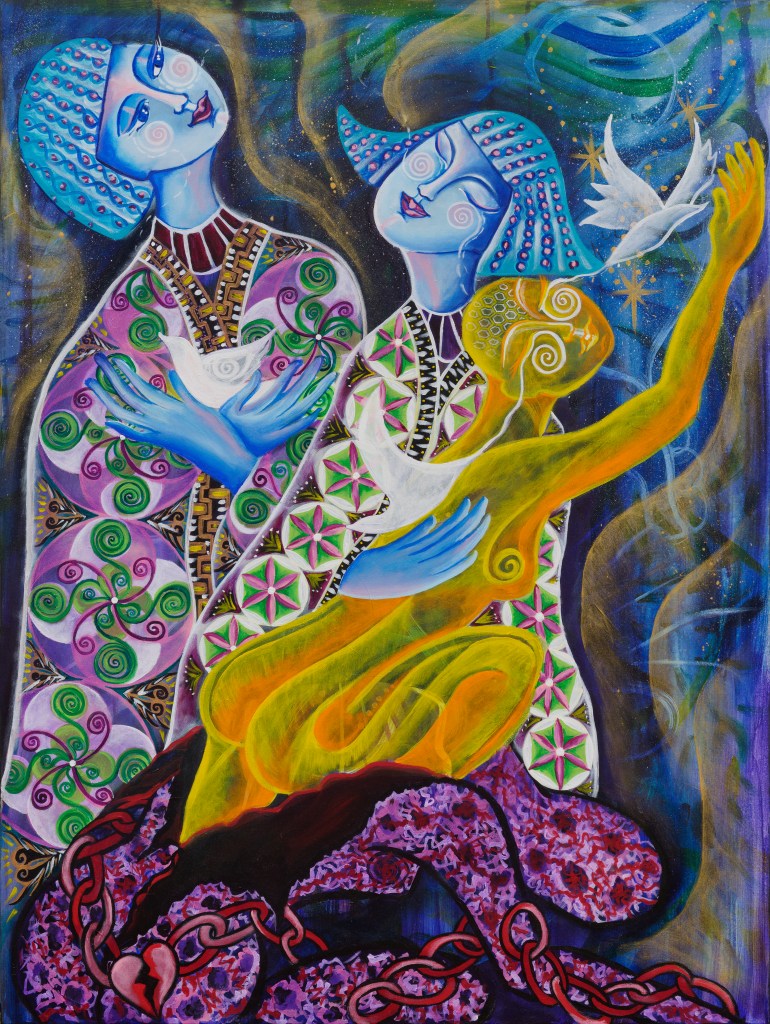
Above painting by maasa.ca

Hold Fast

We are wired to problem-solve, but what happens when the problem affects everyone, yet the solutions feel different for each of us? How do we navigate the collective terror of impending doom—the world vibrating with angst and division?

Fear reigns over what we cannot control, convincing us that we can escape it or defeat it. But how can we “win” if we’re operating from the same mindset that created the problem? Chaos persists because everyone has their own truth to defend. As long as there’s someone or something on the other side of the battlefield, any victory will be short-lived. A Course in Miracles teaches that we must leave the battlefield entirely, beyond the mind that believes in the battle.

So, where do we find our security? At the root of my dis-ease lies scarcity, loss, pain, and death. It’s where I land when the reality I created feels like it’s crumbling into nothing. How can peace be found in what we cannot control? No amount of running, hiding, or fighting against the manifestations of fear will bring lasting assurance. True safety can’t be found through opposition. As long as we fight to protect what we inevitably can’t keep, we lose—like sand slipping through our fingers.

Why do we seek love, happiness, and joy? Because these are the essence of our making, and we long to return to them. Yet, we perceive them as fleeting—things that can be taken or lost.

Often, our gains come at the expense of someone else’s loss. For example, I may celebrate my health by comparing it to someone else’s suffering. This is how ego tries to make me feel safe, but it’s a sham. It convinces me that I’ve escaped a similar fate, while instilling the fear that it could still happen to me. What kind of assurance is that?

But what if the truth is that we already have all we need? What if our inheritance cannot be lost? If the body is what separates us and our identification with it is the source of all our problems, can we look past it? In that understanding, we would no longer be bound by our mortal predicament.

My survival instincts peaked during my own battles with fear. No amount of effort could overcome its formidable force as long as I believed what it was trying to convince me of. What was it trying to tell me? That I am a speck of dust in the grand scheme of things, destined to suffer and fade into being forgotten—with that being the end. But what if the thought that believed I was a speck changed?

All problems originate in the human mind, shaped by a survival-based perspective. Even billionaires feel they need more to secure their existence, just as those struggling for their next meal or seeking escape from unbearable circumstances. The form may differ, but the underlying fear remains the same.

I’m learning to anchor myself in what cannot be shaken—in the intangible realm beyond the part of my mind that feels threatened. It exists in a space where no imaginable worst-case scenario can affect it, untouched by forces I could ever conjure. This requires faith.

I keep holding fast to what I can’t fully understand, yet it miraculously keeps my light lit. I’ve learned that everything I long for is just a thought away—if only I can grasp it. If I succumb to the fear of the possibility of cancer coming to get me again, if I believed I was ‘incurable,’ life would just be a ticking time bomb. That’s no life at all.

There is a way out of nightmares if I recognize that I’m in one and choose to open my eyes. The evidence of this in my life inspires me to keep trusting, even without knowing where it’s leading me. All I know is that this is the only way I know how to do this—whatever this is. My only job is to leave the battleground within myself and bridge the divides in my everyday life, however they appear.

Anything I hold against myself or others only brings pain, even if it’s unconscious. Perhaps the helplessness of witnessing the chaos in our world can only be healed by seeing it for what it truly is—a beast born from the errors of our thinking, and therefore, something that can be undone. Each time we catch ourselves in attack mode and respond with loving forgiveness for what we’ve forgotten, we create an opportunity for change—a change that serves us all, starting with each mind choosing peace.

Does this mean I roll over and don’t take a stand? No, but I can take a stand while holding fast to what can’t be changed in a world dominated by change. A radical shift is necessary in these unprecedented times, which amplify our collective fear. Isn’t it time to try something different to break this cycle of division? I trust in a mighty force that works through each and every one of us when we remember what can’t be taken.

If every interaction reflected the larger whole, and we had the choice to mend the divide—regardless of how things appeared on the surface—would it be a practice worth engaging in? If we viewed conflict as an expression of fear and a desire for safety, recognizing that, in this way, we are all the same- would it shift our perspective on how to approach it? Wouldn’t we help each other from that place? If we are truly connected, then human relationships become the mirror through which we see our relationship with ourselves at the deepest level—and an opportune place to heal from.

Perhaps miracles happen when we step onto a playing field where no one needs to win and fear cannot enter. But first, we must allow the possibility of such a place to exist in our minds. I believe that as we shift from fear to the safety of love, the ripple will spread—benefiting us all. What I’m certain of is that the paradigm of pointing fingers only repeats the same patterns. A Course in Miracles is gently guiding and inspiring me to question the dominance of fear. That’s where the real healing is taking place, and I believe it’s extending outward and beyond.

SOULFIRE

Learning anything new requires practice before the frustration and discomfort start to ease. It’s akin to arriving in a new country with unfamiliar language and customs. We crave familiarity because within what we know, we can navigate predictably. We gather life experiences to establish a standard of living, so when that is forced to change, struggle is inevitable.

We must learn to crawl before we walk, but returning to crawling after knowing how to walk can feel demeaning. However, viewing the world from a different perspective can bring new meaning and challenge what we thought we knew. Certainty is a perception that does not leave any room for growth.

I used to be so confident in my certainly which allowed me to attain so much in my life. The attainment accelerated as I got older and gathered more to be confident about. My appearance, my vitality, and the knowledge I consumed and shared crafted a narrative of success. But why then was it never enough? Why didn’t I feel satisfied?

I’m contemplating the borders of what success once meant to me. It was crucial for me to be recognized as a strong, beautiful, talented and independent woman capable of achieving anything she set her mind to. The umbilical cord of my value was always attached to serving others in a meaningful way, yet beneath the surface of that admirable pursuit lay a less glamorous reality. My outward expression was a super imposed version of what I did not want to feel. I buried my insecurities deep within, amplifying my mission whenever they tried to resurface.

The fire of ambition was fuelled by big dreams and new challenges, most of which I attained. Still, it was never enough, and I continually sought new ways to feed that fire by learning and integrating fresh approaches into my expression. I’ve taken countless courses and pursued numerous endeavours, always seeking something new, exciting, and noteworthy to satisfy the hunger deep within.

Now, in my inability to blaze my way forward, I’m granted the opportunity to make peace with the domineering doer and allow myself to be exactly as I am. To seek ease of being without the pressure to become anything more or less. In exchange for my willingness, I’m given glimpses of aspects of myself that are ripe for healing. What would it be like to approach the unfolding path with curiosity about where it leads, rather than a relentless pursuit of achievement? What will be known by not knowing anything?

The irony lies in this soulful invitation occurring at the most fragile time in my life. Without the loud expression of the persona I once strove to embody, I’m beginning to hear wisdom from a quiet yet powerful voice. This disease is unveiling the stripped down version of me so I can let her be just as she is and be enough. What I want now can’t be found by reaching for it. Peace, containment and ease is like the space in between the breath. It’s always there but easy to miss.

Even in this vulnerable state, I’m cradled by an invisible, tender embrace. Held in this way, my heart unfolds gently, like a rose unfurling to reach the warmth of the sun. There’s a beckoning to return to that which I’ve always been and to what yearns to be known. Not all at once, but in meaningful ways that keeps my Soulfire burning bright.

Mind Matrix

It’s not unusual to have multiple biological programs coexist at the same time. One trauma can piggyback on another, usually from the fear of our symptoms or from what we are forced to face. Currently, I find myself in the midst of an activated phase of the periosteum program. The telltale sign of this activation is the excruciating sharp, stabbing pains reminding me of intense labour contractions but in my breast.

The periosteum program arises from an extreme separation trauma, and it’s no surprise that it results in intense nerve pain. The neural network covering the bones’ surface swells and pinches the nerves during this active phase. I’m certain this program was initiated when I faced the agonizing decision to undergo a mastectomy, the ultimate separation from my breast, or perhaps it’s the fear of ultimate separation from life itself.

After days of being debilitated on the couch , every sharp pulse reaffirms the intimate connection between body and mind. I recognize that the manifestation of disease symptoms is a primal survival response to the thought files of my mind. Despite this understanding, I am having a hard time convincing my mind that it is safe when it is busy responding to the pain, perpetuating a seemingly inescapable and vicious cycle. The struggle is real, the awareness is clear, yet finding the exit from this intricate labyrinth remains elusive.

Even at the precipice of my limit, I hold fast to the faith that I’m exactly where I need to be. It took me four years to reach the peak of my ultimate surrender. I finally understand that surrender doesn’t mean giving up or defeat; instead, it’s about widening the breadth of understanding while letting go of attachments to any kind of outcome. For me, the letting go is happening in increments—like releasing one finger at a time, each one tightly gripping the matrix of mind that wove my safety net.

Awaiting the results of recent scans to detect metastasis left me stranded in a terrain of terror. What has become clear to me is that the terror I felt was tied to the possibility of being proven wrong in my understanding of the disease process. If cancer had “spread,” it would mean I misunderstood, potentially jeopardizing my life for a belief that once made me feel safe. The stakes are high; if cancer does spread through the lymph and blood, my prognosis wouldn’t be good. However, if what I learned through German New Medicine is correct, and if a new significant trauma was not triggered, the results would show that the cancer remains localized in my breast.

The realization of the significance of being right in the way I invested in my healing journey, rather than being physically okay, was something I need to examine closely. Was it my steadfast and unshakable belief that actually kept my body free from metastasis, as the results ultimately proved, or did I find truth in German New Medicine?

Trauma is unavoidable, but armed with the understanding from my own experience, it’s about finding ways to mitigate fear and our survival response by doing whatever it takes. Recognizing this, I am taking every measure to avoid responding in high alert to my frantic mind. Even if it means relying on the assistance of opiates to seek refuge, allowing me to come up for air and gain a new vantage point for perspective.

I am convinced that continuing to endure the intensity of my current physical experience is a sign of a healing phase, where my tumour will eventually decompose or encapsulate. The intense pressure I feel on the surface, the heat, the swelling and the pain suggests that it is moving in that direction. However, I am realistic enough with myself to acknowledge that an open, rotting, oozing mess on my breast would likely trigger other trauma programs in my body and I am unable to risk more.

Understanding the potential trauma of losing a breast torments me. I recognize that opting for reconstructive surgery with implants may alleviate the trauma of that loss, but the thought of replacing my tumor-swollen breast with a foreign object repels me. As I witness the circling of my mind, I can feel my skin respond and I know I just need to stop.

I am reciting the Lord’s Prayer, placing emphasis on “Thy will be done,” visualizing myself opening my hands and letting go. God answered my prayer by narrowing down my options. The surgeon suggested chemo and hormone therapy to shrink the mass over possibly six months, but there isn’t even an iota of space in my capabilities to accept that option, no matter how much I try to surrender. This means that I will require a skin graft to span the space of what will be removed since I won’t have enough skin to cover my wound. Reconstruction is not an available option at this point. Strangely, I find myself able to accept this alternative.

Our minds excel at creating safety, but my fortress is crumbling, revealing a terrified child curled up inside. It’s taken this long to see that she’s always been there, yearning for that special way that only I can comfort her. As I yield to more tests and await the opinions of specialists, I wonder if they will be able to bridge the gap between how much I can let go of and how far they are willing to go, so that I can live with whatever will be done. It’s a delicate balance between what I know and what they know, and my only hope is that we can meet in the middle where I may be finally liberated.

Let Go and Let in

After a prolonged spell under the grip of “what if’s,” I’ve broken free from the fear ingrained in us about cancer. With time, wisdom, and experience, this fear has transformed into knowledge. My focus has shifted away from “healing,” as I now understand that my body consistently moves towards it. It is the psyche that slows down and relapses the process of healing.

Any underlying resistance towards these lumps has waned, giving way to a deep embrace of their existence and a patient curiosity to delve into the wonder of my biology.

I’ve come to realize that the mind fixates on its own disturbances. Even in moments of tranquility, a single trigger can shatter my world. News of cancer-related deaths used to plunge me into hellish thoughts of a similar fate. Through awareness, I’ve learned that fear rarely springs from evidence; it’s often an escalating construction of stories that we create which subsides when we return to the present. That is why many spiritual traditions emphasize anchoring the mind in the here and now to attain peace and freedom.

By liberating the mental space consumed by this particular fear, I’ve uncovered a newfound capacity to engage with life. Fear confines experiences and taints them with a sense of finality which we have to protect ourselves from. In the wake of traumatic events such as a serious diagnosis, our responses often involve fighting, fleeing, suppressing, or, if we’re mindful, processing the intense energy by letting it go.

It’s inherent in our nature to yearn for safety, and we mold our lives around what makes us feel comfortable. However, the potent energy of fear needs to be processed, otherwise it keeps showing up whenever it is triggered. It may morph into various scenarios, yet its core remains rooted in that initial trauma.

Fear becomes a reference point for the mind as we navigate life ahead. We unwittingly design our lives around avoiding undesirable emotions and clinging to pleasurable ones, missing the inherent choice to embrace the present as a passing experience.

Our personalities often evolve to shield us from unresolved matters, even biologically according to GNM. I’ve previously detailed how trauma impacts the brain, psyche, and body in my blogs on GNM. External triggers revive stored experiences, prompting programmed responses that ensures safety—be it anxious thoughts or abnormal cell behaviour.

All emotional states can be traced back to either love or fear. Within these realms reside a spectrum of feelings. Fear breeds insecurity, lack, anxiety, depression, greed, longing and other dense vibrational frequencies. Love is our intrinsic nature, it encompasses compassion, fulfillment, happiness, peace, joy, and connection—all operating within light energetic frequencies. That is why we yearn for all expressions of love.

My lumps are undergoing a shift in behaviour; to me, this signals a positive transformation—from unchanging masses to sharp, throbbing entities tinged with deep purple. They are moving, changing shape, and altering their quality. They seem eager to burst free from my skin, and the strong sensations make their presence known.
While these sensations can be intense, I find excitement in their confirmation of what I’ve learned. This excitement can only arise from the absence of fear.

My practice is to subdue and override sharp sensations by focusing my mind on the world around me and engaging with it without succumbing to fear.
I make an effort to avoid using the word “pain” to prevent falling into a victim mentality and the drama that my mind can easily create. I’m my own cheerleeder saying “let’s do this! I’ve got this, I’m ready, and thank you! ” Every moment is a choice in how I want to respond to life. That is the meaning of free will. I’ve embarked on a lifelong practice to stay on the path to all that love has to give.

This blog was inspired by the teachings of Michael Singer’s brilliant book “The Untethered Soul.”

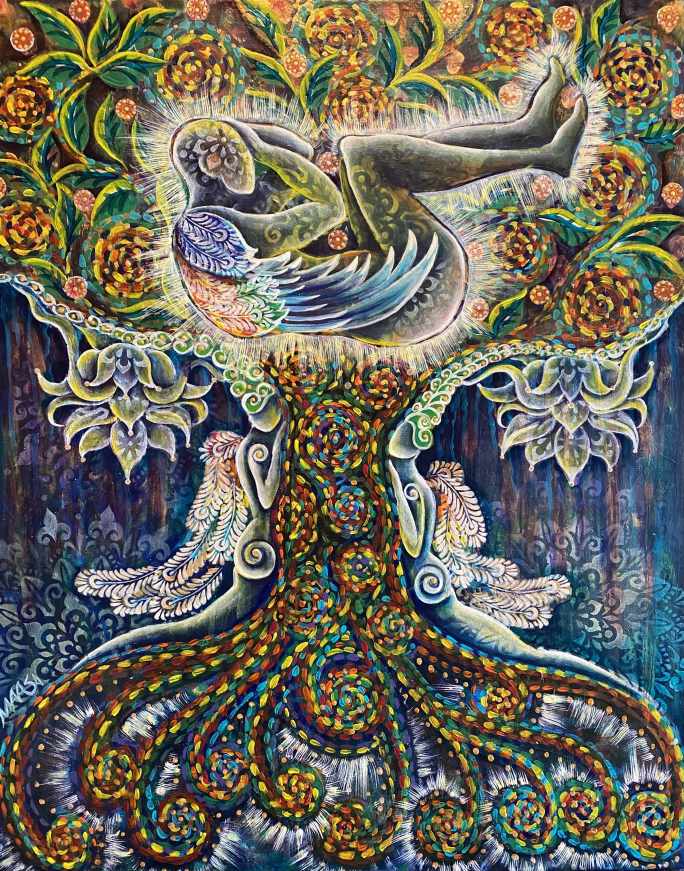
“Forgiveness”- painting by Maasa